Photo: David J. Stang, CC BY-SA 4.0 · Wikimedia Commons
Redbay
Persea borbonia
Also called shorebay, tisswood, Tamala borbonia.
A spicy-leaved evergreen of the southern coast, with dark blue fruit for birds, now dying across much of its range from laurel wilt.
Redbay at a glance
- Type
- Medium tree
- Mature height
- 30–60 ft
- USDA zones
- 7–10
- Growth rate
- Medium
- Sun
- Full, Part, Shade
- Soil moisture
- Dry, Average, Wet
- Grows wild in
- The coast, sandy barrens, stream banks, swamps and wet flats
- Native range
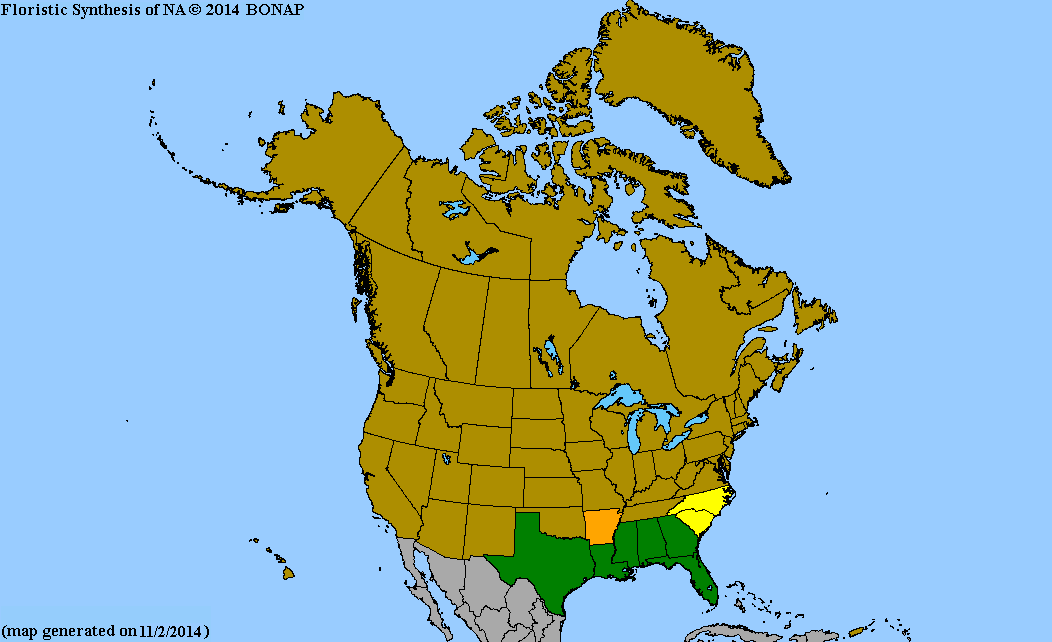
- 9 states, north to North Carolina, south to Florida and west to Texas See what is native in your state
List all 9
Alabama, Arkansas, Florida, Georgia, Louisiana, Mississippi, North Carolina, South Carolina and Texas
Redbay is an evergreen tree of the southern coastal plain and a relative of the avocado, with leathery leaves that smell spicy when crushed. Cooks use the dried leaves in place of bay leaves, and the hard, bright red wood is made locally into cabinets and boats. Laurel wilt, a fungus carried by an ambrosia beetle from Asia, is killing redbays across the Southeast. Grow it for the birds and swallowtails it feeds, on a coastal lot or a swamp edge, and watch it for signs of the disease.
Size, growth and what to expect
Redbay grows at a medium rate, about a foot and a half a year in our growth estimator. Expect 30 to 60 feet, with a crown 30 to 50 feet wide in the open. Wild trees can reach about 80 feet.
Clusters of pale yellow flowers open from April into June. The dark blue fruit, about half an inch long, ripens from August into October and can hang on into winter. Songbirds, turkeys, quail, deer and black bears eat it, and palamedes swallowtail caterpillars feed on the leaves.
It grows wild on the outer coastal plain from North Carolina to Florida and west to Texas. Laurel wilt was first seen killing redbays in Georgia and South Carolina in 2003. By 2023 the beetle had reached nearly 300 counties, from western Texas to eastern North Carolina. On one Florida island the disease killed 92 percent of the redbays, including every tree more than 6 inches across.
How to grow Redbay
Redbay grows in full sun or part shade, and it tolerates shade. It likes moist soil, yet it takes sand or clay, occasional flooding, drought and salt spray. Plant it 25 feet from a wall and more than 50 feet from overhead wires, and set trees 25 feet apart.
Saplings ship bare-root or potted. Plant them in a hole wider than the roots and no deeper. Set the root flare at the soil line, put the native soil back in, and keep the mulch clear of the trunk. Pick the fruit when it turns dark blue, before the birds take it. Sow the seed outdoors in fall as soon as it is picked, and it comes up after several months in the ground. For spring, cut a thin sliver from each seed coat first, since in one test only seed treated that way sprouted.
Water weekly through the first summer and in dry spells until it is established. Deer browse redbay hardest in fall and winter, so cage a young tree for its first few winters. Redbay can lose as much as 40 percent of a year's growth to browsing for two or three years and live. The wood is brittle, so train a young tree to one trunk and keep each side branch less than half as thick as the trunk.
Redbay carries both male and female parts in each flower, but a tree usually needs pollen from another redbay to set seed, and bees carry most of it. Laurel wilt is the grave trouble, and an infected tree cannot be cured. The first sign is wilting, discolored leaves, and within weeks the whole crown follows. The beetle spreads the fungus about 20 miles a year on its own and much farther in firewood, wood chips and logs, so never move them. A preventive fungicide injection can protect a valued tree, and one injected every two years has outlived every redbay around it. Psyllid galls and a leaf spot are common on the leaves but do little harm.
Heights and zones are typical ranges for the species in cultivation; local conditions and seed source shift them.
Sources (13)
- USDA Forest Service, Silvics of North America: redbay (Brendemuehl 1990)
- USDA Forest Service, Fire Effects Information System: Persea borbonia (Van Deelen 1991)
- USDA Forest Service, Woody Plant Seed Manual: Persea chapter (Bonner)
- University of Florida IFAS Extension, ST436/ENH-595: Persea borbonia, Redbay (Gilman, Hilbert, Watson, Klein, Koeser and McLean; page 2024)
- NC State Extension Gardener Plant Toolbox: Tamala borbonia
- Lady Bird Johnson Wildflower Center: Persea borbonia
- Virginia Tech Dendrology: redbay
- Trees and Shrubs Online: Persea borbonia, from New Trees by J. Grimshaw and R. Bayton
- Flora of North America, vol. 3: Persea borbonia
- NatureServe Explorer: Tamala borbonia
- University of Florida IFAS Extension, FOR404/FR475: The Redbay Ambrosia Beetle and Laurel Wilt (Dong, Hulcr, Carrillo and Martini, published 2024-05-23)
- Hughes and others, Recovery Plan for Laurel Wilt on Redbay and Other Forest Species, USDA ARS National Plant Disease Recovery System, January 2015 (Plant Health Progress 16:173-210)
- BONAP, North American Plant Atlas, state map for Persea borbonia
Check your site for it What to plant with it How big, how fast How much to water How to sow it How many for a crop When it flowers and fruits
- Ten planting mistakes that quietly kill trees
- Transplanting young trees: timing, water and protection
- Protecting young trees from voles, rabbits, deer and squirrels
- Multistem or single stem? Sometimes the trunk is hiding the answer
- Leaf litter, not wood chips, under the canopy
- Native trees and shrubs for wildlife: what deer, squirrels, bears, bats and turtles get from a planting
Grows in the same conditions
Plants that share its sun and soil


More like this