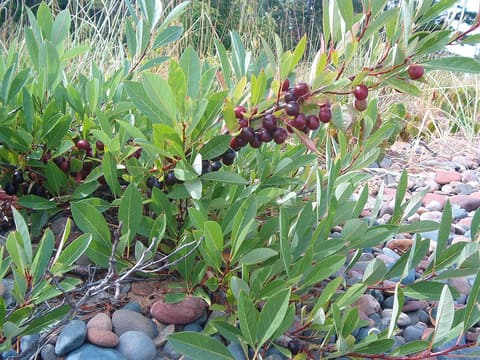
Photo: Leonora (Ellie) Enking, CC BY-SA 2.0, cropped · Wikimedia Commons
Kalm's St. John's-wort
Hypericum kalmianum
Also called Kalm's hypericum.
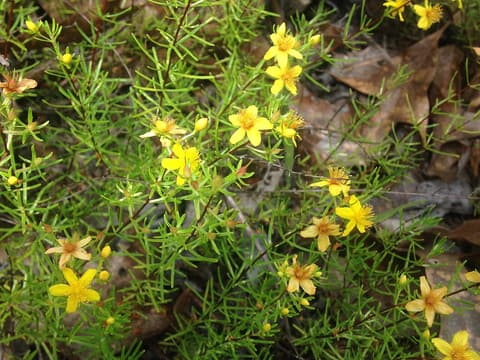
A dense, low shrub of Great Lakes shores with narrow, bluish-green leaves, covered for a month in midsummer with golden flowers.
Be first when Kalm's St. John's-wort is priced
Saplings ship bare-root or in a pot, usually 12 to 18 inches tall, in the dormant season, and their height and age are stated here with the price, once available.
We grow it as saplings and seed. One email when it is listed with prices, and nothing else. Or ask, and we reply with what is ready now. Live plants ship February to May and October to November.
Limited timeSign up now and get 10% off when it is ready.
Share: copy link
Kalm's St. John's-wort at a glance
- Type
- Shrub
- Mature height
- 2–4 ft
- USDA zones
- 4–7
- Growth rate
- Slow
- Flowers
- July to August
- Fruit
- Capsules, September to November
- First crop
- 3 to 5 years
- Mature spread
- 3 ft
- Sun
- Full, Part
- Soil moisture
- Dry, Average, Wet
- Grows wild in
- Sandy barrens, rocky ground, stream banks and the coast
- Native range
- 6 states and the District of Columbia, north and west to Wisconsin and south to Indiana See what is native in your state
Kalm's St. John's-wort is a dense, low shrub of Great Lakes shores, named for Peter Kalm, a student of Linnaeus who found it in the mid-1700s. It is the most cold-hardy of the St. John's-worts. It looks like our golden St. John's-wort in small, with narrower leaves, and botanists see it as a northern offshoot of shrubby St. John's-wort. Illinois and Ohio list it as endangered, and it is gone from New York. Use it as a low hedge, an edging or a rock-garden shrub in full sun, where its flowers carry through midsummer.
Size, growth and what to expect
Kalm's St. John's-wort grows slowly, 6 inches to a foot a year in our growth estimator. It makes a dense, rounded mound 2 to 4 feet tall and 2 to 3 feet wide on four-angled stems, and its bark peels in papery strips with age. Its narrow, bluish-green leaves run up to 2 inches long, dotted with tiny glands, and often stay on through winter.
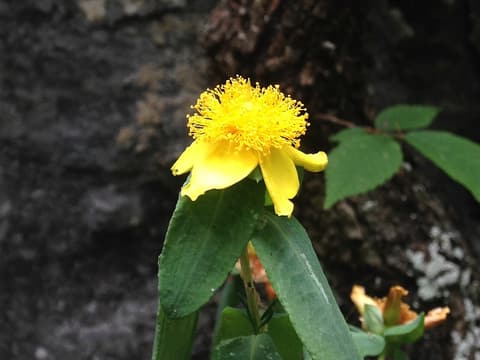
Golden yellow flowers 1 to 1.5 inches across open in July and August, in clusters of 3 to 7, and the show lasts about a month. Each holds a brush of 150 to 200 stamens around five styles. The capsules ripen in fall, turning dark red, and hang on until spring.
It grows wild around the Great Lakes, from Quebec and Ontario to New York, Ohio, Indiana, Illinois, Michigan and Wisconsin. Its home is sandy or limy dune hollows, rocky shores, low prairies, stream banks and sedge swamps.
How to grow Kalm's St. John's-wort
Kalm's St. John's-wort does best in full sun and takes part shade. It wants a moist, well-drained soil, and calcareous sand or limestone suits it, though it takes clay and acid soil too. Once rooted it rides out drought, and it stands brief, shallow flooding. Set plants 3 feet apart and keep them 2 feet from a wall. At its size it can go within 15 feet of overhead wires.
Saplings ship bare-root or potted. Plant them in a hole wider than the roots and no deeper. Set the crown at the soil line, put the native soil back in, and keep the mulch clear of the stems. Collect the capsules once they turn dark red in fall. Many St. John's-worts need light to sprout, so press the fine seed onto damp, sandy soil in spring without covering it.
Water weekly through the first summer, then only in long droughts. Prune, if needed, after it flowers or in late fall, but never cut it to the ground. Deer browse it, so cage young plants where deer are common.
Each flower carries both male and female parts, so there are no male and female plants to pair. Bees collect pollen from the flowers, and in Wisconsin it sometimes crosses with shrubby St. John's-wort. It has no known pest or disease. Its leaves are toxic to livestock, especially pale-skinned animals, since they make the skin sensitive to sunlight.
Heights and zones are typical ranges for the species in cultivation; local conditions and seed source shift them.
Sources (9)
- NC State Extension Gardener Plant Toolbox: Hypericum kalmianum
- Missouri Botanical Garden Plant Finder: Hypericum kalmianum
- Lady Bird Johnson Wildflower Center: Hypericum kalmianum
- Flora of North America, vol. 6: Hypericum kalmianum
- NatureServe Explorer: Hypericum kalmianum
- NatureServe Explorer: Hypericum lissophloeus
- Illinois Endangered Species Protection Board: Checklist of Illinois Endangered and Threatened Animals and Plants, effective October 31, 2025
- Ohio Department of Natural Resources: Rare Native Ohio Plants, 2024-25 Status List
- New York Natural Heritage Program: Rare Plant Status List, 2024
Plan the planting
Check your site for it What to plant with it How big, how fast How much to water How to sow it How many for a crop When it flowers and fruits When to plant it where you live How far from the house and wires How old is yours
Read before planting
- Ten planting mistakes that quietly kill trees
- Transplanting young trees: timing, water and protection
- Protecting young trees from voles, rabbits, deer and squirrels
- How fast every tree and shrub we grow gets tall: growth rate, A to Z
- The habitat around a tree is part of the tree
- Invasive vines and shrubs are what is killing your woods
Other St. John's-worts (Hypericum) we grow: Blue Ridge St. John's-wort, Carolina St. John's-wort, Chapman's St. John's-wort, Golden St. John's-wort, Lloyd's St. John's-wort and Smooth-bark St. John's-wort.
Grows in the same conditions
Plants that share its sun and soil
Trees to plant it under: Northern White Cedar, Rock Elm and Black Oak.
More like this