Photo: Mason Brock, Public domain · Wikimedia Commons
Softleaf Arrowwood
Viburnum molle
Also called soft-leaved arrowwood, Kentucky arrowwood.
A rare arrowwood of wooded limestone bluffs, with loose, peeling bark on its older stems and flat clusters of white flowers in May and June.
Softleaf Arrowwood at a glance
- Type
- Shrub
- Mature height
- 6–12 ft
- USDA zones
- 5–7
- Growth rate
- Medium
- Sun
- Part, Shade
- Soil moisture
- Average
- Grows wild in
- Rich moist slopes, rocky ground, the forest understory and stream banks
- Native range
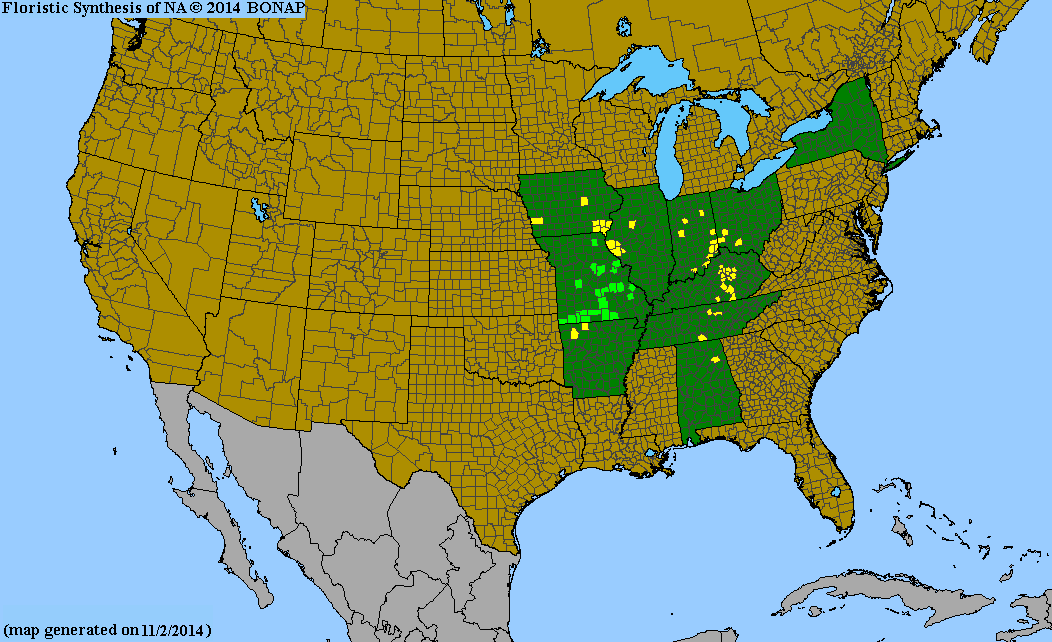
- 8 states, north and west to Iowa, south to Arkansas and east to Ohio Also recorded in 6 other states, outside its native range. See what is native in your state
List all 8
Arkansas, Illinois, Indiana, Iowa, Kentucky, Missouri, Ohio and Tennessee
Softleaf arrowwood is a rare viburnum of shaded bluffs and rocky slopes in the Midwest and the upper South, first described by André Michaux from Kentucky plants in 1803. It differs from our arrowwood viburnum in its long-stalked, nearly round leaves and in bark that peels in loose strips from stems more than two years old. Six states list it, Tennessee as endangered and Iowa, Illinois, Indiana, Kentucky and Ohio as threatened. NatureServe ranks it vulnerable. Plant it on a shaded slope or at the foot of a north-facing bank, where its peeling bark shows in winter.
Size, growth and what to expect
No source rates its growth, so our growth estimator treats it as a medium grower, like our arrowwood viburnum, about a foot and a half a year. It makes a bushy shrub 6 to 12 feet tall. Young shoots are bright green at first and soon turn gray.
Flat clusters of small white flowers, 2 to 4 inches across on long stalks, open in May and June. The fruit ripens from July into September, a flattened, oval, blue-black drupe up to half an inch long. The broad, nearly round leaves run 2 to 5 inches long, with 17 to 44 teeth along each side.
It grows wild in scattered stands from southwest Ohio, Indiana, Illinois and southeast Iowa south to Kentucky, Tennessee, southern Missouri and northwest Arkansas. Its home is shaded bluffs, talus and steep wooded slopes, usually over limestone. Records from Alabama, Maryland, Mississippi, New York, Oklahoma and Pennsylvania lie outside its native range.
How to grow Softleaf Arrowwood
Softleaf arrowwood grows wild in the filtered light under taller trees, so give it part shade. It wants a well-drained soil that stays moist, and in the wild it grows over limestone, on slopes above creeks but out of the floodplain. Plant it 6 feet from a wall and set plants 6 feet apart. At its size it can go within 15 feet of overhead wires.
Saplings ship bare-root or potted. Plant them dormant, from leaf fall until bud swell, in a hole wider than the roots and no deeper. Set the crown at the soil line, put the native soil back in, and keep the mulch ring clear of the stems. Its seed is untested, so sow it as northern viburnums are sown. Sow cleaned seed outdoors in fall or spring, half an inch deep, under wire against mice. Seedlings come up the second spring after you collect the seed.
Water weekly through the first summer if rain is short, and keep a mulch over the roots. Deer browse it in the wild, so cage young plants where deer are many. Keep bush honeysuckle, garlic mustard and other invasive plants from crowding it, since they threaten wild stands.
Each flower carries both male and female parts, and insects carry the pollen. Many Kentucky stands raise no young plants, perhaps because animals eat the seed or the stands are small.
Heights and zones are typical ranges for the species in cultivation; local conditions and seed source shift them.
Sources (13)
- NatureServe Explorer: Viburnum molle, Softleaf Arrow-wood
- Weckman, T. J. 2002, Reinstatement of Viburnum ozarkense (Caprifoliaceae): an endemic taxon of the interior highlands of Arkansas, Missouri and Oklahoma, Sida 20(2): 849-860
- Trees and Shrubs Online (International Dendrology Society): Viburnum molle, from Bean
- Lady Bird Johnson Wildflower Center: Viburnum molle
- USDA Forest Service, Woody Plant Seed Manual (2008), Viburnum chapter
- Tennessee Department of Environment and Conservation, Natural Areas: Tennessee Rare Plant List
- Iowa Administrative Code 571, chapter 77, Endangered and threatened plant and animal species, IAC 5/13/26
- Illinois Endangered Species Protection Board: Checklist of Endangered and Threatened Animals and Plants of Illinois, 2025, rev. 10/31/2025
- Indiana DNR Division of Nature Preserves: Endangered, Threatened, and Extirpated Plants of Indiana, 10/29/2025
- Office of Kentucky Nature Preserves: Kentucky Rare Plant List, September 30, 2022
- Ohio Department of Natural Resources: Rare Native Ohio Plants, 2024-25 Status List
- BONAP, Floristic Synthesis of North America, county map for Viburnum molle, generated 2014-11-02
- Alabama Plant Atlas: Viburnum, species list
Check your site for it What to plant with it How big, how fast How much to water How to sow it How many for a crop When it flowers and fruits
- Ten planting mistakes that quietly kill trees
- Transplanting young trees: timing, water and protection
- Protecting young trees from voles, rabbits, deer and squirrels
- The habitat around a tree is part of the tree
- Invasive vines and shrubs are what is killing your woods
- Native trees and shrubs for butterflies and moths: host plants first, nectar second
Grows in the same conditions
Plants that share its sun and soil


More like this