Photo: Rob Young, CC BY 2.0 · Wikimedia Commons
Water Locust
Gleditsia aquatica
Also called swamp locust, swamp honeylocust, Gleditsia monosperma.
A thorny swamp cousin of honeylocust for floodplains that stay under water for long spells, with small, flat pods holding one to three seeds.
Water Locust at a glance
- Type
- Medium tree
- Mature height
- 40–60 ft
- USDA zones
- 6–10
- Growth rate
- Medium
- Sun
- Full, Part
- Soil moisture
- Average, Wet
- Grows wild in
- Floodplain forests, stream banks, swamps and wet flats
- Native range
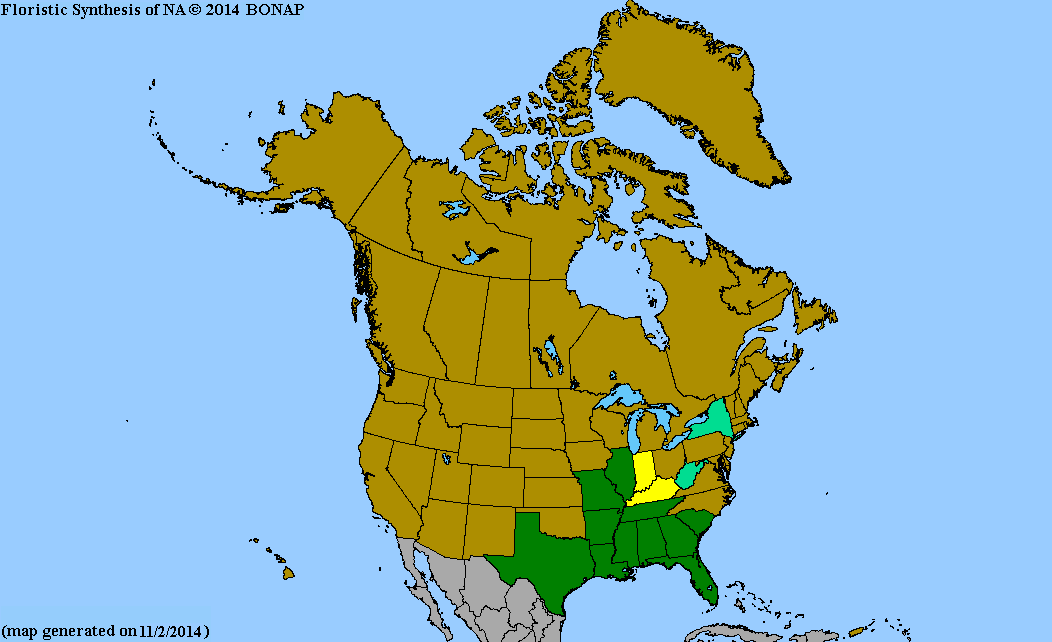
- 13 states, north to Illinois, south to Florida and west to Texas Also recorded in 3 other states, outside its native range. See what is native in your state
List all 13
Alabama, Arkansas, Florida, Georgia, Illinois, Indiana, Kentucky, Louisiana, Mississippi, Missouri, South Carolina, Tennessee and Texas
Water locust is the swamp cousin of honeylocust, a thorny tree of river bottoms and sloughs. Both its common name and its botanical name, aquatica, refer to the wet ground it grows in. The genus honors Johann Gottlieb Gleditsch, who directed the Berlin botanical garden. Indiana lists it as endangered and Kentucky as threatened, at the northern edge of its range. Along a wet riverbank its wide, spreading roots help hold the soil against erosion. Put it on ground that floods for long spells, such as a slough, a floodplain or a pond edge.
Size, growth and what to expect
Water locust grows at a medium rate, about a foot and a half a year in our growth estimator. Expect a tree of 40 to 60 feet with a short trunk and a broad, flat-topped crown of spreading branches. Trees begin to bear seed at about 10 years.
Greenish white flowers open in slender clusters about 2 inches long from April into June. The pods tell it from honeylocust. They are flat ovals 1 to 3 inches long, with no pulp and one to three seeds. The pods ripen from August into October and fall through December.
It grows wild on the coastal plain from South Carolina to central Florida and west to Texas. It also follows the Mississippi Valley north to Missouri, southern Illinois and southwestern Indiana. Records from New Jersey, New York and West Virginia lie outside that native range.
How to grow Water Locust
Water locust wants wet ground, such as a river bank, a floodplain or a swamp, even where water stands for long periods. Give it full sun or light shade. Plant it 20 feet from a wall and more than 50 feet from overhead wires, and set trees 30 feet apart.
Saplings ship bare-root or potted. Plant them dormant, from leaf fall until bud swell, in a hole wider than the roots and no deeper. Set the root flare at the soil line, put the native soil back in, and keep the mulch clear of the trunk. The seed has a hard coat, so pour water just off the boil over it and let it cool until the seed swells. Sow the swollen seed right away, half an inch deep, since soaked seed does not keep.
Water weekly through the first summer unless the ground stays wet. Guard young trees against deer and rabbits with a tube or cage for the first few years. The branched thorns grow to about 4 inches, so wear gloves, and prune only to keep one leader, in the dormant season.
Trees bear mostly male or mostly female flowers, with a few flowers carrying both parts, so plant several if you want seed. Where honeylocust grows nearby the two can cross, and the hybrid is known as Texas honeylocust.
Heights and zones are typical ranges for the species in cultivation; local conditions and seed source shift them.
Sources (11)
- USDA Forest Service, Woody Plant Seed Manual: Gleditsia chapter (Bonner)
- Lady Bird Johnson Wildflower Center: Gleditsia aquatica
- Virginia Tech Dendrology: waterlocust
- Trees and Shrubs Online: Gleditsia aquatica, from Bean
- USDA Forest Service, Silvics of North America: honeylocust (Blair 1990)
- USDA Forest Service, Fire Effects Information System: Gleditsia triacanthos (Sullivan 1994)
- NatureServe Explorer: Gleditsia aquatica
- Indiana Department of Natural Resources: Endangered, Threatened, and Extirpated Plants of Indiana, 10/29/2025
- Office of Kentucky Nature Preserves: Kentucky Rare Plant List, September 30, 2022
- BONAP, North American Plant Atlas, state map for Gleditsia aquatica
- USDA ARS and the PRISM Climate Group, 2023 Plant Hardiness Zone Map ZIP code listing
Grows in the same conditions
Plants that share its sun and soil


More like this