Photo: Zeynel Cebeci, CC BY-SA 4.0 · Wikimedia Commons
Southern Catalpa
Catalpa bignonioides
Also called common catalpa, eastern catalpa, Indian bean, bean tree, Catawba.
Upright clusters of white flowers spotted purple and yellow in May and June, then long bean-like pods, on the fast-growing catalpa native to the Gulf states.
Southern Catalpa at a glance
- Type
- Medium tree
- Mature height
- 30–60 ft
- USDA zones
- 5–9
- Growth rate
- Fast
- Sun
- Full, Part
- Soil moisture
- Dry, Average, Wet
- Grows wild in
- Floodplain forests and stream banks
- Native range
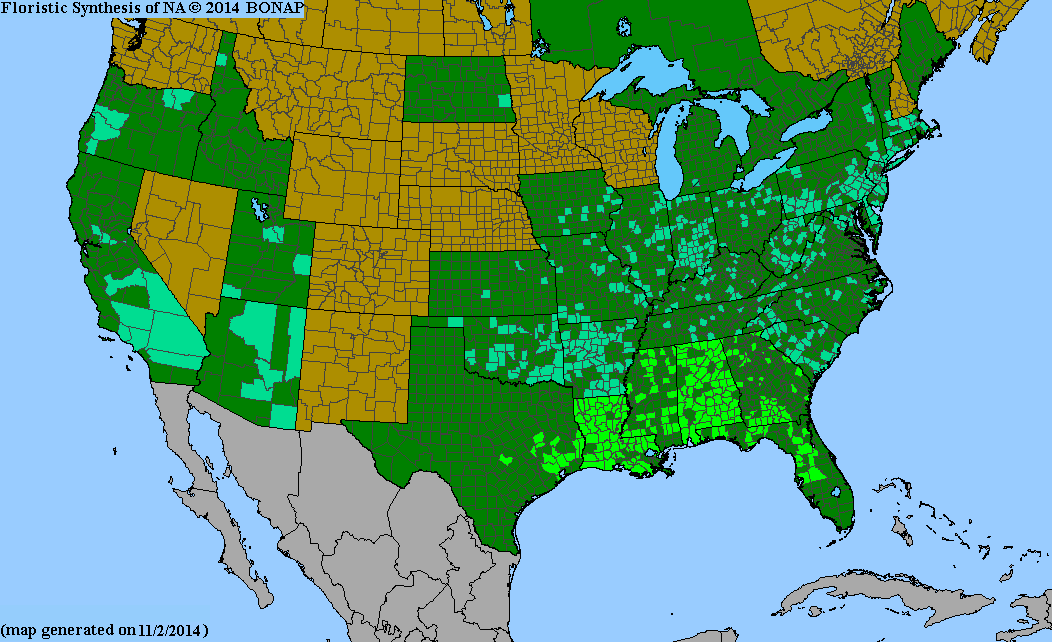
- Alabama, Florida, Georgia, Louisiana and Mississippi Also recorded in 32 other states, outside its native range. See what is native in your state
Southern catalpa is the catalpa of the Deep South, growing wild in rich, moist soil along streams and rivers. It was the first catalpa taken into gardens, after Mark Catesby brought its seed to London in 1726. It flowers later than our northern catalpa, its flowers are more densely spotted with purple, and its crushed leaves smell fetid. Catalpa sphinx caterpillars feed on its leaves and are prized as fish bait. Its extensive roots hold the soil, and it has been planted to reclaim mined land. Give it a low, damp corner of a large lot, where it grows fast and its litter falls on grass.
Size, growth and what to expect
Southern catalpa grows fast, and our growth estimator gives it about two and three quarter feet a year while young. It makes a short-trunked tree of 30 to 60 feet, most often 30 to 40, with a broad, irregular crown 20 to 40 feet wide. It lives about 40 to 60 years, and a champion in Mississippi measured 88 feet.
Upright clusters of bell-shaped flowers, each about 1.5 inches across, open in May and June. They are white, with two yellow blotches and dense purple spots in the throat. The leaves grow up to 10 inches long and 6 inches wide. The slender pods, up to 15 inches long, ripen from October into December and hang on through winter, splitting in spring to drop papery, winged seeds. It hosts the catalpa sphinx and tersa sphinx moths, food in turn for birds and bats.
Its native ground is the Gulf coastal plain, from southwest Georgia and the Florida panhandle west through Alabama and Mississippi to Louisiana. After three centuries of planting it grows wild across most of the East.
How to grow Southern Catalpa
Southern catalpa grows in full sun or part shade, but not in full shade. It prefers a moist, fertile loam and takes clay, wet or dry ground and seasonal flooding. Its branches are brittle, and it drops flowers in spring, leaves in fall and pods in winter. Keep it away from walks, patios and septic fields. Plant it 20 feet from a wall and more than 50 feet from overhead wires, and set trees 20 feet apart.
Saplings ship bare-root or potted. Plant them dormant, from leaf fall until bud swell, in a hole wider than the roots and no deeper. Set the root flare at the soil line, put the native soil back in, and keep the mulch clear of the trunk. Collect the pods in late winter, once they are brown and dry, since seed left in the pod over winter sprouts better. The seed needs no treatment. Sow it in spring under an eighth of an inch of soil, and seedlings start coming up in about 12 days.
Water weekly through the first summer. Rabbits girdle young stems, so guard each trunk for its first few winters, though deer seldom browse it. Prune while it is young to build strong limbs on a single leader.
Each flower carries both male and female parts, and bees work the flowers. No study has tested whether a lone tree sets pods. Good crops of pods come every two to three years, beginning at about age 20. Catalpa sphinx caterpillars can strip the leaves once or twice a summer, with no lasting harm to the tree. Verticillium wilt can kill a tree, while leaf spots and powdery mildew are minor. Its winged seed lets it escape from plantings, and outside its home range it spreads into nearby woods.
Heights and zones are typical ranges for the species in cultivation; local conditions and seed source shift them.
Sources (10)
- NC State Extension Gardener Plant Toolbox: Catalpa bignonioides
- Missouri Botanical Garden Plant Finder: Catalpa bignonioides
- The Morton Arboretum: Southern catalpa
- USDA NRCS Plant Guide: Southern Catalpa, Catalpa bignonioides (Geyer, Broyles and Row, Manhattan Plant Materials Center)
- University of Florida IFAS Extension, ENH289/ST130: Catalpa spp.: Catalpa, Gilman and others
- USDA Forest Service, Woody Plant Seed Manual (2008), Catalpa chapter, Bonner and Graney
- Trees and Shrubs Online (International Dendrology Society): Catalpa bignonioides, Deasy, Olsen and Grimshaw 2025
- Lady Bird Johnson Wildflower Center: Catalpa bignonioides
- NatureServe Explorer: Catalpa bignonioides
- BONAP, Floristic Synthesis of North America, county map for Catalpa bignonioides, generated 2014-11-02
Check your site for it What to plant with it How big, how fast How much to water How to sow it How many for a crop When it flowers and fruits
- Ten planting mistakes that quietly kill trees
- Transplanting young trees: timing, water and protection
- Protecting young trees from voles, rabbits, deer and squirrels
- Multistem or single stem? Sometimes the trunk is hiding the answer
- Leaf litter, not wood chips, under the canopy
- Native trees and shrubs for butterflies and moths: host plants first, nectar second
Grows in the same conditions
Plants that share its sun and soil


More like this