Photo: Nicholas A. Tonelli, CC BY 2.0 · Wikimedia Commons
Gray Birch
Betula populifolia
Also called grey birch, wire birch, fire birch, oldfield birch, poplar birch, aspen-leaved birch.
A fast, small birch with chalky white bark that does not peel, often growing as a clump of slender trunks on poor, sandy ground.
Gray Birch at a glance
- Type
- Small tree
- Mature height
- 20–40 ft
- USDA zones
- 3–8
- Growth rate
- Fast
- Sun
- Full, Part
- Soil moisture
- Dry, Average, Wet
- Grows wild in
- Sandy barrens, rocky ground, dry uplands, old fields and edges
- Native range
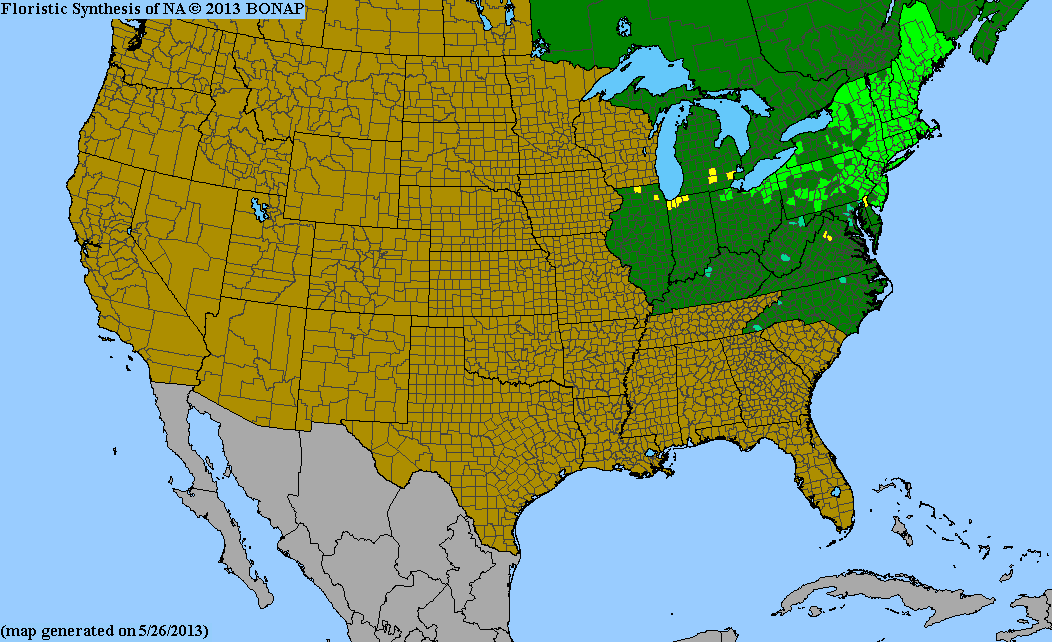
- 15 states, north to Maine, south to Virginia and west to Illinois Also recorded in 3 other states, outside its native range. See what is native in your state
List all 15
Connecticut, Delaware, Illinois, Indiana, Maine, Maryland, Massachusetts, New Hampshire, New Jersey, New York, Ohio, Pennsylvania, Rhode Island, Vermont and Virginia
Gray birch is a small birch and one of the first trees to come up on old fields, burns and cleared land across the Northeast. Its chalky white bark stays tight, and black triangles mark the trunk below each branch, which tells it from paper birch. Its long-pointed, triangular leaves hang on slender stalks and flutter in the slightest breeze, like a poplar's. It is often grown as a tree for the winter landscape. Plant it on poor, dry or sandy ground, or in a small yard that wants a quick clump of white trunks.
Size, growth and what to expect
Gray birch grows fast, 2 to 5 feet a year on fertile ground, and about 2.75 feet a year in our growth estimator. Expect 20 to 40 feet with a narrow crown 10 to 20 feet wide, often on several trunks. It is short-lived, often lasting about 20 years and rarely more than 50.
Yellowish male catkins hang from the twig tips in April and May, while the small female catkins stand upright. The slender cones ripen in September and October. Goldfinches, pine siskins and chickadees eat the seeds, and ruffed grouse eat the male catkins and buds. The leaves turn yellow in fall.
It grows wild from Nova Scotia and southern Quebec to southern Ontario, and south to New Jersey and Pennsylvania. Small outlying stands grow west to northern Ohio, Indiana and Illinois. Others grow south through Delaware and Maryland to Virginia. It grows on dry sandy or rocky ground as well as along streams, ponds and swamps. It also turns up in a few counties of Kentucky, West Virginia and North Carolina, beyond its main range.
How to grow Gray Birch
Gray birch wants full sun and takes part shade, but not deep shade. It grows best in a moist soil that drains well, but it also grows in poor, dry or sandy ground. It takes wet ground but not long flooding. A soil with a high pH can yellow its leaves. It does best where summers stay cool and struggles in hot, humid ones. Plant it 15 feet from a wall and at least 15 feet from overhead wires, and set trees 15 feet apart.
Saplings ship bare-root or potted. Plant them dormant, as early in spring as you can or in fall once the leaves have turned, in a hole wider than the roots and no deeper. Set the root flare at the soil line, put the native soil back in, and keep the mulch clear of the trunks. Pick the cones in early fall, while they are still a little green. Sow the seed at once on the surface of moist soil, barely covered, since light helps it sprout. For spring, hold it damp in the refrigerator for 4 to 8 weeks first. Shade the seedlings lightly through their first summer.
Water weekly through the first two summers, and in dry spells after that. Keep grass and weeds well back from young trees, which grow poorly among them. Deer, moose and snowshoe hares browse the twigs in winter, so cage young trees. Avoid pruning in spring, when a birch bleeds sap.
Male and female catkins grow on the same tree, and the wind carries the pollen. Gray birch sets almost no good seed with its own pollen, so plant two or more seedlings if you want seed. Trees bear seed from about 8 years old, with a heavy crop every year. It seeds itself onto bare ground nearby and can sucker from the roots. Birch leaf miner can disfigure the leaves but does not kill the tree. It resists the bronze birch borer better than paper birch, and the borer seldom kills it. Ice and heavy snow can bend or break the slender trunks.
Heights and zones are typical ranges for the species in cultivation; local conditions and seed source shift them.
Sources (15)
- USDA Forest Service, Fire Effects Information System: Betula populifolia (Coladonato 1992)
- USDA Forest Service, Woody Plant Seed Manual: Betula chapter
- USDA NRCS Plant Guide: gray birch, Betula populifolia (Wennerberg)
- USDA NRCS Plant Fact Sheet: gray birch, Betula populifolia (Dickerson)
- Missouri Botanical Garden Plant Finder: Betula populifolia
- The Morton Arboretum: gray birch
- Lady Bird Johnson Wildflower Center: Betula populifolia
- Virginia Tech Dendrology: gray birch
- Trees and Shrubs Online: Betula populifolia
- Flora of North America: Betula populifolia
- NatureServe Explorer: Betula populifolia
- Delaware Division of Fish and Wildlife: Rare and Uncommon Plants of Delaware (McAvoy 2024)
- Maryland Wildlife and Heritage Service: List of Rare, Threatened, and Endangered Plants of Maryland, March 2021
- Virginia Division of Natural Heritage: Natural Heritage Resources of Virginia, Rare Plants, June 2026
- BONAP (Biota of North America Program): Betula populifolia county map
Check your site for it What to plant with it How big, how fast How much to water How to sow it How many for a crop When it flowers and fruits
- Ten planting mistakes that quietly kill trees
- Transplanting young trees: timing, water and protection
- Protecting young trees from voles, rabbits, deer and squirrels
- How fast native trees grow: a year's growth by species, soil and sun
- Native trees for insects: the beetles, wasps, cicadas and fireflies that everything else eats
- Multistem or single stem? Sometimes the trunk is hiding the answer
Grows in the same conditions
Plants that share its sun and soil


More like this