Photo: Charles Edward Faxon, Public domain · Wikimedia Commons
Hortulan Plum
Prunus hortulana
A wild plum that grows as a single small tree rather than a thicket, with white spring flowers and red or yellow plums about an inch across in late summer.
Hortulan Plum at a glance
- Type
- Small tree
- Mature height
- 20–30 ft
- USDA zones
- 5–7
- Growth rate
- Medium
- Sun
- Full, Part
- Soil moisture
- Average, Wet
- Grows wild in
- Stream banks, floodplain forests, old fields and edges
- Native range
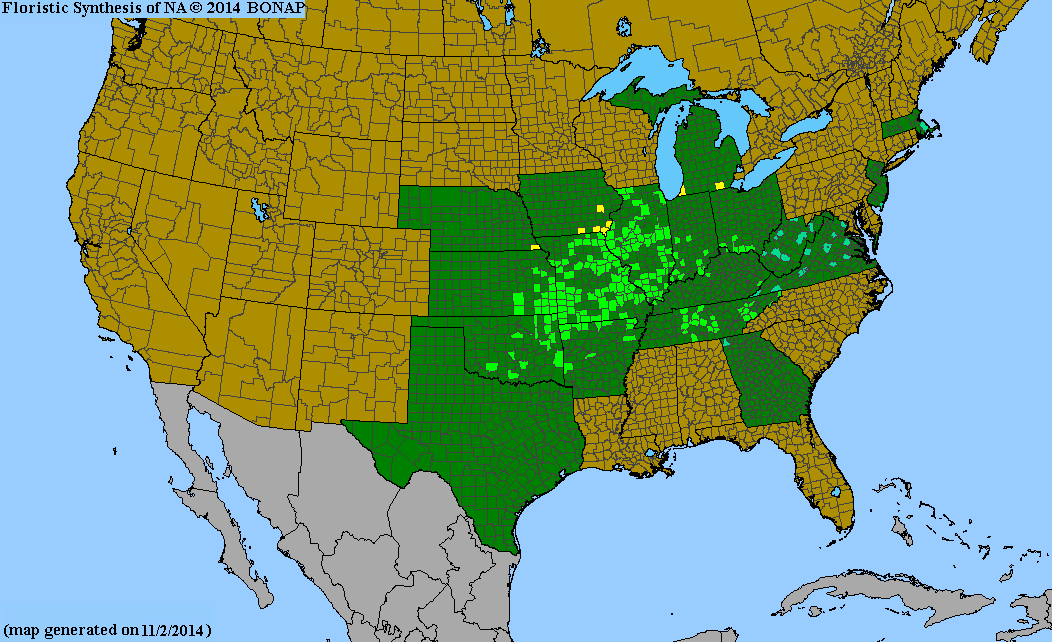
- 11 states, north to Iowa, south to Arkansas, east to Ohio and west to Nebraska Also recorded in 5 other states, outside its native range. See what is native in your state
List all 11
Arkansas, Illinois, Indiana, Iowa, Kansas, Kentucky, Missouri, Nebraska, Ohio, Oklahoma and Tennessee
Hortulan plum is a wild plum of the central states, from southern Ohio, Indiana and Illinois west to Iowa, Nebraska and eastern Kansas, and south to Tennessee, northern Arkansas and Oklahoma. It grows as a small tree and rarely suckers, unlike our American and Chickasaw plums, which form thickets. It was once thought a cross of those two, but botanists now treat it as a species of its own. Its garden varieties, known as the Wayland or hortulana plums, were grown for fruit in the Mississippi Valley and the South. NatureServe ranks it critically imperiled in Iowa, Kansas and Nebraska. Plant it at the edge of a yard or along a creek, where you want one fruiting plum rather than a thicket.
Size, growth and what to expect
No source rates its growth, so our growth estimator treats it as a medium grower, like our Mexican plum, about a foot and a half a year. It makes a small tree of 20 to 30 feet, sometimes a shrub, with moderately thorny branches.
White flowers up to an inch across open in clusters of two to four in April and May, before or as the leaves emerge. The plums ripen in August and September, about an inch across, red to yellow with small white dots and little bloom. Birds and mammals eat wild plums, and rodents eat the pits.
It grows wild in prairies, on stream banks, floodplains and pond margins, and at woodland edges, fencerows and old fields. Records from Maryland, Massachusetts, Texas, Virginia and West Virginia lie outside its native range.
How to grow Hortulan Plum
Hortulan plum grows in full sun or part shade. In the wild it grows on stream banks, floodplains, pond margins and woodland edges, so give it a soil that stays moist but drains. Plant it 15 feet from a wall and at least 15 feet from overhead wires, and set trees 20 feet apart.
Saplings ship bare-root or potted. Plant them dormant, from leaf fall until bud swell, in a hole wider than the roots and no deeper. Set the root flare at the soil line, put the native soil back in, and keep the mulch clear of the trunk. Sow the cleaned pits outdoors in early fall, an inch deep, under hardware cloth against mice. For spring, hold them damp in the refrigerator for about three months first.
Water weekly through the first summer, then only in a long drought. Deer browse the twigs of wild plums, so guard each young tree with wire for its first two or three years. Prune in late winter, only to remove dead, broken or crossing branches.
Plums need pollen from a second plum to set fruit, so plant two or more from different seed. Seedlings can bear from about their third year.
Heights and zones are typical ranges for the species in cultivation; local conditions and seed source shift them.
Sources (10)
- Flora of North America, vol. 9: Prunus hortulana
- NatureServe Explorer: Prunus hortulana
- Trees and Shrubs Online (International Dendrology Society): Prunus hortulana, from Bean
- Lady Bird Johnson Wildflower Center: Prunus hortulana
- USDA Forest Service, Woody Plant Seed Manual (2008), Prunus chapter
- BONAP, Floristic Synthesis of North America, county map for Prunus hortulana
- Hedrick 1911, The Plums of New York, New York Agricultural Experiment Station, account of Prunus hortulana
- Missouri Department of Conservation Field Guide: Wild Plum, the note on hortulan plum
- Illinois Natural History Survey, Illinois Plants Database: Prunus hortulana
- Go Botany, Native Plant Trust: Prunus hortulana
Check your site for it What to plant with it How big, how fast How much to water How to sow it How many for a crop When it flowers and fruits
- Ten planting mistakes that quietly kill trees
- Transplanting young trees: timing, water and protection
- Protecting young trees from voles, rabbits, deer and squirrels
- Multistem or single stem? Sometimes the trunk is hiding the answer
- Leaf litter, not wood chips, under the canopy
- Native trees and shrubs for butterflies and moths: host plants first, nectar second
Grows in the same conditions
Plants that share its sun and soil


More like this