Photo: Nichole Ouellette, CC BY 4.0 · Wikimedia Commons
Yellow Birch
Betula alleghaniensis
Also called golden birch, Betula lutea.
A long-lived shade tree for cool, moist ground, with shiny golden bronze bark that peels in thin curls and bright yellow leaves in fall.
Yellow Birch at a glance
- Type
- Large tree
- Mature height
- 60–75 ft
- USDA zones
- 3–7
- Growth rate
- Slow
- Sun
- Full, Part
- Soil moisture
- Average, Wet
- Grows wild in
- Rich moist slopes, the Appalachians, stream banks, swamps and wet flats
- Native range
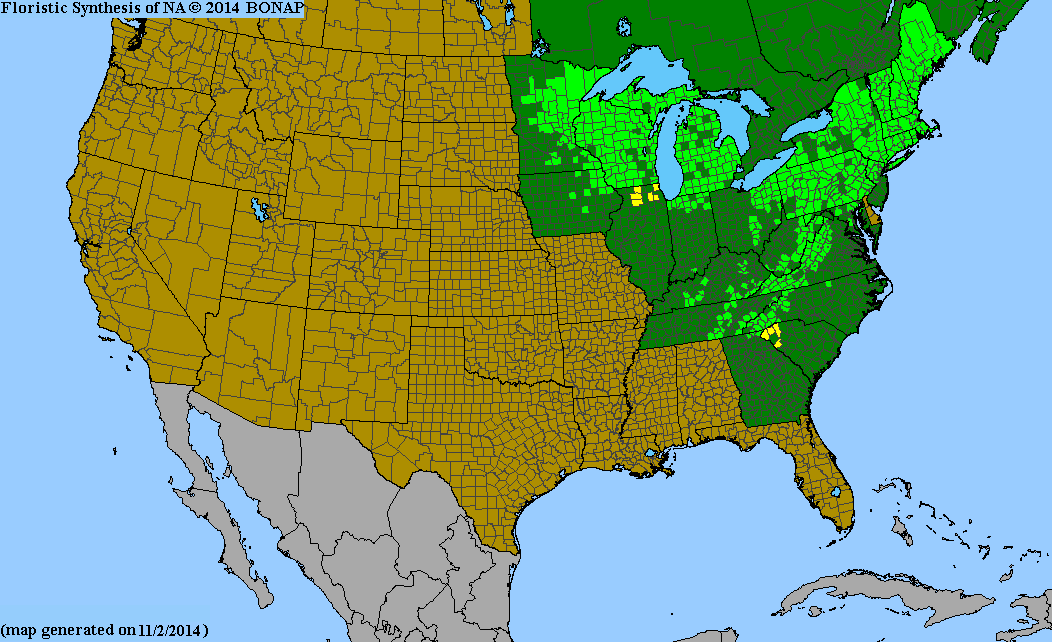
- 24 states, north and west to Minnesota and south to Georgia See what is native in your state
List all 24
Connecticut, Georgia, Illinois, Indiana, Iowa, Kentucky, Maine, Maryland, Massachusetts, Michigan, Minnesota, New Hampshire, New Jersey, New York, North Carolina, Ohio, Pennsylvania, Rhode Island, South Carolina, Tennessee, Vermont, Virginia, West Virginia and Wisconsin
Yellow birch is the largest of the eastern birches and the most valuable for timber, a tree of cool northern forests and high Appalachian slopes. A snapped twig smells of wintergreen. It is close kin to sweet birch, whose bark stays tight and dark instead of peeling. Its sap boils down to a sweet syrup much like maple syrup. Give it a cool, moist lawn, a stream bank or a woodland edge, where it can grow into a broad shade tree.
Size, growth and what to expect
Yellow birch grows slowly, about a foot a year in our growth estimator. Expect 60 to 75 feet with a crown as wide, and wild trees occasionally reach 100 feet. Trees in the open can bear seed at 7 years, though forest trees usually start at about 40. Many live 150 years, and some pass 300.
Slender male catkins hang from the twig tips in April and May, while the small upright female catkins open with the leaves. Plump, hairy cones ripen from August to October. Ruffed grouse, redpolls, pine siskins and chickadees eat the seeds, and yellow-bellied sapsuckers feed on the sap. The leaves turn bright golden yellow in fall.
It grows wild from Newfoundland west to southeastern Manitoba, and south to northeastern Iowa, northern Illinois, Ohio, Pennsylvania and northern New Jersey. In the Appalachians it reaches eastern Tennessee and northeastern Georgia, mostly above 3,000 feet. Its seedlings often root on mossy logs and rotting stumps. Illinois lists it as endangered.
How to grow Yellow Birch
Yellow birch grows in full sun or part shade. Give it a cool, moist, rich soil that drains well, and it will take wet ground too. Heat, drought and packed soil stress it, so it belongs where summers stay cool. Plant it 40 feet from a wall and more than 50 feet from overhead wires, and set trees 60 feet apart.
Saplings ship bare-root or potted. Plant them dormant, from leaf fall until bud swell, in a hole wider than the roots and no deeper. Set the root flare at the soil line, put the native soil back in, and spread mulch over the root zone, clear of the trunk. Pick the cones in September, while they still hold together. Sow the seed at once on the surface of moist soil, barely covered, since light helps it sprout. For spring, hold it damp in the refrigerator for 4 to 8 weeks first. Shade the seedlings lightly through their first summer.
Water deeply every week through the first two summers, and in dry spells after that, since drought harms its shallow roots. A wide ring of mulch keeps the roots cool and moist. Deer, moose and snowshoe hares browse young trees, so cage them for the first few years. Prune only in summer or after leaf fall, since a birch cut in late winter or spring bleeds sap.
Male and female catkins grow on the same tree and the wind carries the pollen. A lone tree sets some seed with its own pollen, but a second yellow birch nearby improves the crop. Good seed crops come every 2 or 3 years. It resists the bronze birch borer better than most birches, but the borer can kill a tree weakened by heat, drought or injury. Birch skeletonizers and leaf miners damage the leaves in some years, and Nectria canker can scar the trunk. Ice and heavy snow can break its fine branches. It tolerates black walnut.
Heights and zones are typical ranges for the species in cultivation; local conditions and seed source shift them.
Sources (14)
- USDA Forest Service, Silvics of North America: yellow birch (Erdmann 1990)
- USDA Forest Service, Fire Effects Information System: Betula alleghaniensis (Sullivan 1994)
- USDA Forest Service, Woody Plant Seed Manual: Betula chapter
- NC State Extension Gardener Plant Toolbox: Betula alleghaniensis
- Missouri Botanical Garden Plant Finder: Betula alleghaniensis
- The Morton Arboretum: yellow birch
- Lady Bird Johnson Wildflower Center: Betula alleghaniensis
- Virginia Tech Dendrology: yellow birch
- Trees and Shrubs Online: Betula alleghaniensis (McAllister, Ashburner, Bartlett and Deasy 2026)
- Flora of North America: Betula alleghaniensis
- USDA NRCS Plant Guide: yellow birch, Betula alleghaniensis (Nesom)
- NatureServe Explorer: Betula alleghaniensis
- Illinois Endangered Species Protection Board: Checklist of Illinois Endangered and Threatened Animals and Plants, effective October 31, 2025
- BONAP (Biota of North America Program): Betula alleghaniensis county map
Check your site for it What to plant with it How big, how fast How much to water How to sow it How many for a crop When it flowers and fruits
- Ten planting mistakes that quietly kill trees
- Transplanting young trees: timing, water and protection
- Protecting young trees from voles, rabbits, deer and squirrels
- Sapsucker holes and the wasps that follow them
- Native trees for the Great Lakes and Midwest: Michigan, Ohio, Indiana, Illinois and Wisconsin
- Six trees not to plant near a house, and what to plant instead
Grows in the same conditions
Plants that share its sun and soil


More like this