Photo: Krzysztof Ziarnek, CC BY-SA 4.0, cropped · Wikimedia Commons
Grape Honeysuckle
Lonicera reticulata
Also called Lonicera prolifera, Lonicera sullivantii.
A native midwestern honeysuckle with round, blue-green leaves, whorls of pale yellow flowers in late spring and clusters of red berries in fall.
Be first when grape honeysuckle is priced
Saplings ship bare-root or in a pot, usually 12 to 18 inches tall, in the dormant season, and their height and age are stated here with the price, once available.
We grow it as saplings and seed. One email when it is listed with prices, and nothing else. Or ask, and we reply with what is ready now. Live plants ship February to May and October to November.
Limited timeSign up now and get 10% off when it is ready.
Share: copy link
Grape Honeysuckle at a glance
- Type
- Shrub
- Mature height
- 3–15 ft
- USDA zones
- 4–8
- Growth rate
- Medium
- Flowers
- May to June
- Fruit
- Berries, September to October
- First crop
- 3 to 5 years
- Mature spread
- 5 ft
- Sun
- Full, Part
- Soil moisture
- Dry, Average
- Grows wild in
- The forest understory, stream banks and rocky ground
- Native range
- 14 states, north to Minnesota, south to Georgia, east to Ohio and west to Kansas Also recorded, not native, in Massachusetts and New York. See what is native in your state
List all 14
Arkansas, Georgia, Illinois, Indiana, Iowa, Kansas, Kentucky, Michigan, Minnesota, Missouri, Ohio, Oklahoma, Tennessee and Wisconsin
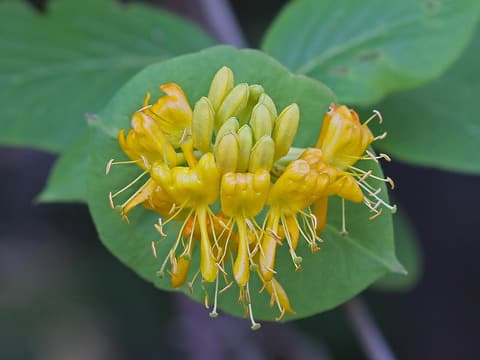
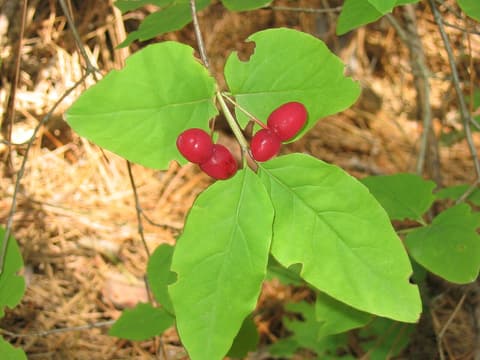
Grape honeysuckle is a native honeysuckle of the Midwest that twines through shrubs or stands on its own as a loose bush. Its leaves are round and blue-green under a waxy bloom that rubs off, and the pair beneath each flower cluster joins into one disk. In Minnesota it is the least common of the three vining honeysuckles, at the northwest edge of its range. Grow it as an accent on a short trellis in a cottage or pollinator garden, where hummingbirds and butterflies find it.
Size, growth and what to expect
Grape honeysuckle grows at a medium pace, about a foot and a half a year in our growth estimator. It is a twining vine of 3 to 15 feet that sprawls into a loose, mounded shrub when nothing holds it up, and a plant spreads 3 to 5 feet.
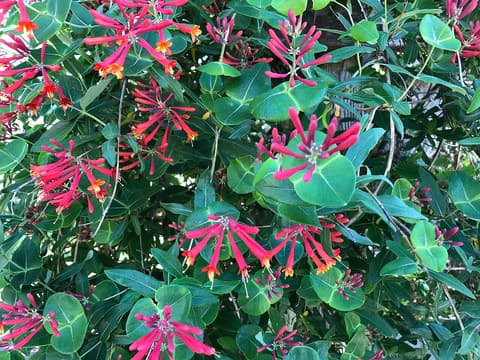
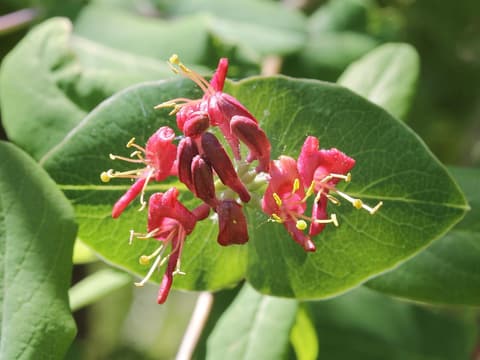
Whorls of pale yellow flowers three quarters of an inch to an inch long open in May and June, often fading to orange or red. In fall the bright red berries, a quarter to half an inch across, hang in tight clusters like small bunches of grapes. Birds and small mammals eat them, and many kinds of caterpillars feed on the leaves.
It grows wild across the Midwest, from Ohio and Tennessee west to Minnesota and Oklahoma. Its home is moist woods, wooded slopes, thickets, bluff ledges and riverbanks. Vines planted in gardens have gone wild in New York and Massachusetts. Kentucky lists it as threatened and Tennessee as endangered.
How to grow Grape Honeysuckle
Grape honeysuckle grows in full sun or part shade, and it flowers most in full sun on moist soil. It takes moist or dry soil, clay or loam, as long as it drains well. With a fence or trellis it twines up to 15 feet, and without one it makes a loose, mounded shrub. Set the support 3 feet from a wall and set plants 3 feet apart. At its size it can go within 15 feet of overhead wires.
Saplings ship bare-root or potted. Plant them dormant, from leaf fall until bud swell, in a hole wider than the roots and no deeper. Set the crown at the soil line, put the native soil back in, and keep the mulch clear of the stems. Young plants need a support to twine on, and older ones can stand as a loose bush. Clean the seed from the red berries in fall and sow it outdoors a quarter inch deep, under a little straw. For a spring sowing, chill it damp in the refrigerator for two to three months first.
Water weekly through the first summer if rain is short. Deer browse the leaves and stems, so cage young plants where deer are many. It blooms on old wood, so prune only right after it flowers. Stems that touch the ground may root and widen the plant into a patch.
Each flower carries both male and female parts, so there are no male and female plants to pair. Hummingbirds and long-tongued bees, butterflies and flies pollinate the flowers. Powdery mildew can appear, but no serious pest or disease troubles it. Birds eat the berries, but as with other honeysuckle vines, treat them as toxic to people.
Heights and zones are typical ranges for the species in cultivation; local conditions and seed source shift them.
Sources (12)
- NC State Extension Gardener Plant Toolbox: Lonicera reticulata
- Missouri Department of Conservation Field Guide: Grape Honeysuckle
- Minnesota Wildflowers: Lonicera reticulata, grape honeysuckle
- Go Botany, Native Plant Trust: Lonicera reticulata
- Lady Bird Johnson Wildflower Center: Lonicera reticulata
- Trees and Shrubs Online (International Dendrology Society): Lonicera reticulata
- USDA Forest Service, Woody Plant Seed Manual (2008), Lonicera chapter (Dubois and Blazich)
- USDA NRCS PLANTS Database: Lonicera reticulata
- NatureServe Explorer: Lonicera reticulata, Grape Honeysuckle
- Office of Kentucky Nature Preserves: Kentucky Rare Plant List, September 30, 2022
- Tennessee Natural Heritage Program: Rare Plant List
- USDA Forest Service, Fire Effects Information System: Lonicera japonica, Japanese honeysuckle, Munger 2002
Plan the planting
Check your site for it What to plant with it How big, how fast How much to water How to sow it How many for a crop When it flowers and fruits When to plant it where you live How far from the house and wires How old is yours
Read before planting
- Ten planting mistakes that quietly kill trees
- Transplanting young trees: timing, water and protection
- Protecting young trees from voles, rabbits, deer and squirrels
- How fast every tree and shrub we grow gets tall: growth rate, A to Z
- The habitat around a tree is part of the tree
- Invasive vines and shrubs are what is killing your woods
Other honeysuckles (Lonicera) we grow: American Fly Honeysuckle, Hairy Honeysuckle, Limber Honeysuckle, Mountain Fly Honeysuckle, Trumpet Honeysuckle and Yellow Honeysuckle.
Grows in the same conditions
Plants that share its sun and soil
Trees to plant it under: Rock Elm, September Elm and Common Hackberry.
More like this