Photo: Rob Routledge, CC BY 3.0, cropped · Wikimedia Commons
Hairy Honeysuckle
Lonicera hirsuta
A native twining vine for cold northern gardens, with whorls of yellow flowers in early summer and orange-red berries in fall.
Be first when hairy honeysuckle is priced
Saplings ship bare-root or in a pot, usually 12 to 18 inches tall, in the dormant season, and their height and age are stated here with the price, once available.
We grow it as saplings and seed. One email when it is listed with prices, and nothing else. Or ask, and we reply with what is ready now. Live plants ship February to May and October to November.
Limited timeSign up now and get 10% off when it is ready.
Share: copy link
Hairy Honeysuckle at a glance
- Type
- Shrub
- Mature height
- 3–16 ft
- USDA zones
- 2–6
- Growth rate
- Fast
- Flowers
- June to July
- Fruit
- Berries, September to October
- First crop
- 3 to 5 years
- Mature spread
- 5 ft
- Sun
- Full, Part
- Soil moisture
- Dry, Average
- Grows wild in
- Rocky ground, stream banks, old fields and edges
- Native range
- 7 states, north and west to Minnesota and south to Pennsylvania See what is native in your state
List all 7
Massachusetts, Michigan, Minnesota, New York, Pennsylvania, Vermont and Wisconsin
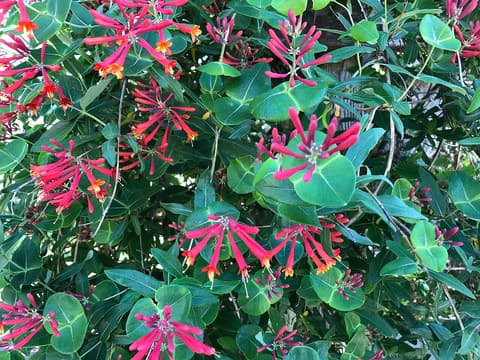
Hairy honeysuckle is a twining vine of northern woods and thickets, native from New England to Minnesota. It is the hairiest of the honeysuckle vines, sticky to the touch, and it flourishes where winters are cold. It is a native honeysuckle, unlike the Japanese and bush honeysuckles that have gone wild across the East. Grow it on a fence as a screen, or let it climb through shrubs at a woodland edge, where its late berries feed the birds that stay for winter.
Size, growth and what to expect
Hairy honeysuckle grows fast, nearly three feet a year in our growth estimator. It is a twining vine that reaches 3 to 16 feet, winding loosely through shrubs or up a support, and a plant fills 3 to 5 feet. Its stems root where they touch the ground, so a plant slowly widens into a patch.
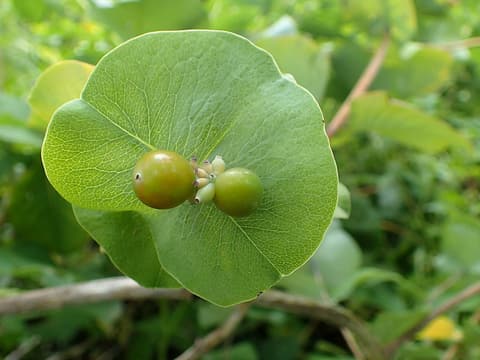
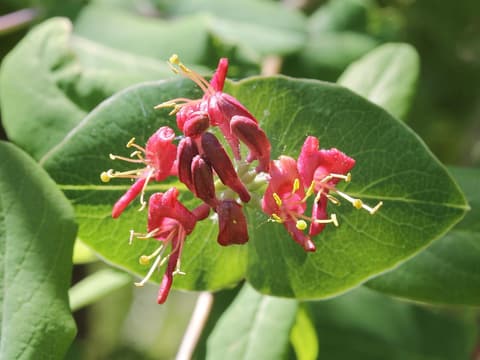
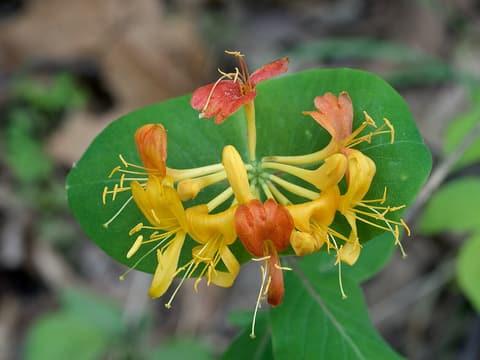
Clusters of yellow flowers, half an inch to an inch long, open in June and July and darken to orange as they age. Orange-red berries a third to half an inch long ripen in September and October, after most migrating birds have left. Small mammals and the birds that stay through winter eat them.
It grows wild from Quebec and western New England west through the Great Lakes region to Minnesota and Manitoba. Its home is woodland edges, clearings, thickets and stream banks, often on sandy or rocky ground over limestone or marble. Massachusetts lists it as endangered, and Pennsylvania has proposed listing it as endangered.
How to grow Hairy Honeysuckle
Hairy honeysuckle grows in full sun or part shade, in sandy or rocky soil that stays moist but drains well. It takes limy ground, and once rooted it rides out some drought. Its twining stems need a fence, a trellis or a shrub to climb. Set plants 3 feet apart for a screen along a fence, and set the support 3 feet from a wall. At its size it can go within 15 feet of overhead wires.
Saplings ship bare-root or potted. Plant them dormant, from leaf fall until bud swell, in a hole wider than the roots and no deeper. Set the crown at the soil line, put the native soil back in, and keep the mulch clear of the stems. Lead the first shoots to their support. Keep cleaned seed damp at room temperature for two months, then in the refrigerator for two months more. Sow it a quarter inch deep once the cold is done. Sown outdoors as soon as it is cleaned in fall, it comes up the next spring. A low stem pinned to the soil roots into a new plant.
Water weekly through the first summer if rain is short. It flowers on last year's stems, so prune only right after it blooms. Let stems that touch the ground root if you want a wider patch.
Each flower carries both male and female parts, so there are no male and female plants to pair. Bumble bees work the flowers. No serious pest or disease troubles it. As with other honeysuckle vines, treat the berries as toxic to people.
Heights and zones are typical ranges for the species in cultivation; local conditions and seed source shift them.
Sources (12)
- NC State Extension Gardener Plant Toolbox: Lonicera hirsuta
- Minnesota Wildflowers: Lonicera hirsuta, hairy honeysuckle
- Go Botany, Native Plant Trust: Lonicera hirsuta
- Lady Bird Johnson Wildflower Center: Lonicera hirsuta
- Trees and Shrubs Online (International Dendrology Society): Lonicera hirsuta
- USDA Forest Service, Woody Plant Seed Manual (2008), Lonicera chapter (Dubois and Blazich)
- USDA NRCS PLANTS Database: Lonicera hirsuta
- NatureServe Explorer: Lonicera hirsuta, Hairy Honeysuckle
- Massachusetts Division of Fisheries and Wildlife: List of Endangered, Threatened and Special Concern Species
- Pennsylvania Natural Heritage Program: Species and Natural Features List, updated June 2026
- USDA Forest Service, Fire Effects Information System: Lonicera japonica, Japanese honeysuckle, Munger 2002
- Penn State Extension: Honeysuckle Species in Pennsylvania (Marquesen, updated March 10, 2025)
Plan the planting
Check your site for it What to plant with it How big, how fast How much to water How to sow it How many for a crop When it flowers and fruits When to plant it where you live How far from the house and wires How old is yours
Read before planting
- Ten planting mistakes that quietly kill trees
- Transplanting young trees: timing, water and protection
- Protecting young trees from voles, rabbits, deer and squirrels
- How fast every tree and shrub we grow gets tall: growth rate, A to Z
- The habitat around a tree is part of the tree
- Invasive vines and shrubs are what is killing your woods
Other honeysuckles (Lonicera) we grow: American Fly Honeysuckle, Grape Honeysuckle, Limber Honeysuckle, Mountain Fly Honeysuckle, Trumpet Honeysuckle and Yellow Honeysuckle.
Grows in the same conditions
Plants that share its sun and soil
Trees to plant it under: Common Hackberry, Rock Elm and American Elm.
More like this