Photo: Chris Light, CC BY-SA 4.0 · Wikimedia Commons
Ohio Buckeye
Aesculus glabra
Also called fetid buckeye, American buckeye, white buckeye.
Ohio's state tree, among the first to leaf out, with upright clusters of greenish yellow flowers and glossy brown buckeyes in prickly husks.
Ohio Buckeye at a glance
- Type
- Medium tree
- Mature height
- 20–40 ft
- USDA zones
- 3–7
- Growth rate
- Medium
- Sun
- Full, Part, Shade
- Soil moisture
- Average, Wet
- Grows wild in
- Floodplain forests, stream banks and rich moist slopes
- Native range
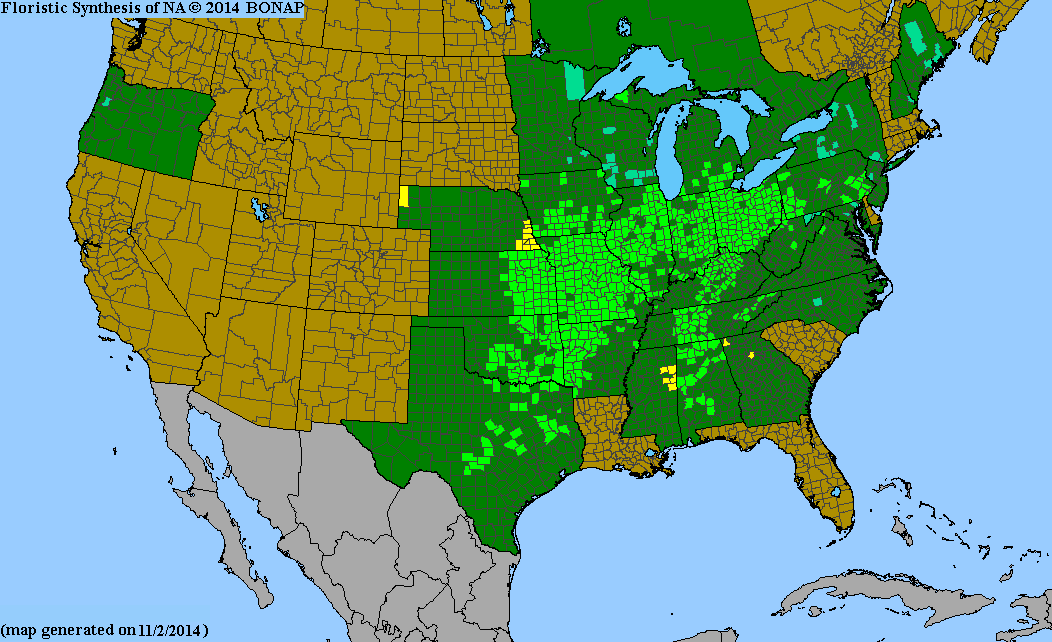
- 18 states, north to Michigan, south to Texas, east to Pennsylvania and west to Nebraska Also recorded in 7 other states, outside its native range. See what is native in your state
List all 18
Alabama, Arkansas, Georgia, Illinois, Indiana, Iowa, Kansas, Kentucky, Michigan, Mississippi, Missouri, Nebraska, Ohio, Oklahoma, Pennsylvania, Tennessee, Texas and West Virginia
Ohio buckeye is a small to medium tree of moist river valleys, and the state tree of Ohio, the Buckeye State. Its shiny seed with a pale scar looks like the eye of a buck deer, which gave the tree its name. Crushed leaves, twigs and flowers smell unpleasant, hence the name fetid buckeye. Its husk is prickly, where yellow buckeye's is smooth. Grow it at a woodland edge or in a wild corner of a large yard, away from patios and drives.
Size, growth and what to expect
Ohio buckeye grows at a moderate pace, about a foot and a half a year in our growth estimator. Expect 20 to 40 feet with a rounded crown as wide, and less often 75 feet. Most trees live 80 to 100 years.
Upright clusters of greenish yellow flowers, 4 to 7 inches long, open from March to May, after the leaves. The prickly husk splits in September and October to drop one to three glossy brown seeds, each with a pale eye. Hummingbirds visit the flowers, fox squirrels eat some of the seeds, and the leaves turn yellow to orange in fall.
It grows wild from western Pennsylvania, Ohio and southern Michigan west to Iowa, and south to eastern Kansas, central Texas and central Alabama. It favors river bottoms and stream banks. It has been planted north and east of that range, and it escapes from planting in New York.
How to grow Ohio Buckeye
Ohio buckeye does best in part shade and also grows in full sun or shade. Give it a deep, rich, moist soil that drains well. In full sun or drought the leaves scorch and can look ragged by late summer. It drops twigs, husks and leaves, so plant it 25 feet from a wall and away from patios and drives. Keep it at least 15 feet from overhead wires, and set trees 30 feet apart.
Saplings ship potted. Ohio buckeye grows a strong taproot in its first year and is very hard to move once it settles in, so plant it young and leave it in place. Plant in the dormant season, in a hole wider than the pot and deep enough for the taproot. Set the root flare at the soil line, put the native soil back in, and mulch a wide ring clear of the trunk. Ohio buckeye seed dries out and dies quickly, so sow it fresh in fall. Set each seed an inch or two deep with the pale scar down. For spring, hold it damp in the refrigerator for about 120 days first.
Water deeply every week through the first two summers, and in dry spells after that. Deer and rabbits seldom damage it. It leafs out early, and a late frost sometimes kills the young leaves.
Each flower cluster carries male flowers and flowers with both male and female parts. Its close relatives set seed as well with their own pollen as with another tree's, so one tree should bear alone. Trees begin to bear at about 8 years. The seeds, leaves and bark are poisonous, so keep children, pets and livestock from eating them. Leaf blotch can brown the leaves without lasting harm, and powdery mildew, anthracnose and Japanese beetles also appear.
Heights and zones are typical ranges for the species in cultivation; local conditions and seed source shift them.
Sources (12)
- USDA Forest Service, Silvics of North America: Ohio buckeye (Williams 1990)
- USDA Forest Service, Woody Plant Seed Manual: Aesculus chapter
- NC State Extension Gardener Plant Toolbox: Aesculus glabra
- Missouri Botanical Garden Plant Finder: Aesculus glabra
- The Morton Arboretum: Ohio buckeye
- Lady Bird Johnson Wildflower Center: Aesculus glabra
- Virginia Tech Dendrology: Ohio buckeye
- Trees and Shrubs Online: Aesculus glabra, from Bean's Trees and Shrubs Hardy in the British Isles
- USDA NRCS Plant Guide: Ohio buckeye, Aesculus glabra (Nesom)
- NatureServe Explorer: Aesculus glabra
- Georgia Biodiversity Portal: All Rare Plants, export of July 7, 2026
- BONAP (Biota of North America Program): Aesculus glabra county map
Check your site for it What to plant with it How big, how fast How much to water How to sow it How many for a crop When it flowers and fruits
- Ten planting mistakes that quietly kill trees
- Transplanting young trees: timing, water and protection
- Protecting young trees from voles, rabbits, deer and squirrels
- How a tree's photosynthesis changes through the year, from leaf-out to leaf fall
- Multistem or single stem? Sometimes the trunk is hiding the answer
- Leaf litter, not wood chips, under the canopy
Grows in the same conditions
Plants that share its sun and soil


More like this