Photo: Eric Hunt, CC BY-SA 3.0 · Wikimedia Commons
Red Buckeye
Aesculus pavia
Also called scarlet buckeye, firecracker plant.
A small buckeye for part shade whose upright clusters of tubular red flowers open in early spring, in time for the returning hummingbirds.
Red Buckeye at a glance
- Type
- Small tree
- Mature height
- 10–25 ft
- USDA zones
- 4–9
- Growth rate
- Medium
- Sun
- Full, Part, Shade
- Soil moisture
- Average
- Grows wild in
- The forest understory, stream banks, floodplain forests and rich moist slopes
- Native range
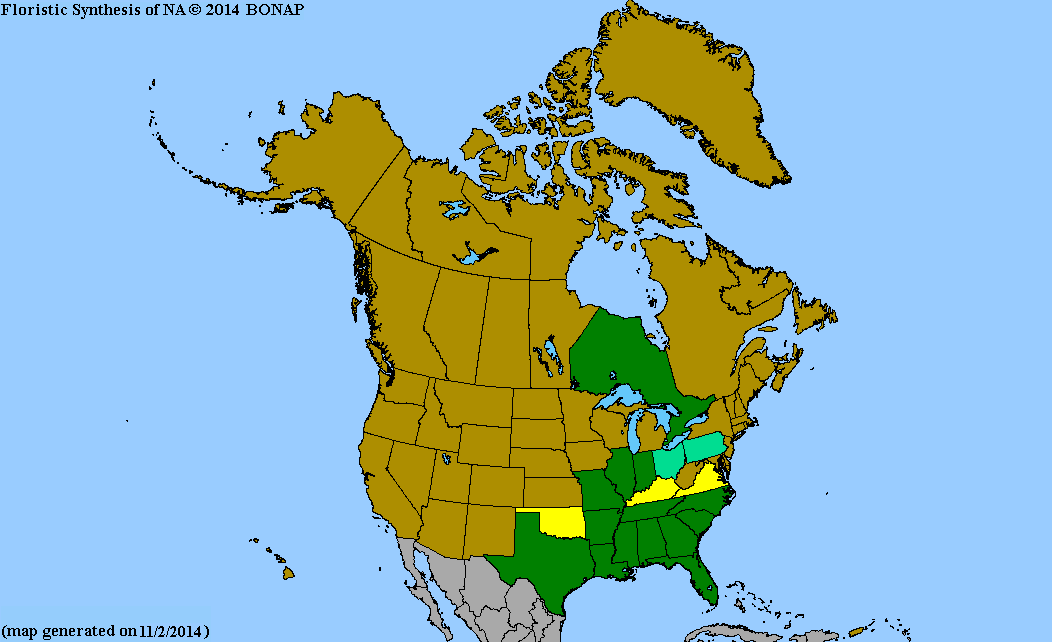
- 17 states, north to Illinois, south to Florida and west to Texas Also recorded in 1 other state, outside its native range. See what is native in your state
List all 17
Alabama, Arkansas, Florida, Georgia, Illinois, Indiana, Kentucky, Louisiana, Mississippi, Missouri, North Carolina, Oklahoma, South Carolina, Tennessee, Texas, Virginia and West Virginia
Red buckeye is a shrub or small tree of rich, moist woods and stream banks across the South, often on several stems. It leafs out and flowers before the canopy trees are in full leaf, and it often drops its leaves by late summer. Where it meets the yellow, Ohio and painted buckeyes, it crosses with them. Every part of the tree is poisonous if eaten, the seeds above all. Even a street planting strip three feet wide has room for it. Set it at a woodland edge or near a window where the spring flowers show, with other plants in front to hide its early leaf drop.
Size, growth and what to expect
Red buckeye grows at a medium pace, about a foot and a half a year in our growth estimator. It makes a shrub or small tree of 10 to 25 feet with a crown 10 to 20 feet wide, and wild trees can reach 25 to 30 feet.
Upright clusters of tubular red flowers, 4 to 10 inches long, open in March and April in the South and in May and June farther north. Hummingbirds, bees and butterflies visit them. The smooth, light brown husks ripen in September and October and split to drop one to three glossy seeds. Few animals eat the seeds besides squirrels.
It grows wild from North Carolina to northern Florida and west to central Texas, and up the Mississippi Valley to southern Illinois and southeastern Missouri. Its home is low, rich woods, stream banks and the foot of bluffs. In Ohio and Pennsylvania it grows wild only where it has escaped from planting. Kentucky lists it as threatened.
How to grow Red Buckeye
Red buckeye does best in part shade, or in sun with shade in the afternoon, in a rich, moist soil that drains well. It takes clay, sand and a range of soil pH. Dry soil and hot sun scorch its leaves and hurry their fall. Plant it 15 feet from a wall and set trees 10 feet apart. Keep it 15 feet from overhead wires, since some trees pass 20 feet.
Saplings ship potted. Seedlings grow a taproot, and older plants do not move well, so plant it young and leave it in place. Plant in the dormant season, in a hole wider than the pot and no deeper. Set the root flare at the soil line, put the native soil back in, and mulch a wide ring clear of the trunk. Buckeye seed dies if it dries out, so sow it as soon as the husks split in fall. Set each seed an inch or two deep with the pale scar down. It needs no chilling, and the seedlings come up in spring.
Water weekly through the first two summers and in dry spells after that, which also keeps the leaves on longer. Deer browse it only moderately. Let it grow as a clump, or remove the extra stems early for a single trunk.
Each flower cluster carries male flowers and a few with both male and female parts, and hummingbirds and bees carry the pollen. A lone tree sets seed with its own pollen. In hand pollinations, though, another tree's pollen set about three times as much fruit, so a second tree nearby improves the crop. Seedlings can flower in their second or third year. Leaf blotch and powdery mildew can spot the leaves, and the husks and early leaf fall make some litter.
Heights and zones are typical ranges for the species in cultivation; local conditions and seed source shift them.
Sources (13)
- The Ohio State University, PhD dissertation: Chanon, A. M. 2005, Studies on the reproductive capacity of Aesculus parviflora and Aesculus pavia
- USDA Forest Service, Woody Plant Seed Manual (2008), Aesculus chapter
- NC State Extension Gardener Plant Toolbox: Aesculus pavia
- UF/IFAS Extension, ENH223/ST064: Aesculus pavia, Red Buckeye
- Missouri Botanical Garden Plant Finder: Aesculus pavia
- Lady Bird Johnson Wildflower Center: Aesculus pavia
- The Morton Arboretum: Red buckeye
- Trees and Shrubs Online (International Dendrology Society): Aesculus pavia, from Bean
- Missouri Department of Conservation Field Guide: Red Buckeye
- Virginia Tech Dendrology: red buckeye
- Kentucky Office of Nature Preserves: 2022 Kentucky Rare Plant List
- NatureServe Explorer: Aesculus pavia
- BONAP North American Plant Atlas (2014): Aesculus pavia state and county maps
Check your site for it What to plant with it How big, how fast How much to water How to sow it How many for a crop When it flowers and fruits
- Ten planting mistakes that quietly kill trees
- Transplanting young trees: timing, water and protection
- Protecting young trees from voles, rabbits, deer and squirrels
- How a tree's photosynthesis changes through the year, from leaf-out to leaf fall
- Native trees and shrubs for birds: caterpillars, fruit, mast, nests and winter cover, month by month
- Multistem or single stem? Sometimes the trunk is hiding the answer
Grows in the same conditions
Plants that share its sun and soil


More like this