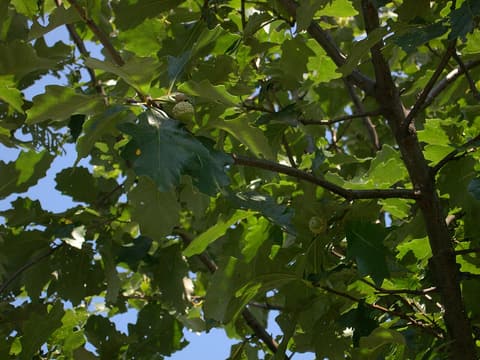
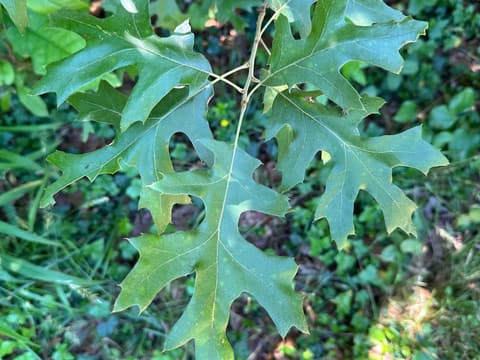
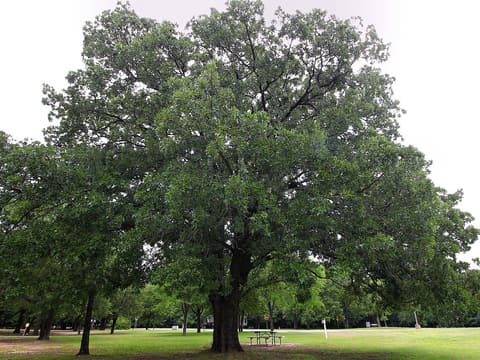
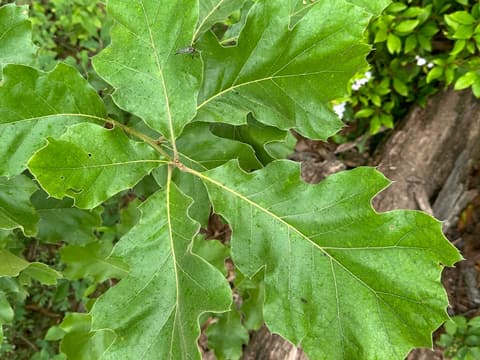
Photo: Bruce Kirchoff, CC BY 2.0, cropped · Wikimedia Commons
Swamp Laurel Oak
Quercus laurifolia
Also called diamond-leaf oak, laurel-leaf oak, Quercus obtusa.
A fast red oak for wet southern ground, with glossy leaves that are often diamond-shaped and big acorn crops that turkeys and deer seek out.
Be first when swamp laurel oak is priced
Saplings ship bare-root or in a pot, usually 12 to 18 inches tall, in the dormant season, and their height and age are stated here with the price, once available.
We grow it as saplings and acorns. One email when it is listed with prices, and nothing else. Or ask, and we reply with what is ready now. Live plants ship February to May and October to November.
Limited timeSign up now and get 10% off when it is ready.
Share: copy link
Swamp Laurel Oak at a glance
- Type
- Large tree
- Mature height
- 40–80 ft
- USDA zones
- 6–10
- Growth rate
- Fast
- Flowers
- February to March
- Fruit
- Acorns, September to October
- First crop
- 15 to 20 years
- Mature spread
- 45 ft
- Sun
- Full, Part, Shade
- Soil moisture
- Average, Wet
- Grows wild in
- Floodplain forests, stream banks, swamps and wet flats
- Native range
- 10 states, north to Virginia, south to Florida and west to Texas Also recorded, not native, in Maryland and Pennsylvania. See what is native in your state
List all 10
Alabama, Arkansas, Florida, Georgia, Louisiana, Mississippi, North Carolina, South Carolina, Texas and Virginia
Swamp laurel oak is a fast-growing red oak of sandy floodplains, river banks and swamp edges on the southeastern Coastal Plain. Its leaves are glossy above and pale below, often diamond-shaped with a rounded tip, and in the South many hang on until spring. It is easily confused with our laurel oak, which keeps to dry, sandy uplands and flowers about two weeks later. The two were long treated as one species, and some botanists still lump them. It grows well as a street tree. Grow it as quick shade for a damp lawn, a pond edge or a southern street.
Size, growth and what to expect
Swamp laurel oak grows fast, about 2.75 feet a year in our growth estimator. Expect 40 to 80 feet with a dense, rounded crown 30 to 45 feet wide. It is short-lived, maturing in about 50 years, though the tallest known tree stands 127 feet in Suffolk, Virginia.
It flowers in February and March, as the last of the old leaves fall, and the new leaves often open coppery red. The acorns, about half an inch long and dark brown to black, ripen in September and October of their second year. Large crops come nearly every year from age 15 to 20. Deer, raccoons, squirrels, wild turkeys, ducks and quail eat them, and the leaves feed hairstreak and duskywing caterpillars.
It grows wild on the Coastal Plain from southeastern Virginia to southern Florida, and west to southeastern Texas and southern Arkansas. It is most common on sandy floodplains, river banks and swamp edges, and grows best in north Florida and Georgia. NatureServe ranks it imperiled to vulnerable in Arkansas.
How to grow Swamp Laurel Oak
Swamp laurel oak takes full sun to shade and a moist, acid soil of sand, loam or clay. It grows on floodplains and swamp edges and takes wet ground, but not long months of standing water. It has little tolerance for salty wind or spray. Its trunk flares at the base and lifts pavement in narrow strips, so give it a planting strip at least 8 feet wide. Plant it 25 feet from a wall and more than 50 feet from overhead wires, and set trees 30 feet apart.
Saplings ship bare-root or potted. Plant them young, since the seedlings soon send down a long taproot. Plant dormant saplings from leaf fall until bud swell, in a hole wider than the roots and no deeper. Set the root flare at the soil line, put the native soil back in, and keep the mulch clear of the trunk. Swamp laurel oak acorns have only a mild dormancy, and half of them sprout in spring without chilling. Sow them in fall half an inch deep under hardware cloth. For spring, hold them damp in the refrigerator for four to twelve weeks first.
Water every week or two through the first summer unless the ground stays wet. Guard young trees with a tube or cage against deer and rabbits for the first two years. Train it early to one central trunk with well-spaced limbs. Prune a little each year so you only cut small branches, since a large cut can start a column of decay many feet long.
The flowers are wind pollinated, and an acorn crop wants another oak nearby. Swamp laurel oak belongs to the red oak group, so its acorns take two seasons to ripen. As a red oak, prune it only in the dormant season, so fresh cuts do not draw the beetles that spread oak wilt. Its wood is weak and can break in high winds, and the trunk often hollows with heart rot as it nears 50 years. Even a light ground fire can kill it. Weevils infest the acorns, and it carries the alternate stage of fusiform rust of southern pines, though the rust does the oak little harm.
Heights and zones are typical ranges for the species in cultivation; local conditions and seed source shift them.
Sources (11)
- Flora of North America, vol. 3: Quercus laurifolia
- USDA Forest Service, Silvics of North America: Laurel Oak, McReynolds and Hebb 1990
- NC State Extension Gardener Plant Toolbox: Quercus laurifolia
- Lady Bird Johnson Wildflower Center: Quercus laurifolia
- Florida Native Plant Society Plant Database: Quercus laurifolia
- Trees and Shrubs Online, International Dendrology Society: Quercus laurifolia
- UF/IFAS Extension, ENH-707/ST549: Quercus laurifolia, Laurel Oak, Gilman and others
- Virginia Tech Dendrology: laurel oak, Quercus laurifolia
- USDA Forest Service, Woody Plant Seed Manual (2008), Quercus chapter
- USDA NRCS PLANTS Database: Quercus laurifolia
- NatureServe Explorer: Quercus laurifolia
Plan the planting
Check your site for it What to plant with it How big, how fast How much to water How to sow it How many for a crop When it flowers and fruits When to plant it where you live How far from the house and wires How old is yours Moving one you already have
Read before planting
- Ten planting mistakes that quietly kill trees
- Transplanting young trees: timing, water and protection
- Protecting young trees from voles, rabbits, deer and squirrels
- How fast every tree and shrub we grow gets tall: growth rate, A to Z
- Red oaks and white oaks, and where each belongs
- When oaks leaf out, and why two of them never agree
We grow 42 other oaks (Quercus): see them all.
Grows in the same conditions
Plants that share its sun and soil
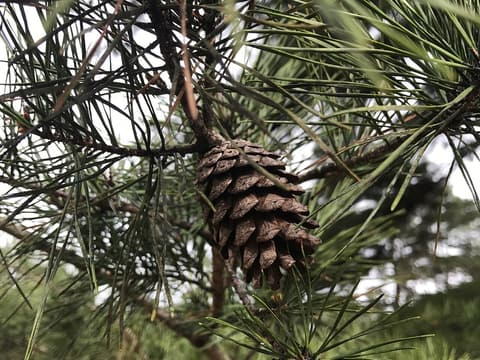
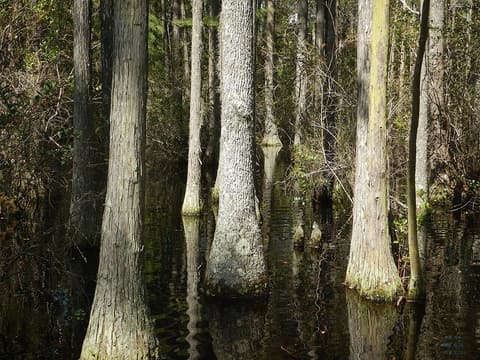
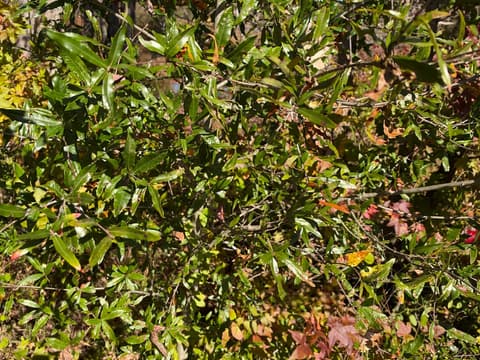
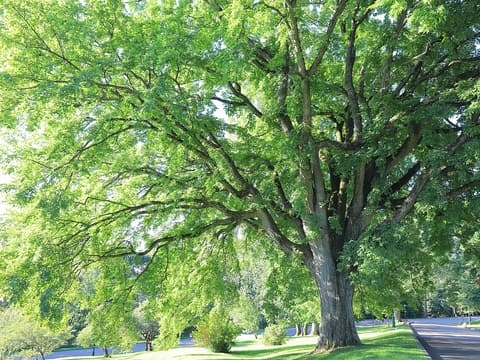
Under its canopy: Florida Anise, Needle Palm and Dwarf Palmetto.
More like this