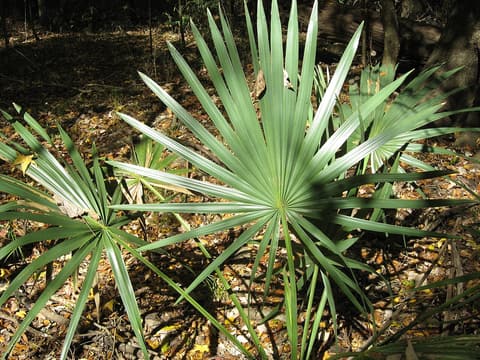
Photo: Katherine Wagner-Reiss, CC BY-SA 4.0, cropped · Wikimedia Commons
Needle Palm
Rhapidophyllum hystrix
Also called porcupine palm, blue palmetto.
One of the hardiest palms, a trunkless clump of glossy fans up to 30 inches across, guarded at the base by long black needles.
Be first when needle palm is priced
Saplings ship bare-root or in a pot, usually 12 to 18 inches tall, in the dormant season, and their height and age are stated here with the price, once available.
We grow it as saplings and seed. One email when it is listed with prices, and nothing else. Or ask, and we reply with what is ready now. Live plants ship February to May and October to November.
Limited timeSign up now and get 10% off when it is ready.
Share: copy link
Needle Palm at a glance
- Type
- Shrub
- Mature height
- 3–6 ft
- USDA zones
- 6–10
- Growth rate
- Slow
- Flowers
- April to July
- Fruit
- Fleshy fruit, September to November
- First crop
- 20 or more years
- Mature spread
- 8 ft
- Sun
- Full, Part, Shade
- Soil moisture
- Dry, Average, Wet
- Grows wild in
- Floodplain forests, stream banks, the forest understory, swamps and wet flats
- Native range
- Alabama, Florida, Georgia, Mississippi and South Carolina See what is native in your state
Needle palm is a palm with almost no trunk, a dense clump of glossy, fan-shaped leaves armed at the base with stiff black needles. Mature plants often survive cold down to 5 degrees below zero, a hardiness few other palms match. It is the only species in its genus, probably a relict, and its closest relatives are palms of the Himalayan region of Asia. It is native to the shady, damp woods of the Southeast. Its spiky evergreen leaves add interest to the winter garden. Set it as a specimen or an accent in a shady border, back from paths, or grow it in a large container.
Size, growth and what to expect
Needle palm grows slowly, 6 inches to a foot a year in our growth estimator. It makes a clump 3 to 6 feet tall and 4 to 8 feet wide on a short stem that often leans and roots where it touches moist soil. Each fan runs up to 30 inches across, split into narrow segments, and the needles at its base reach 10 inches. A clump likely lives 50 years or more.
Clusters of small yellowish flowers open from April into July, low among the leaf bases and mostly hidden. Fuzzy, reddish-brown fruits about three quarters of an inch long ripen in fall. The spiny clump gives wildlife cover. In the wild, suckers more than seedlings keep most stands going.
It grows wild mostly on the coastal plain, from southern South Carolina through Georgia and Florida to Alabama and south-central Mississippi. Its home is shady woods on rich soil over limestone, wet hammocks, seepage swamps, floodplains and the banks of ravines and streams. NatureServe ranks it critically imperiled in South Carolina, at the north end of its range.
How to grow Needle Palm
Needle palm is a trunkless palm for part shade, and it also grows in shade or full sun. It wants a rich, moist soil on the acid side, from sand to clay. It takes wet ground and an occasional flood, and once rooted it rides out dry spells. Keep it out of salt spray, and plant it where winter winds cannot reach it. Set plants 6 feet apart and keep them 4 feet from a wall and well back from paths, since the needles wound. At its size it can go within 15 feet of overhead wires.
Saplings ship bare-root or potted. Plant them in a hole wider than the roots and no deeper. Set the base of the stem at the soil line, put the native soil back in, and keep the mulch clear of the stem. Sow the seed as palmetto seed is sown, half an inch to an inch deep, soon after it arrives, and never let it dry out. It is slow and takes six to twelve months to come up.
Water weekly through the first two summers unless the ground stays wet. Mulch over the roots before winter, since a mulch helps it through hard cold. Deer seldom damage it. Wear thick gloves near the base, where the needles are. Leave the suckers to thicken the clump, since dividing it among the needles is difficult and hazardous work.
Its small flowers are male, female or both, and weevils most likely carry the pollen. The fuzzy fruit smells foul, and black bears and other mammals eat it. It has no serious pest or disease.
Heights and zones are typical ranges for the species in cultivation; local conditions and seed source shift them.
Sources (11)
- NC State Extension Gardener Plant Toolbox: Rhapidophyllum hystrix
- Missouri Botanical Garden Plant Finder: Rhapidophyllum hystrix
- Lady Bird Johnson Wildflower Center: Rhapidophyllum hystrix
- Flora of North America, vol. 22: Rhapidophyllum hystrix
- Florida Native Plant Society: Rhapidophyllum hystrix
- NatureServe Explorer: Rhapidophyllum hystrix
- Mississippi Natural Heritage Program: Special Plant Tracking List, 2018
- Florida Administrative Code, Rule 5B-40.0055, Regulated Plant Index, effective January 8, 2020
- USDA Forest Service, Woody Plant Seed Manual (2008), Sabal chapter, Olson, Barnes and Karrfalt
- Butler, C. J. and M. Larson 2020, Climate change winners and losers: the effects of climate change on five palm species in the southeastern United States, Ecology and Evolution 10
- Abrahamson, W. G. and C. R. Abrahamson 2009, Life in the slow lane: palmetto seedlings exhibit remarkable survival but slow growth in Florida's nutrient-poor uplands, Castanea 74
Plan the planting
Check your site for it What to plant with it How big, how fast How much to water How to sow it How many for a crop When it flowers and fruits When to plant it where you live How far from the house and wires How old is yours
Read before planting
- Ten planting mistakes that quietly kill trees
- Transplanting young trees: timing, water and protection
- Protecting young trees from voles, rabbits, deer and squirrels
- How fast every tree and shrub we grow gets tall: growth rate, A to Z
- The habitat around a tree is part of the tree
- Invasive vines and shrubs are what is killing your woods
Grows in the same conditions
Plants that share its sun and soil
Trees to plant it under: Swamp Laurel Oak, Florida Maple and American Elm.
More like this