Photo: Alex Abair, CC BY 4.0 · Wikimedia Commons
American Beautyberry
Callicarpa americana
Also called French mulberry, sourbush, American mulberry.
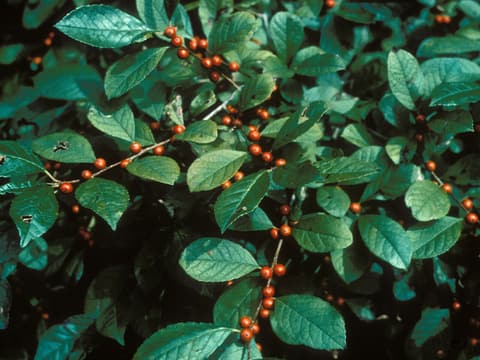
Glossy violet berries ring every stem in fall and feed mockingbirds and thrushes into winter. A fast, easy native shrub for sun or light shade.
American Beautyberry at a glance
- Type
- Shrub
- Mature height
- 3–6 ft
- USDA zones
- 6–10
- Growth rate
- Medium
- Flowers
- June to July
- Fruit
- Berries, August to December
- First crop
- 2 years (first flowers)
- Mature spread
- 6 ft
- Sun
- Full, Part
- Soil moisture
- Dry, Average
- Grows wild in
- The forest understory, sandy barrens, the coast, old fields and edges
- Native range
- 14 states, north to Maryland, south to Florida and west to Texas See what is native in your state
List all 14
Alabama, Arkansas, Florida, Georgia, Louisiana, Maryland, Mississippi, Missouri, North Carolina, Oklahoma, South Carolina, Tennessee, Texas and Virginia
American beautyberry is a loose, arching shrub of open woods, edges and fencerows. Small pink flowers sit in whorls at the leaf joints in early summer. By September each joint carries a ring of berries in a purple no other native shrub can match, held on the bare stems after the leaves drop. Mockingbirds, catbirds, robins, thrushes and towhees strip them through the winter; the fruit is edible for people too, bland raw and good as a jelly. Perfect for a sunny edge, a bird hedge or the bright spot by a deck where a shrub can be cut back hard each spring.
The crushed leaves were a folk mosquito repellent in the rural South, and USDA chemists later isolated the compounds responsible.
Size, growth and what to expect
American beautyberry grows at a moderate pace. Our growth estimator puts it in the medium class, at roughly a foot and a half of new height a year in youth. In a yard it stands 3 to 6 feet tall and about as wide, and on rich, moist ground it can reach 8 feet.
Small pink flowers open in whorls at the leaf joints from June into July, and the fruit ripens from August to November on the same year's new growth. Each berry is about a quarter inch long and holds two to four seeds, packed in clusters that hug the stem. At least ten kinds of birds eat them, the northern bobwhite above all, along with raccoons, opossums and gray foxes. Older names for it include French mulberry.
It grows wild on the Atlantic and Gulf coastal plains from Virginia south to Florida and west to Arkansas, Oklahoma and eastern Texas.
How to grow American Beautyberry
American beautyberry fruits best in full sun, though it takes light shade with a thinner crop. Any well-drained soil suits it, sand and clay alike, and it shrugs off summer drought once established. Allow 5 feet between plants and 4 feet from a wall or walk.
Plant potted or bare-root shrubs while dormant, from leaf fall until the buds swell, in a hole wider than the roots and no deeper. Set the crown at the soil line and put the native soil back. Mulch a ring two inches deep, clear of the stems. Sow seed in fall, cleaned of pulp, a quarter inch deep in a pot or bed left outdoors for the winter. Or hold it damp in the refrigerator for 60 to 90 days and sow it in spring. It germinates in spring, and seedlings can flower in their second year.
Water weekly through the first summer if rain is short; after that it needs nothing. Deer browse it, so cage young plants for two years where deer are heavy. It flowers on the new growth, so cut the whole shrub back to about a foot in late winter to keep it compact and loaded with fruit. Near the northern edge of its range the tops may die in a hard winter; cut them off in spring and it regrows from the base.
The berries ripen in September and hold into winter unless the birds find them first. A single plant fruits on its own, and a few more of its kind nearby seem to set more fruit.
Heights and zones are typical ranges for the species in cultivation; local conditions and seed source shift them.
Sources (12)
- USDA Fire Effects Information System: Callicarpa americana
- NC State Extension Gardener Plant Toolbox: Callicarpa americana
- University of Florida IFAS: Callicarpa americana fact sheet FP090
- Lady Bird Johnson Wildflower Center: Callicarpa americana
- USDA NRCS PLANTS Database: Callicarpa americana
- USDA Forest Service, Woody Plant Seed Manual: Callicarpa americana chapter
- USDA NRCS Plant Guide: American beautyberry, Callicarpa americana
- USDA NRCS Plant Fact Sheet: American beautyberry, Callicarpa americana
- USDA Agricultural Research Service news: A Granddad's Advice May Help Thwart Mosquitoes, 2006
- Virginia Tech Dendrology: American beautyberry, Callicarpa americana
- NatureServe Explorer: Callicarpa americana
- Trees and Shrubs Online: Callicarpa americana
Check your site for it What to plant with it How big, how fast How much to water How to sow it How many for a crop When it flowers and fruits When to plant it where you live How far from the house and wires
- Ten planting mistakes that quietly kill trees
- Transplanting young trees: timing, water and protection
- Protecting young trees from voles, rabbits, deer and squirrels
- Native trees and shrubs for wildlife: what deer, squirrels, bears, bats and turtles get from a planting
- Bare-root trees on arrival: the first hour, the first week and the first spring
- The habitat around a tree is part of the tree
Grows in the same conditions
Plants that share its sun and soil
More like this