Photo: Fepup, Public domain · Wikimedia Commons
Smooth Alder (Swamp Alder)
Scientific name: Alnus serrulata
Also called hazel alder, tag alder, swamp alder.
A nitrogen-fixing streambank shrub that holds soil, feeds woodcock and grouse, and thrives in standing water.
Be first when smooth alder is priced
Saplings ship bare-root or in a pot, usually 12 to 18 inches tall, in the dormant season, and their height and age are stated here with the price, once available.
We grow it as saplings and seed. One email when it is listed with prices, and nothing else. Or ask, and we reply with what is ready now. Live plants ship February to May and October to November.
Limited timeSign up now and get 10% off when it is ready.
Share: copy link
Smooth Alder at a glance
- Type
- Shrub
- Mature height
- 10–20 ft
- USDA zones
- 4–9
- Growth rate
- Fast
- Flowers
- March to April
- Fruit
- Cones, September to February
- First crop
- About 2 years
- Mature spread
- 15 ft
- Sun
- Full, Part
- Soil moisture
- Wet
- Grows wild in
- Stream banks, swamps and wet flats
- Native range
- 30 states and the District of Columbia, north to Maine, south to Florida and west to Texas See what is native in your state
List all 31
Alabama, Arkansas, Connecticut, Delaware, Florida, Georgia, Illinois, Indiana, Kansas, Kentucky, Louisiana, Maine, Maryland, Massachusetts, Mississippi, Missouri, New Hampshire, New Jersey, New York, North Carolina, Ohio, Oklahoma, Pennsylvania, Rhode Island, South Carolina, Tennessee, Texas, Vermont, Virginia, West Virginia and the District of Columbia
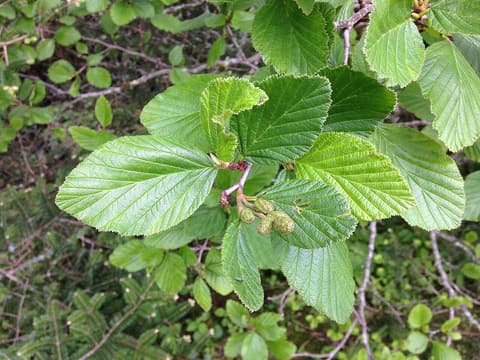
Smooth alder lines slow streams and pond edges across the eastern states. Its roots fix nitrogen and knit wet banks together, its catkins feed early bees and its cone-like fruits feed finches all winter. Plant it to stabilize a wet ditch or shoreline, or as a nurse shrub around young bottomland trees. A screen for wet ground first, and woodcock cover second.
Size, growth and what to expect
Smooth alder feeds itself. Root nodules fix nitrogen, which makes it a pioneer for reclaiming bare wet ground. It grows fast, nearly three feet a year in its youth on an average site in our growth estimator's model. It makes a multi-stemmed, suckering shrub or small tree 10 to 20 feet tall and 8 to 15 feet wide that spreads into a thicket.
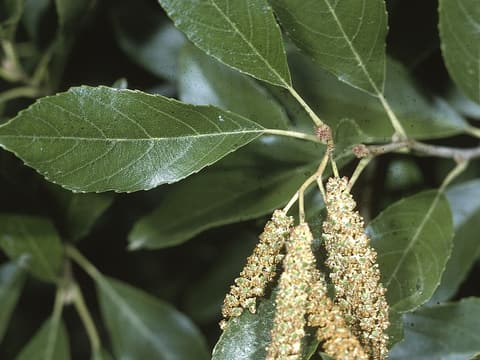
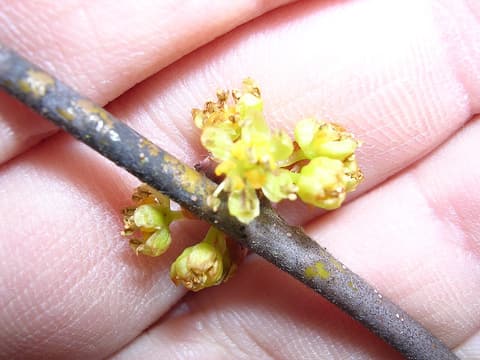
Male catkins 1½ to 2½ inches long and half-inch red female catkins open in March and April. The female catkins ripen into inch-long cones that turn dark brown in fall and hang on through winter, and birds feed on the seed. Deer browse the foliage, birds and small mammals eat the pollen-rich male catkins in spring, and it hosts the caterpillars of the harvester butterfly.
It grows wild from Nova Scotia west to Illinois and Missouri and south to east Texas and north Florida. Its home is boggy ground along streams, lakes and rivers, wet meadows, ditches and swamp borders.
How to grow Smooth Alder
Smooth alder wants its feet wet: a stream bank, a pond shore or a ditch, in full sun or light shade. Do not put it in a dry bed. Clumps spread by suckers, so keep it 10 feet from a building and 6 feet between plants along a shore.
Plant dormant saplings, bare-root or potted, between leaf drop and bud swell, in a hole wider than the roots and no deeper, crown at the soil line, native mud back in. It fixes its own nitrogen, so skip fertilizer. Seed is tiny: chill it damp for a month, then sow on the surface of wet mix in spring, uncovered, and keep it wet under a screen.
Water only if the site dries the first summer. Deer, rabbits and beaver chew alder, so cage it for two years where they visit. It needs no pruning; a clump cut to the ground in late winter resprouts.
Smooth alder carries male and female flowers on the same shrub, but alders set little seed with their own pollen. Plant two or more from different parents so the wind can carry pollen between them. Expect a thicket, not a specimen; smooth alder suckers into a bank-holding colony. Catkins open in late winter before the leaves. Flea beetles chew leaves in summer and woolly aphids cluster on twigs; both are harmless.
Heights and zones are typical ranges for the species in cultivation; local conditions and seed source shift them.
Sources (11)
- NC State Extension Gardener Plant Toolbox: Alnus serrulata
- Missouri Botanical Garden Plant Finder: Alnus serrulata
- Lady Bird Johnson Wildflower Center: Alnus serrulata
- USDA NRCS PLANTS Database: Alnus serrulata
- USDA Forest Service, Woody Plant Seed Manual (2008), Alnus chapter, Harrington and others
- USDA NRCS Plant Fact Sheet: smooth alder, Alnus serrulata
- NatureServe Explorer: Alnus serrulata, Brookside Alder
- Go Botany, Native Plant Trust: Alnus serrulata
- Trees and Shrubs Online: Alnus serrulata, Baxter and McAllister (2024)
- Flora of North America, vol. 3: Alnus serrulata
- Native Plant Network, propagation protocol: Alnus serrulata
Plan the planting
Check your site for it What to plant with it How big, how fast How much to water How to sow it How many for a crop When it flowers and fruits When to plant it where you live How far from the house and wires How old is yours
Read before planting
- Ten planting mistakes that quietly kill trees
- Transplanting young trees: timing, water and protection
- Protecting young trees from voles, rabbits, deer and squirrels
- Why reservoirs and drinking watersheds are surrounded by forest, and what the trees do for the water
- Trees and shrubs that soak up water: what they can do for a wet yard, and the natives for a rain garden
- The habitat around a tree is part of the tree
Other alders (Alnus) we grow: Green Alder and Seaside Alder.
Grows in the same conditions
Plants that share its sun and soil
Trees to plant it under: River Birch, American Elm and Atlantic White Cedar.
More like this