Photo: Raul654, CC BY-SA 3.0, cropped · Wikimedia Commons
Darrow's Blueberry
Vaccinium darrowii
Also called evergreen blueberry, Darrow's evergreen blueberry, Vaccinium myrsinites var. glaucum.
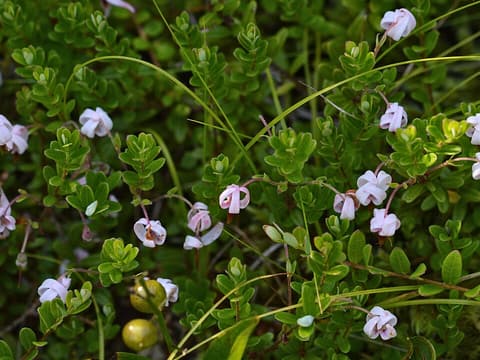
A low evergreen blueberry of Gulf Coast pine flatwoods, with tiny blue-green leaves under a silvery bloom, pink-tinged bells and edible blue berries.
Be first when Darrow's blueberry is priced
Saplings ship bare-root or in a pot, usually 12 to 18 inches tall, in the dormant season, and their height and age are stated here with the price, once available.
We grow it as saplings and seed. One email when it is listed with prices, and nothing else. Or ask, and we reply with what is ready now. Live plants ship October to November.
Limited timeSign up now and get 10% off when it is ready.
Share: copy link
Darrow's Blueberry at a glance
- Type
- Shrub
- Mature height
- 1–5 ft
- USDA zones
- 7–10
- Growth rate
- Medium
- Flowers
- February to April
- Fruit
- Berries, May to June
- First crop
- 3 to 5 years after planting
- Mature spread
- 2 ft
- Sun
- Full, Part
- Soil moisture
- Dry, Average
- Grows wild in
- Sandy barrens and dry uplands
- Native range
- Alabama, Florida, Georgia, Louisiana and Mississippi See what is native in your state
Darrow's blueberry is a low, silvery evergreen blueberry of the Gulf coastal plain. Breeders have crossed it with highbush blueberry and our rabbiteye blueberry to make the southern highbush blueberries. It gave them a low need for winter chill, tolerance of hot, wet summers and resistance to leaf diseases. Most of those crosses go back to a single wild Florida plant, though the species varies widely there. Use it as a low evergreen border or ground cover on sandy, acid soil in sun.
Size, growth and what to expect
No source rates its growth, so our growth estimator treats it as a medium grower, like our creeping blueberry, and gives it 6 inches to a foot a year. It makes a low evergreen shrub 1 to 5 feet tall, most often about 2 feet, with pale, waxy twigs. It spreads by underground runners into open colonies, and one clone can reach about 50 feet across.
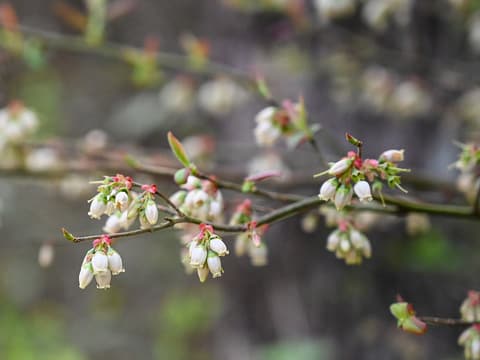
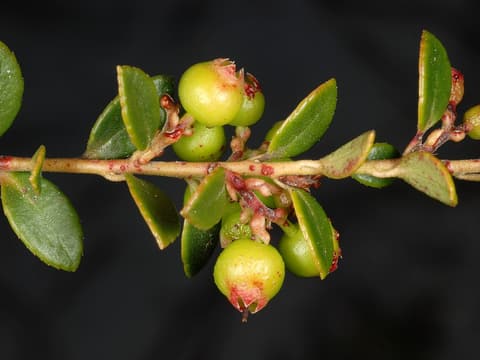
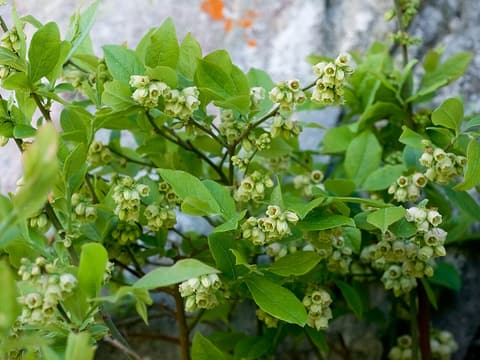
Its leathery leaves are under half an inch long, blue-green under a whitish bloom and sometimes tinged pink or violet, and they stay on for more than a year. Small bells, white tinged with pink, open from late winter into April. The berries ripen in late spring, blue under a waxy bloom and about a third of an inch across. They are edible, and birds and other wildlife eat them.
It grows wild on the coastal plain of Florida, southern Georgia, Alabama, Mississippi and Louisiana, near sea level. Its home is low and scrubby pine flatwoods, oak scrub, palmetto scrub, sand hills and swales.
How to grow Darrow's Blueberry
Darrow's blueberry grows in full sun or part shade. It needs a sandy, acid soil, seasonally moist to dry, that never floods, and it will not take salt spray or salty ground. Set plants 2 feet apart, and keep them 2 feet from a wall. At its size it can go within 15 feet of overhead wires.
Saplings ship bare-root or potted. Plant them in fall or winter, in a hole wider than the roots and no deeper. Set the crown at the soil line, put the native soil back in, and mulch with pine straw or pine bark, clear of the stems. The seed is tiny and needs light to sprout. Keep the dry seed in the refrigerator for 60 to 90 days. Then sow it on the surface of a moist, acid mix, uncovered, in light.
Water weekly through the first summer while the roots take hold, then only in a long drought. It needs no pruning, and the colony can be left to spread.
Darrow's blueberry sets far more fruit with pollen from another plant, and some plants set none with their own, so plant two or more seedlings from different parents. Native bees and honey bees work the flowers.
Heights and zones are typical ranges for the species in cultivation; local conditions and seed source shift them.
Sources (9)
- Flora of North America, vol. 8: Vaccinium darrowii
- Lady Bird Johnson Wildflower Center: Vaccinium darrowii
- Florida Native Plant Society: Vaccinium darrowii
- Kim, Lyrene and others, HortScience 44(6): 1538 (2009), Effects of Self-pollination and Cross-pollination of Vaccinium darrowii (Ericaceae) and Other Low-chill Blueberries
- Journal of the American Society for Horticultural Science 134(2): 273 (2009), Interspecific Crosses and Backcrosses between Diploid Vaccinium darrowii and Tetraploid Southern Highbush Blueberry
- Horticulture Research 8: 245 (2021), High-quality reference genome and annotation aids understanding of berry development for evergreen blueberry (Vaccinium darrowii)
- UF/IFAS Extension Gardening Solutions: Florida's Edible Native Plants
- USDA Forest Service, Woody Plant Seed Manual (2008), Vaccinium chapter
- NatureServe Explorer: Vaccinium darrowii
Plan the planting
Check your site for it What to plant with it How big, how fast How much to water How to sow it How many for a crop When it flowers and fruits When to plant it where you live How far from the house and wires How old is yours
Read before planting
- Ten planting mistakes that quietly kill trees
- Transplanting young trees: timing, water and protection
- Protecting young trees from voles, rabbits, deer and squirrels
- How fast every tree and shrub we grow gets tall: growth rate, A to Z
- The habitat around a tree is part of the tree
- Invasive vines and shrubs are what is killing your woods
We grow 10 other blueberries (Vaccinium): see them all.
Grows in the same conditions
Plants that share its sun and soil
Trees to plant it under: Laurel Oak, Black Hickory and Southern Red Oak.
More like this