Photo: gailhampshire, CC BY 2.0, cropped · Wikimedia Commons
Coral Bean
Erythrina herbacea
Also called Cherokee bean, red cardinal, cardinal-spear, eastern coral bean, Erythrina arborea.
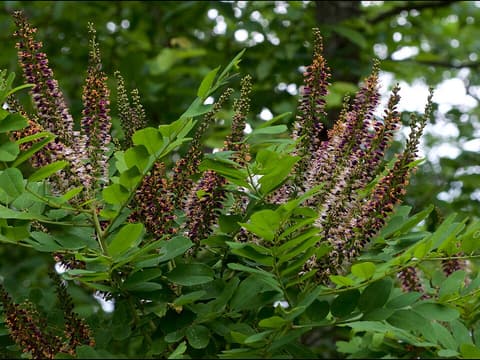
Spikes of scarlet, tubular flowers on bare stems in spring draw hummingbirds, followed by black pods that split to show red seeds.
Be first when coral bean is priced
Saplings ship bare-root or in a pot, usually 12 to 18 inches tall, in the dormant season, and their height and age are stated here with the price, once available.
We grow it as saplings and seed. One email when it is listed with prices, and nothing else. Or ask, and we reply with what is ready now. Live plants ship February to May and October to November.
Limited timeSign up now and get 10% off when it is ready.
Share: copy link
Coral Bean at a glance
- Type
- Shrub
- Mature height
- 3–12 ft
- USDA zones
- 6–10
- Growth rate
- Slow
- Flowers
- April to July
- Fruit
- Pods, July to September
- First crop
- 1 year after planting
- Mature spread
- 6 ft
- Sun
- Full, Part
- Soil moisture
- Dry, Average
- Grows wild in
- Sandy barrens, the coast, dry uplands, old fields and edges
- Native range
- 10 states, north to North Carolina, south to Florida and west to Texas See what is native in your state
List all 10
Alabama, Arkansas, Florida, Georgia, Louisiana, Mississippi, North Carolina, Oklahoma, South Carolina and Texas
Coral bean is a tropical tree that reaches north along the southern coastal plain as a thorny shrub, and at its northern edge as a soft-stemmed perennial. Its scarlet flowers, shaped like slim crescent moons, open on bare stems before the leaves. North Carolina lists it as endangered, and NatureServe ranks it critically imperiled in Arkansas, at the edge of its range. Its split pods, with their bright red seeds, hang on the bare stems through winter. Give it a sunny spot in a hummingbird garden, away from where small children play.
Size, growth and what to expect
Coral bean grows slowly, about a foot a year in our growth estimator. Where winters freeze its stems back, it stays a shrub of 3 to 6 feet. Where frost spares it, it grows to 12 feet or more and can become a small tree of 20 to 25 feet. It spreads 3 to 6 feet. Each leaf has three arrowhead-shaped leaflets, often prickly beneath, and the leaves fall in winter.
Spikes up to a foot long of scarlet, tubular flowers open from April into July, before the leaves. Each flower is 1.5 to 2 inches long, its upper petal wrapped around the others. Black pods up to 8.5 inches long ripen from July to September, then split to show bright red seeds that cling for months. Its dense, thorny stems shelter small birds and animals.
It grows wild on the coastal plain from southeastern North Carolina to Florida and west to Texas. Its home is open, sandy woods and clearings, thickets, hammocks, sandhills, flatwoods and coastal dunes, mostly on dry ground.
How to grow Coral Bean
Coral bean grows in full sun or part shade, in a well-drained sandy, loamy or clay soil. It takes long dry spells and salt spray, but not salt water over its roots. Set plants 6 feet apart and keep them 3 feet from a wall. Keep it back from paths, since the stems carry small thorns. At its size it can go within 15 feet of overhead wires.
Saplings ship bare-root or potted. Plant them dormant, from leaf fall until bud swell, in a hole wider than the roots and no deeper. Set the crown at the soil line, put the native soil back in, and keep the mulch clear of the stems. Wear gloves when you handle the seed, which is poisonous. Scratch or file the hard coat of each seed before you sow it in spring. Store any extra seed sealed and out of children's reach.
Water weekly through the first summer, then only in long droughts. In cold winters the stems die back, and new ones rise from the root in spring. Trim off the dead stem tips once the new growth shows. Wear gloves, since the stems carry spines.
Each flower carries both male and female parts, so there are no male and female plants to pair. Hummingbirds and other long-tongued pollinators visit the flowers. The brittle branches can break in windstorms. The seeds are poisonous if eaten, and children are most at risk.
Heights and zones are typical ranges for the species in cultivation; local conditions and seed source shift them.
Sources (5)
- NC State Extension Gardener Plant Toolbox: Erythrina herbacea
- Lady Bird Johnson Wildflower Center: Erythrina herbacea
- Florida Native Plant Society: Erythrina herbacea
- NatureServe Explorer: Erythrina herbacea
- North Carolina Natural Heritage Program: List of Rare Plant Species of North Carolina 2024, revised 11/03/2025
Plan the planting
Check your site for it What to plant with it How big, how fast How much to water How to sow it How many for a crop When it flowers and fruits When to plant it where you live How far from the house and wires How old is yours
Read before planting
- Ten planting mistakes that quietly kill trees
- Transplanting young trees: timing, water and protection
- Protecting young trees from voles, rabbits, deer and squirrels
- How fast every tree and shrub we grow gets tall: growth rate, A to Z
- The habitat around a tree is part of the tree
- Invasive vines and shrubs are what is killing your woods
Grows in the same conditions
Plants that share its sun and soil
Trees to plant it under: Sassafras, Laurel Oak and Redbay.
More like this