Photo: Ryan Hodnett, CC BY-SA 4.0, cropped · Wikimedia Commons
Large Cranberry
Vaccinium macrocarpon
Also called cranberry, American cranberry, Oxycoccus macrocarpus.
A low evergreen mat of wiry runners, with pink crane-like flowers in early summer and red fall berries, the wild parent of the cultivated cranberry.
Be first when large cranberry is priced
Saplings ship in a pot, usually 12 to 18 inches tall, in the dormant season, and their height and age are stated here with the price, once available.
We grow it as saplings and seed. One email when it is listed with prices, and nothing else. Or ask, and we reply with what is ready now. Live plants ship February to May.
Limited timeSign up now and get 10% off when it is ready.
Share: copy link
Large Cranberry at a glance
- Type
- Shrub
- Mature height
- 1–2 ft
- USDA zones
- 2–7
- Growth rate
- Medium
- Flowers
- May to July
- Fruit
- Berries, September to October
- First crop
- 1 to 2 years after planting
- Mature spread
- 3 ft
- Sun
- Full, Part
- Soil moisture
- Average, Wet
- Grows wild in
- Stream banks, the coast, the Appalachians, swamps and wet flats
- Native range
- 21 states, north and west to Minnesota and south to North Carolina Also recorded, not native, in California, Oregon and Washington. See what is native in your state
List all 21
Connecticut, Delaware, Illinois, Indiana, Maine, Maryland, Massachusetts, Michigan, Minnesota, New Hampshire, New Jersey, New York, North Carolina, Ohio, Pennsylvania, Rhode Island, Tennessee, Vermont, Virginia, West Virginia and Wisconsin
Large cranberry is the wild parent of the cultivated cranberry, a trailing evergreen of northern bogs, fens and wet shores. Its old name, craneberry, comes from the flowers, whose swept-back petals and beak of stamens recall a crane's head. Cranberry farming began by impounding its wild bogs on Cape Cod and in New Jersey. Illinois lists it as endangered, and Indiana, North Carolina and Tennessee list it as threatened. Give it a sunny bed of moist, acid sand and peat, where it knits into an evergreen carpet with berries each fall.
Size, growth and what to expect
It grows at a medium pace for its size, a few inches a year in our growth estimator. It makes a mat under a foot tall, with upright shoots about 2 to 8 inches high, and one plant spreads 2 to 3 feet. The small, glossy leaves are bronze in spring, green in summer and coppery to purple in fall.
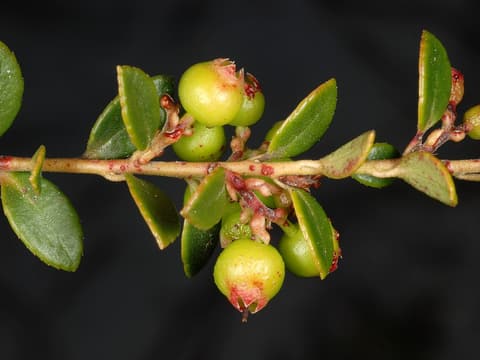
Pink to white flowers nod on slender stalks from May into July, each with four swept-back petals around a beak of stamens. The berries ripen in September and October, red, round and a third to half an inch across, and they can hang on into winter. They make good sauce, jam and muffins. Bees carry the pollen, and birds eat some berries.
It grows wild from Newfoundland and Quebec west to Minnesota, south to Illinois, Indiana, Ohio and Virginia, and in mountain bogs to North Carolina and Tennessee. Its home is bogs, fens, swamps, marshes and wet shores. It needs about three months of cool winter weather and does poorly in heat and drought. It is grown on the Pacific coast too, and it has escaped there.
How to grow Large Cranberry
Large cranberry grows in full sun or light shade, and the more sun it gets, the more it fruits. It needs an acid soil, about pH 4 to 5.5, that stays moist but drains, such as sand, peat or a mix of the two. Alkaline soil or limy water yellows the leaves. Standing water for more than about two weeks starves the roots, though it takes brief flooding. Set plants 2 feet apart and keep them 2 feet from a wall. At its size it can go within 15 feet of overhead wires.
Saplings ship potted. The roots are tender and the plant is hard to move, so plant it from the pot in spring, before hot weather, and keep the root ball whole. Set the crown at the soil line, firm the soil around it, and spread a thin layer of sand between the runners. The seed is small and needs light to sprout. Keep the damp seed in the refrigerator for 60 to 90 days. Then sow it on the surface of a moist, acid mix, uncovered, in light. Much of the seed fails to sprout, and many seedlings make runners but little fruit, so growers start fruiting beds from rooted cuttings.
Water daily for the first week or two, then every few days until the runners take hold, using fresh water, never salty. Mulch the bed with pine boughs over winter where snow is thin, since frozen ground and drying winds can strip the leaves. Every two or three years, spread half an inch of sand over the bed, which encourages upright shoots and keeps weeds down.
Each flower carries both male and female parts, and a lone plant sets fruit with its own pollen. Pollen from another plant brings more seeds and larger berries, so plant two or more from different seed. Rooted plants often flower and set a few berries the year after planting, and more the next. Cranberry fruitworms, weevils and fruit rot are its main troubles, and young growth may need cover on frosty spring nights.
Heights and zones are typical ranges for the species in cultivation; local conditions and seed source shift them.
Sources (12)
- NC State Extension Gardener Plant Toolbox: Vaccinium macrocarpon
- Lady Bird Johnson Wildflower Center: Vaccinium macrocarpon
- Native Plant Trust, Go Botany: Vaccinium macrocarpon
- Flora of North America, vol. 8: Vaccinium macrocarpon
- USDA Forest Service, Woody Plant Seed Manual (2008), Vaccinium chapter, Griffin and Blazich
- UMass Amherst Cranberry Station: Homeowners' Guide to Cranberry Vine Propagation, July 2010
- University of Maine Cooperative Extension, Maine Home Garden News, April 2012: How to Have Your Own Cranberry Garden, Armstrong
- University of Wisconsin-Madison, Department of Horticulture: Botanical Aspects of Pollination, Roper
- Sarracino and Vorsa 1991, Self and cross fertility in cranberry, Euphytica 58: 129-136
- Chicago Botanic Garden Plant Finder: Large Cranberry, Vaccinium macrocarpon
- Kwantlen Polytechnic University Plant Database: Vaccinium macrocarpon
- NatureServe Explorer: Vaccinium macrocarpon
Plan the planting
Check your site for it What to plant with it How big, how fast How much to water How to sow it How many for a crop When it flowers and fruits When to plant it where you live How far from the house and wires How old is yours
Read before planting
- Ten planting mistakes that quietly kill trees
- Transplanting young trees: timing, water and protection
- Protecting young trees from voles, rabbits, deer and squirrels
- How fast every tree and shrub we grow gets tall: growth rate, A to Z
- The habitat around a tree is part of the tree
- Invasive vines and shrubs are what is killing your woods
We grow 10 other blueberries (Vaccinium): see them all.
Grows in the same conditions
Plants that share its sun and soil
Trees to plant it under: Yellow Birch, Atlantic White Cedar and Pond Cypress.
More like this