Photo: Peter Pearsall, U.S. Fish and Wildlife Service, Public domain · Wikimedia Commons
Saskatoon
Amelanchier alnifolia
Also called Saskatoon serviceberry, western serviceberry, Saskatoon berry, alder-leaved serviceberry, western shadbush.
A suckering shrub of the northern Plains and the West, with fragrant white flowers in spring and sweet purple-black berries for pies and jam.
Be first when Saskatoon is priced
Saplings ship bare-root or in a pot, usually 12 to 18 inches tall, in the dormant season, and their height and age are stated here with the price, once available.
We grow it as saplings and seed. One email when it is listed with prices, and nothing else. Or ask, and we reply with what is ready now. Live plants ship February to May and October to November.
Limited timeSign up now and get 10% off when it is ready.
Share: copy link
Saskatoon at a glance
Edible, Showy flowers, Wildlife value, Fall color, Hedge or screen, Winter interest, Erosion control
- Type
- Shrub
- Mature height
- 3–26 ft
- USDA zones
- 2–9
- Growth rate
- Medium
- Flowers
- April to June
- Fruit
- Berries, June to August
- First crop
- 2 to 5 years
- Mature spread
- 10 ft
- Sun
- Full, Part
- Soil moisture
- Dry, Average
- Grows wild in
- Stream banks, dry uplands, rocky ground, old fields and edges
- Native range
- Alaska and 15 other states, north to North Dakota, south to New Mexico, east to Iowa and west to Oregon See what is native in your state
List all 16
Alaska, California, Colorado, Idaho, Iowa, Minnesota, Montana, Nebraska, Nevada, New Mexico, North Dakota, Oregon, South Dakota, Utah, Washington and Wyoming
Saskatoon is the serviceberry of the West and the northern Plains, a shrub that suckers into clumps on stream banks, rocky slopes and the wooded draws of the prairie. Its name is that of the city of Saskatoon, in the heart of its range. Plains peoples dried the berries into pemmican, and selected plants are grown in orchards for their fruit. It usually stays a many-stemmed shrub, where our downy and Allegheny serviceberries grow into small trees. Its smooth gray bark, streaked lengthwise, adds winter interest, and on slopes and banks it holds the soil. Grow it as a fruiting hedge or a clump at a sunny edge, where birds and people can share the summer crop.
Size, growth and what to expect
It grows at a medium pace, about a foot and a half a year in our growth estimator. Most plants make a clump of stems 6 to 10 feet tall and as wide, though some reach 26 feet. It is fairly short-lived, but it sprouts again from the root crown. The oldest of 470 plants aged in western Montana was 85 years old.
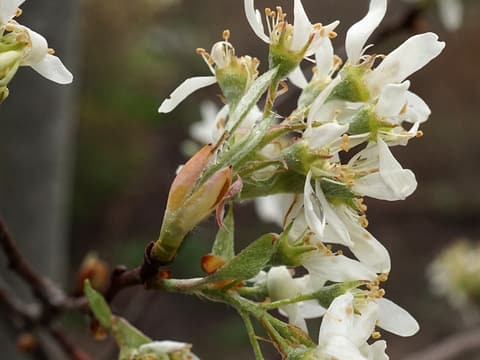
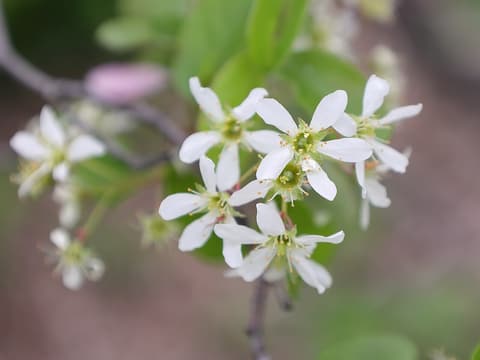
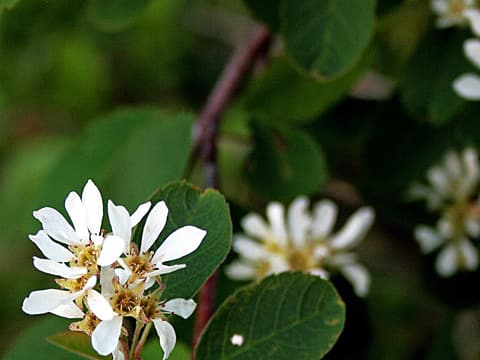
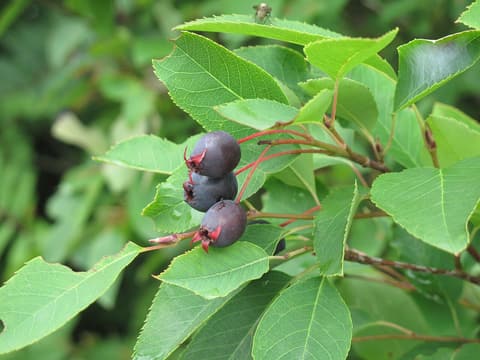
Fragrant white flowers open in short clusters from April into June, just before or as the leaves unfold. The fruit ripens from June into August, purple-black, sweet and a third to half an inch across. It looks and tastes much like a blueberry, and it is eaten fresh or baked into pies, jams and syrup. Bears, game birds, songbirds and small mammals eat the fruit, and deer and elk browse the twigs.
It grows wild from Alaska south to California and New Mexico and east across the northern Plains to Minnesota, Iowa and Ontario. Its home is stream banks, rocky slopes, open woods and thickets. It is a plant of cold winters, and in Kentucky it is not considered winter hardy.
How to grow Saskatoon
Saskatoon wants full sun or light shade and a well-drained soil, sandy, loamy or clay, acid or alkaline. It fruits best in full sun, and it will not take wet ground. Give it an open, airy spot, since leaf spot is worst where the air stays damp. Set plants 6 feet apart, and keep each one 5 feet from a wall. Keep it 15 feet from overhead wires.
Saplings ship bare-root or potted. Plant them dormant, from leaf fall until bud swell, in a hole wider than the roots and no deeper. Set the crown at the soil line, put the native soil back in, and keep the mulch clear of the stems. Clean the seed from the fruit at once, before it ferments. Sow it outdoors in fall a quarter inch deep. For spring, hold it damp in the refrigerator for 90 to 180 days first. Many seeds wait until the second spring to come up. Give the seedlings light shade in their first summer.
Water weekly through the first summer, and in later dry spells while the fruit swells, since the crop needs steady moisture. Deer, elk and hares browse the twigs and bark, so guard young plants with wire for the first two or three winters. It needs little pruning beyond pulling suckers that stray from the clump.
Most plants set fruit with their own pollen, but some cannot, so plant two from different seed for a surer crop. Seedlings can take up to five years to bear, and plants from cuttings or suckers often begin at two to four. Birds take much of the crop, so cover the plants with netting as the berries start to swell. Juniper rust, leaf spot, fire blight and powdery mildew are its usual diseases, and sawfly larvae can bore into the fruit. Keep it away from junipers and red cedars, which carry the rust. The leaves and twigs contain cyanide compounds and can poison livestock that eat large amounts.
Heights and zones are typical ranges for the species in cultivation; local conditions and seed source shift them.
Sources (16)
- USDA Forest Service, Fire Effects Information System: Amelanchier alnifolia, Fryer 1997
- USDA NRCS Plant Guide: Saskatoon, Amelanchier alnifolia, Nesom
- USDA Forest Service, Woody Plant Seed Manual (2008), Amelanchier chapter, Brinkman and Strong
- Flora of North America, vol. 9: Amelanchier alnifolia
- Flora of North America, vol. 9: Amelanchier alnifolia var. alnifolia
- NC State Extension Gardener Plant Toolbox: Amelanchier alnifolia
- The Morton Arboretum: Saskatoon serviceberry, Amelanchier alnifolia
- Missouri Botanical Garden Plant Finder: Amelanchier alnifolia
- Lady Bird Johnson Wildflower Center: Amelanchier alnifolia
- Trees and Shrubs Online: Amelanchier alnifolia, from Bean
- NDSU Extension, North Dakota Tree Selector F2167: Juneberry (Saskatoon or Serviceberry), Zeleznik
- NDSU Carrington Research Extension Center: Juneberries, Amelanchier alnifolia
- University of Wisconsin-Madison, Center for Integrated Agricultural Systems, Uncommon Fruit: Saskatoon
- University of Kentucky Cooperative Extension, CCD-CP-11: Juneberries, Ernst and Kaiser, 2017
- Robinson 1982, Experimental taxonomy in the genus Amelanchier. II: Do the taxa in the genus Amelanchier form an agamic complex?, Rhodora 84, from page 85
- NatureServe Explorer: Amelanchier alnifolia
Plan the planting
Check your site for it What to plant with it How big, how fast How much to water How to sow it How many for a crop When it flowers and fruits When to plant it where you live How far from the house and wires How old is yours
Read before planting
- Ten planting mistakes that quietly kill trees
- Transplanting young trees: timing, water and protection
- Protecting young trees from voles, rabbits, deer and squirrels
- How fast every tree and shrub we grow gets tall: growth rate, A to Z
- The habitat around a tree is part of the tree
- Invasive vines and shrubs are what is killing your woods
We grow 7 other serviceberries (Amelanchier): see them all.
Grows in the same conditions
Plants that share its sun and soil
Trees to plant it under: Common Hackberry, Western Soapberry and Rock Elm.
More like this