Photo: Citrula, CC BY-SA 4.0, cropped · Wikimedia Commons
Plateau Live Oak
Scientific name: Quercus fusiformis · Family: Fagaceae (beech family)
Also called Texas live oak, escarpment live oak, plateau oak, Hill Country live oak, Quercus virginiana var. fusiformis.
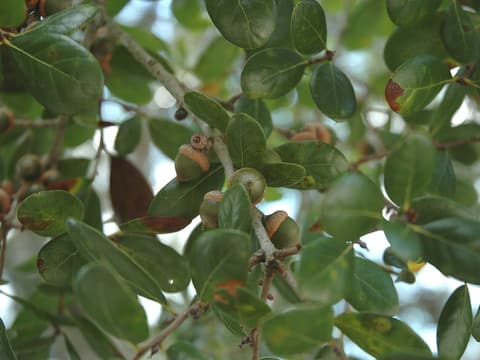
The common live oak of central Texas, green through the winter, with gnarled limbs that spread a great distance from a short trunk.
Be first when plateau live oak is priced
Saplings ship bare-root or in a pot, usually 12 to 18 inches tall, in the dormant season, and their height and age are stated here with the price, once available.
We grow it as saplings and acorns. One email when it is listed with prices, and nothing else. Or ask, and we reply with what is ready now. Live plants ship February to May and October to November.
Limited timeSign up now and get 10% off when it is ready.
Share: copy link
Plateau Live Oak at a glance
- Type
- Small tree
- Mature height
- 20–40 ft
- USDA zones
- 5–10
- Growth rate
- Medium
- Flowers
- March to May
- Fruit
- Acorns, September to October
- First crop
- 20 to 30 years
- Mature spread
- 40 ft
- Sun
- Full, Part
- Soil moisture
- Dry, Average
- Grows wild in
- Dry uplands and rocky ground
- Native range
- Oklahoma and Texas See what is native in your state
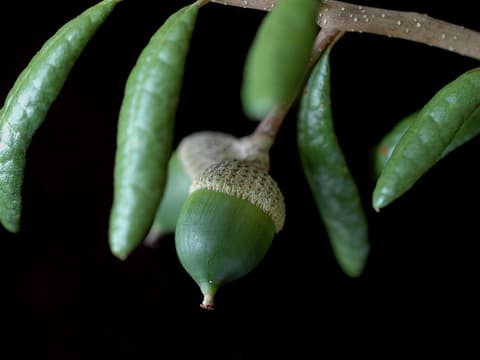
Plateau live oak grows wild in southern Oklahoma, in Texas between the Brazos and Pecos rivers, and in the mountains of northeastern Mexico. It is so close to southern live oak that some botanists count it a variety of that tree, but its acorns are spindle-shaped and it stands more drought and cold. Trees from southern Oklahoma are the hardiest, surviving cold as low as 20 degrees below zero Fahrenheit. NatureServe ranks it critically imperiled in Oklahoma. On the Edwards Plateau it forms copses of small trees joined by underground stems, known as shinneries. Plant it as an evergreen shade tree where southern live oak is too tender or the soil too alkaline.
Size, growth and what to expect
Live oaks grow fast when well watered on good soil, but this one grows wild on dry, rocky ground. Our growth estimator gives it the medium rate, about a foot and a half a year. Expect 20 to 40 feet. Kimble County, Texas, held its first court in 1876 under a large live oak, and the Texas A&M Forest Service listed the Kimble Court Oaks as still standing in 2025. By that history, not by a ring count, the tree is at least 149 years old. The oldest of the live oaks cut and ring-counted for a study in Hays County, Texas, was 130 years old. Only a tiny share of trees is ever dated this way, so older ones may exist.
It flowers from March to May, and as in every white oak the acorns ripen the same year, in September and October. They are narrow and dark brown with lighter stripes, five eighths of an inch to an inch long. Live oaks bear a crop every year, often in great abundance. Birds and mammals eat the acorns, and hairstreak and Horace's duskywing caterpillars eat the leaves.
It grows wild on savannas, rocky hills and uplands of limestone or limy loam. The old leaves hang on until late February or March and fall as the new ones open, so it looks evergreen. The largest known grows in Real County, Texas.
How to grow Plateau Live Oak
Plateau live oak wants full sun or part shade and a well-drained soil, dry to average in moisture. It grows in rocky, sandy, clay or loam soils, usually limy, even caliche. Once rooted it tolerates drought well. Set trees 30 feet apart, and keep each one 20 feet from a wall and 15 feet or more from overhead wires.
Saplings ship bare-root or potted. Plant them in the cool months, from late fall to early spring, in a hole wider than the roots and no deeper. Set the root flare at the soil line, put the native soil back in, and keep the mulch clear of the trunk. Plateau live oak acorns sprout soon after they fall and need no winter chill. Sow them on arrival, an inch deep, under hardware cloth.
Water it every day for the first two weeks after planting, then every two to three days until week 12. After that, water weekly through the first summer, then only in a long drought. Deer browse the young sprouts, so guard each sapling with a tube or cage for its first three years. The young bark is thin and easily killed by fire, so keep flames and string trimmers away from the trunk.
The flowers are wind pollinated, and an acorn crop wants another oak nearby. Oak wilt is a serious threat to this tree, above all when drought has stressed it. Live oaks grow from root sprouts into vast, joined root systems, so the fungus passes between neighboring trees, on average 75 feet a year. Prune only in the dormant season, never from February through June, and paint each cut at once. Do not bring in firewood from oaks killed by wilt, since the fungus lives on in dead wood for up to a year.
Heights and zones are typical ranges for the species in cultivation; local conditions and seed source shift them.
Sources (16)
- Flora of North America, vol. 3: Quercus fusiformis
- Lady Bird Johnson Wildflower Center: Quercus fusiformis
- USDA Forest Service, Field Guide to Native Oak Species of Eastern North America, FHTET-03-01, Stein, Binion and Acciavatti 2003
- Trees and Shrubs Online, International Dendrology Society: Quercus fusiformis
- USDA Forest Service, Silvics of North America: Live Oak, Quercus virginiana
- USDA Fire Effects Information System: Quercus virginiana, southern live oak, Carey 1992
- Texas A&M Forest Service: Texas Oak Wilt
- Texas A&M Forest Service: Pruning Mature Trees
- Texas A&M Forest Service, Texas Tree Selector: Live Oak (Encino), Quercus virginiana
- NatureServe Explorer: Quercus fusiformis
- Oklahoma Natural Heritage Inventory, Oklahoma Biodiversity Information System tracking list
- The Morton Arboretum and Botanic Gardens Conservation International, The Red List of Oaks 2020, Carrero and others (PDF)
- USDA Forest Service, Woody Plant Seed Manual (2008), Quercus chapter, Bonner (PDF)
- USDA PLANTS: Quercus fusiformis, QUFU
- Texas A&M Forest Service, Famous Trees of Texas: Kimble Court Oaks
- Texas A&M University: Kamps 2014, Carbon and Water Cycling in a Texas Hill Country Woodland, Ph.D. dissertation
Plan the planting
Check your site for it What to plant with it How big, how fast How much to water How to sow it How many for a crop When it flowers and fruits When to plant it where you live How far from the house and wires How old is yours Moving one you already have
Read before planting
- Ten planting mistakes that quietly kill trees
- Transplanting young trees: timing, water and protection
- Protecting young trees from voles, rabbits, deer, squirrels and beavers
- Red oaks and white oaks, and where each belongs
More about plateau live oak
We grow 42 other oaks (Quercus): see them all.
Grows in the same conditions
Plants that share its sun and soil
Trees to plant it under: Mockernut Hickory, Pignut Hickory and Black Oak.
More like this