Photo: Bruce Kirchoff, CC BY 2.0, cropped · Wikimedia Commons
Sand Live Oak
Quercus geminata
Also called sandhills live oak, Quercus virginiana var. geminata.
A smaller, tougher cousin of live oak for deep, dry sand, evergreen and wind-firm, with acorns that often hang in pairs.
Be first when sand live oak is priced
Saplings ship bare-root or in a pot, usually 12 to 18 inches tall, in the dormant season, and their height and age are stated here with the price, once available.
We grow it as saplings and acorns. One email when it is listed with prices, and nothing else. Or ask, and we reply with what is ready now. Live plants ship February to May and October to November.
Limited timeSign up now and get 10% off when it is ready.
Share: copy link
Sand Live Oak at a glance
- Type
- Small tree
- Mature height
- 20–50 ft
- USDA zones
- 7–10
- Growth rate
- Slow
- Flowers
- March to May
- Fruit
- Acorns, August to October
- First crop
- 20 to 30 years
- Mature spread
- 50 ft
- Sun
- Full, Part
- Soil moisture
- Dry, Average
- Grows wild in
- Sandy barrens, the coast and dry uplands
- Native range
- 7 states, north to North Carolina, south to Florida and west to Louisiana See what is native in your state
List all 7
Alabama, Florida, Georgia, Louisiana, Mississippi, North Carolina and South Carolina
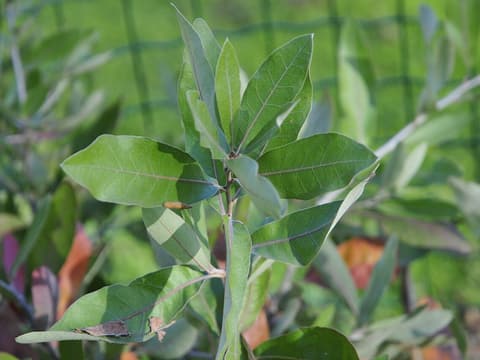
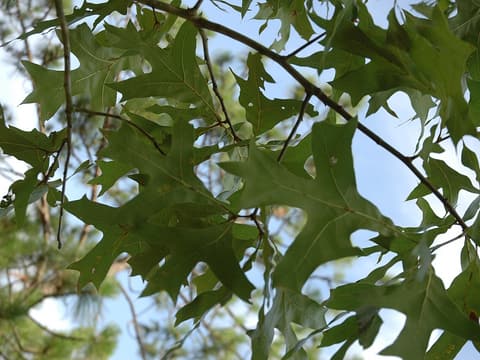
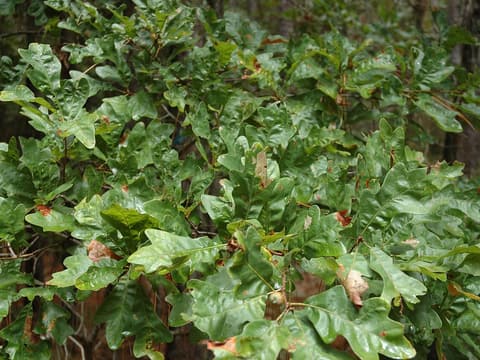
Sand live oak is the live oak of deep, dry sand on the southeastern Coastal Plain, in scrub, sandhills, dunes and pine flatwoods. It is smaller and slower than live oak, and its thick leaves have veins pressed deep into the upper side and edges curled under. Its name, geminata, means twins, for the acorns that often come in pairs. Where fires sweep the scrub it stays a low thicket, since most of its weight lies in its roots and it regrows from them. It can form colonies that help hold a bank or slope. Grow it as a small evergreen shade tree on hot, dry sand, or let it spread into a thicket where nothing else will grow.
Size, growth and what to expect
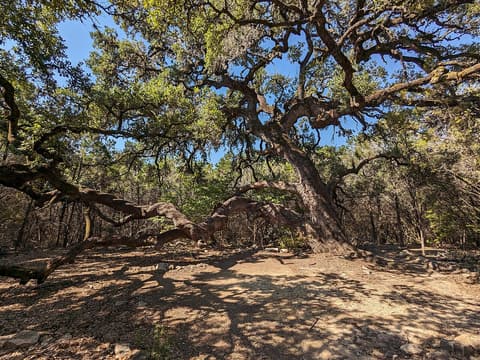
Sand live oak grows slowly, about a foot a year in our growth estimator. Expect a tree of 20 to 50 feet with a broad, spreading crown, though it stays a shrubby thicket where fires are frequent. Old trees can reach 95 feet, and the two largest known stand in Gainesville, Florida.
Small catkins open from March to May, later than those of live oak. The acorns ripen the same year, from August to October, in ones, twos and threes on stalks up to 4 inches long. Each is 5/8 to 1 inch long and dark brown, a third sunk in a scaly gray cup. Florida scrub-jays, wild turkeys, woodpeckers, squirrels and deer eat them, and the leaves feed hairstreak and duskywing caterpillars.
It grows wild on the Coastal Plain from North Carolina south through most of peninsular Florida and west along the Gulf to Louisiana. Look for it on deep sand in scrub, sandhills, coastal dunes, flatwoods and coastal hammocks, often under pines. NatureServe ranks it vulnerable in North Carolina, at the north end of its range.
How to grow Sand Live Oak
Sand live oak wants full sun or light shade and deep, sharply drained sand, acid or neutral. Once rooted it stands long droughts and strong wind. It takes salty wind, but not direct salt spray or flooding with salt or brackish water. Its leaves and acorns are rich in tannin and can stain concrete, so keep it back from patios and drives. Plant it 25 feet from a wall and more than 50 feet from overhead wires, and set trees 20 feet apart.
Saplings ship bare-root or potted. Plant them from late fall to early spring, in a hole wider than the roots and no deeper. Set the root flare at the soil line, put the sand back in, and keep the mulch clear of the trunk. Sand live oak acorns sprout soon after they fall and need no winter chill, as live oak acorns do. Sow them on arrival, an inch deep, under hardware cloth.
Water every week or two through the first summer, then only in a long drought. Deer browse young oaks, so guard each sapling with a tube or cage for its first two years. Some plants stay shrubby and sucker into thickets, so pull the suckers if you want a single trunk.
The flowers are wind pollinated, and an acorn crop wants another oak nearby. Sand live oak belongs to the white oak group, so its acorns ripen in one season. It flowers later in spring than live oak, so the two seldom cross even where they grow together. Acorns come every year.
Heights and zones are typical ranges for the species in cultivation; local conditions and seed source shift them.
Sources (9)
- Flora of North America, vol. 3: Quercus geminata
- NC State Extension Gardener Plant Toolbox: Quercus geminata
- Lady Bird Johnson Wildflower Center: Quercus geminata
- Florida Native Plant Society Plant Database: Quercus geminata
- UF/IFAS Extension, FOR 249: Quercus geminata, Sand Live Oak
- UF/IFAS Florida 4-H Forest Ecology: Sand Live Oak
- Trees and Shrubs Online, International Dendrology Society: Quercus geminata
- USDA Forest Service, Woody Plant Seed Manual (2008), Quercus chapter
- NatureServe Explorer: Quercus geminata
Plan the planting
Check your site for it What to plant with it How big, how fast How much to water How to sow it How many for a crop When it flowers and fruits When to plant it where you live How far from the house and wires How old is yours Moving one you already have
Read before planting
- Ten planting mistakes that quietly kill trees
- Transplanting young trees: timing, water and protection
- Protecting young trees from voles, rabbits, deer and squirrels
- How fast every tree and shrub we grow gets tall: growth rate, A to Z
- Red oaks and white oaks, and where each belongs
- When oaks leaf out, and why two of them never agree
We grow 42 other oaks (Quercus): see them all.
Grows in the same conditions
Plants that share its sun and soil
Trees to plant it under: Live Oak, Southern Red Oak and Mockernut Hickory.
More like this