Photo: Eric Hunt, CC BY-SA 4.0, cropped · Wikimedia Commons
Roseshell Azalea
Rhododendron prinophyllum
Also called early azalea, rose-shell azalea, woolly azalea, mayflower azalea, Rhododendron roseum, Azalea prinophylla.
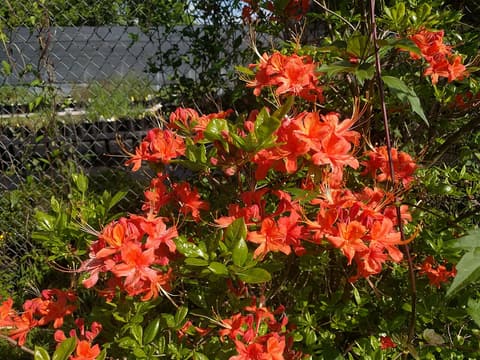
Bright pink, clove-scented flower clusters in spring on a wild azalea hardy enough to grow from southern Quebec to the Ozarks.
Be first when roseshell azalea is priced
Saplings ship in a pot, usually 12 to 18 inches tall, in the dormant season, and their height and age are stated here with the price, once available.
We grow it as saplings and seed. One email when it is listed with prices, and nothing else. Or ask, and we reply with what is ready now. Live plants ship February to May and October to November.
Limited timeSign up now and get 10% off when it is ready.
Share: copy link
Roseshell Azalea at a glance
- Type
- Shrub
- Mature height
- 3–10 ft
- USDA zones
- 3–8
- Growth rate
- Slow
- Flowers
- April to June
- Fruit
- Capsules, August to October
- First crop
- About 3 years
- Mature spread
- 8 ft
- Sun
- Full, Part, Shade
- Soil moisture
- Average
- Grows wild in
- The forest understory, rich moist slopes, stream banks, rocky ground and the Appalachians
- Native range
- 23 states, north to Maine and south and west to Texas See what is native in your state
List all 23
Alabama, Arkansas, Connecticut, Georgia, Illinois, Kentucky, Maine, Maryland, Massachusetts, Missouri, New Hampshire, New Jersey, New York, North Carolina, Ohio, Oklahoma, Pennsylvania, Rhode Island, Tennessee, Texas, Vermont, Virginia and West Virginia
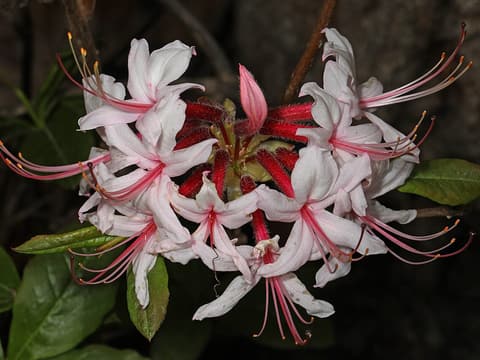
Roseshell azalea is a deciduous wild azalea of unusual hardiness, the only pink, fragrant azalea native throughout New England. It looks much like our pinxterbloom azalea, but its flowers are usually a brighter pink with a stronger, spicy scent, and its flower stalks carry glandular hairs. It is a parent of the cold-hardy Northern Lights hybrids. North Carolina lists it as threatened. Plant it at a woodland edge or in a shrub border, where its fragrance carries on a spring day.
Size, growth and what to expect
No source rates its growth, so our growth estimator treats it as slow, like our pinxterbloom azalea, about a foot a year. It makes an upright, rounded shrub 3 to 10 feet tall and 4 to 8 feet wide, and now and then 15 feet. Its bright green leaves are grayish and woolly beneath and turn bronze to purplish in fall.
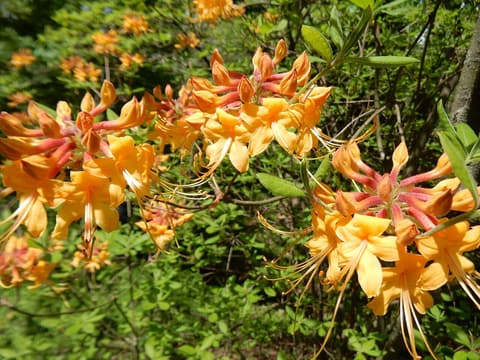
Clusters of 4 to 13 bright pink flowers open from April into June, before or with the new leaves. Each funnel is about 1.5 inches long, with five long stamens, and the scent is spicy, like cloves. Bumble bees find the flowers especially valuable. The slender capsules ripen from August to October.
It grows wild from southern Quebec and New England through the Appalachians to North Carolina, with stands in Georgia and Alabama. A second, separate range runs from southern Illinois and Missouri to Oklahoma and eastern Texas. Its home is acid thickets and bogs, swampy to dry rocky woods, bluffs, ravines and stream banks.
How to grow Roseshell Azalea
Roseshell azalea does best in dappled or part shade, sheltered from the afternoon sun that can scorch its leaves. It also takes full sun or shade. It wants a moist, rich soil that drains well, and it takes soil closer to neutral than most azaleas. It will not stand dense clay or ground where water stands. Set plants 6 feet apart and keep them 4 feet from a wall. At its size it can go within 15 feet of overhead wires.
Saplings ship potted. Plant dormant plants in early spring or fall, in a hole three times as wide as the root ball and no deeper. Set the top of the ball a little above grade, since the roots rot where water stands, and put the native soil back in. Mulch with oak leaves, bark or pine needles, kept off the stems. The seed is dust-fine and needs light but no chilling. Sow it in winter on the surface of damp milled sphagnum, uncovered, at room temperature under a clear cover. Seedlings come up in one to three weeks.
Water weekly through the first two summers, and never let the shallow roots dry out. Deer damage it often, so cage it where deer are common, though rabbits mostly leave it alone. Prune, if at all, right after it flowers.
Each flower carries both male and female parts, and bees, butterflies and hummingbirds visit the flowers. Sources disagree on whether a native azalea sets seed with its own pollen, so plant two seedlings from different parents for seed. Aphids, lace bugs and mites can mark the leaves, and root rot takes plants in wet, heavy soil. Every part of the plant is poisonous if eaten.
Heights and zones are typical ranges for the species in cultivation; local conditions and seed source shift them.
Sources (11)
- NC State Extension Gardener Plant Toolbox: Rhododendron prinophyllum
- Missouri Botanical Garden Plant Finder: Rhododendron prinophyllum
- Lady Bird Johnson Wildflower Center: Rhododendron prinophyllum
- Flora of North America, vol. 8: Rhododendron prinophyllum
- Native Plant Trust Garden Plant Finder: Rhododendron prinophyllum
- Go Botany, Native Plant Trust: Rhododendron prinophyllum
- USDA Forest Service, Woody Plant Seed Manual (2008), Rhododendron chapter, Blazich and Rowe
- NatureServe Explorer: Rhododendron prinophyllum
- North Carolina Natural Heritage Program: List of Rare Plant Species of North Carolina 2024, revised 11/03/2025
- Perkins and Perkins 2010, Rules of engagement: have pollen, will travel, The Azalean 32(2): 28-33
- Rouse, Knox and Williams 1993, Inter- and intraspecific pollinations involving Rhododendron species, Journal American Rhododendron Society 47(1)
Plan the planting
Check your site for it What to plant with it How big, how fast How much to water How to sow it How many for a crop When it flowers and fruits When to plant it where you live How far from the house and wires How old is yours
Read before planting
- Ten planting mistakes that quietly kill trees
- Transplanting young trees: timing, water and protection
- Protecting young trees from voles, rabbits, deer and squirrels
- How fast every tree and shrub we grow gets tall: growth rate, A to Z
- The habitat around a tree is part of the tree
- Invasive vines and shrubs are what is killing your woods
We grow 21 other rhododendrons and azaleas (Rhododendron): see them all.
Grows in the same conditions
Plants that share its sun and soil
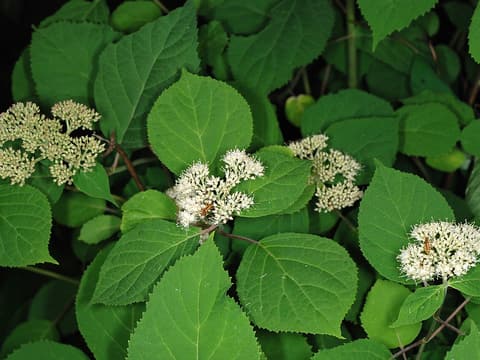
Trees to plant it under: Eastern Hemlock, Florida Maple and Sweet Birch (Black Birch).
More like this