Photo: Julie Dewilde, CC BY-SA 2.0, cropped · Wikimedia Commons
Sheep Laurel
Kalmia angustifolia
Also called lambkill, sheepkill, calfkill, dwarf laurel, Chamaedaphne angustifolia.
A low evergreen shrub of northern bogs and barrens, with rose-pink flowers ringing the stems in early summer. Every part is poisonous to livestock.
Be first when sheep laurel is priced
Saplings ship bare-root or in a pot, usually 12 to 18 inches tall, in the dormant season, and their height and age are stated here with the price, once available.
We grow it as saplings and seed. One email when it is listed with prices, and nothing else. Or ask, and we reply with what is ready now. Live plants ship February to May and October to November.
Limited timeSign up now and get 10% off when it is ready.
Share: copy link
Sheep Laurel at a glance
- Type
- Shrub
- Mature height
- 1–5 ft
- USDA zones
- 2–8
- Growth rate
- Slow
- Flowers
- June to July
- Fruit
- Capsules, July to October
- First crop
- About 3 years
- Mature spread
- 6 ft
- Sun
- Full, Part
- Soil moisture
- Dry, Average, Wet
- Grows wild in
- Dry uplands, the forest understory, swamps and wet flats, old fields and edges
- Native range
- 15 states and the District of Columbia, north to Maine, south to North Carolina and west to Michigan See what is native in your state
List all 16
Connecticut, Delaware, Maine, Maryland, Massachusetts, Michigan, New Hampshire, New Jersey, New York, North Carolina, Pennsylvania, Rhode Island, Vermont, Virginia, West Virginia and the District of Columbia
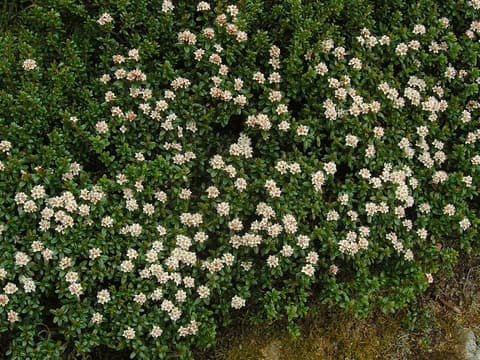
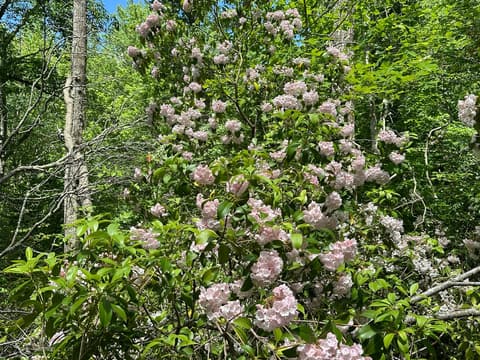
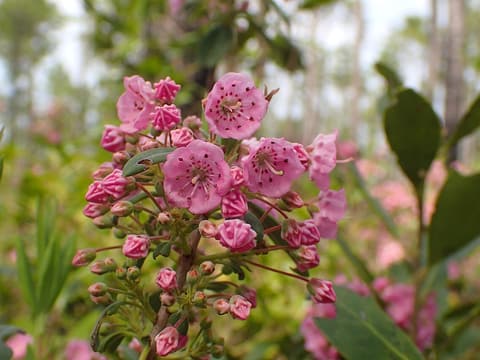
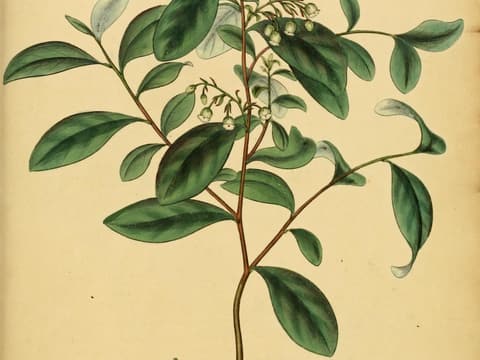
Sheep laurel is a low evergreen shrub of the Northeast, from bogs and wet pastures to dry, rocky barrens and pine woods. Its leaves come in whorls of three, and its rose-pink flowers circle the stem below the new shoots in early summer. Its southern form, our Carolina bog laurel, is now often treated as a separate species. It is poisonous to livestock, which gave it the names lambkill and sheepkill. North Carolina lists it as threatened. Let it colonize a sunny, acid bank or the edge of a bog garden.
Size, growth and what to expect
Sheep laurel grows slowly, 6 inches to a foot a year in our growth estimator. It makes a low, branching shrub 1 to 5 feet tall and up to 6 feet wide. A dense mat of rhizomes lets it spread into wide colonies, called heaths, on open ground.
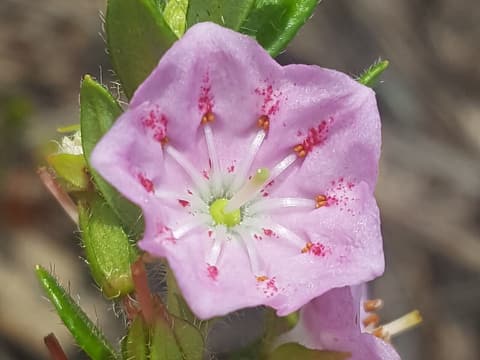
Clusters of small, saucer-shaped, rose-pink flowers open from June into early July, ringed around the stem below the new leaves. The small capsules ripen from late July to mid-September and shed their seed in early October, and the empty capsules hang on for years. Grouse eat the leaves, and it feeds the caterpillars of the brown elfin and northern blue butterflies and the Columbia silkmoth.
It grows wild from Newfoundland and Labrador west to Ontario and Michigan. It is most common in northern New England, the Maritime Provinces and along the St. Lawrence. It reaches south to Virginia and West Virginia, with a few stands in North Carolina.
How to grow Sheep Laurel
Sheep laurel grows in full sun or part shade, and in deep shade it grows thin and blooms sparsely. It wants a cool, moist, acid soil, peaty or sandy, and it takes ground that is wet in spring and dry in summer. Limy soil yellows its leaves, and windswept spots burn them. Set plants 4 feet apart and keep them 3 feet from a wall. At its size it can go within 15 feet of overhead wires.
Saplings ship bare-root or potted. Plant them in spring or fall, in a hole wider than the roots and no deeper, and put the native soil back in. The seed is dust-fine and needs no chilling. Sow it on the surface of moist peat at room temperature, uncovered, in good light, which the seed of its relative mountain laurel needs.
Water weekly through the first two summers. Next year's flowers form on this year's growth, so prune, if at all, right after bloom. Removing the spent flower heads gives better bloom the next year.
Each flower carries both male and female parts. A single sheep laurel sets seed with its own pollen, though seedlings from two different parents grow more strongly. Lace bugs and leaf spot can trouble it, and leaf spot is worst in moist, heavy shade. Every part of the plant is highly poisonous if eaten, and it has poisoned sheep, cattle, goats and horses that browse it in winter.
Heights and zones are typical ranges for the species in cultivation; local conditions and seed source shift them.
Sources (12)
- USDA Forest Service, Fire Effects Information System: Kalmia angustifolia, Van Deelen 1991
- NC State Extension Gardener Plant Toolbox: Kalmia angustifolia
- Lady Bird Johnson Wildflower Center: Kalmia angustifolia
- Flora of North America, vol. 8: Kalmia angustifolia
- USDA Forest Service, Woody Plant Seed Manual: Kalmia chapter, Blazich and Starrett
- Native Plant Network: Kalmia angustifolia protocol, after Baskin and Baskin (1998) and Jaynes (1971)
- University of Connecticut Plant Database: Kalmia angustifolia
- Go Botany, Native Plant Trust: Kalmia angustifolia
- Trees and Shrubs Online: Kalmia angustifolia
- Michigan Flora: Kalmia angustifolia
- NatureServe Explorer: Kalmia angustifolia
- State lists: North Carolina 2024
Plan the planting
Check your site for it What to plant with it How big, how fast How much to water How to sow it How many for a crop When it flowers and fruits When to plant it where you live How far from the house and wires How old is yours
Read before planting
- Ten planting mistakes that quietly kill trees
- Transplanting young trees: timing, water and protection
- Protecting young trees from voles, rabbits, deer and squirrels
- How fast every tree and shrub we grow gets tall: growth rate, A to Z
- The habitat around a tree is part of the tree
- Invasive vines and shrubs are what is killing your woods
Other laurels (Kalmia) we grow: Carolina Bog Laurel, Hairy Laurel, Mountain Laurel, Sand Myrtle and White Wicky.
Grows in the same conditions
Plants that share its sun and soil
Trees to plant it under: Black Gum (Tupelo), American Elm and Slippery Elm.
More like this