Photo: Blue Whale Trees
Mountain Laurel
Scientific name: Kalmia latifolia
Also called calico bush, spoonwood.
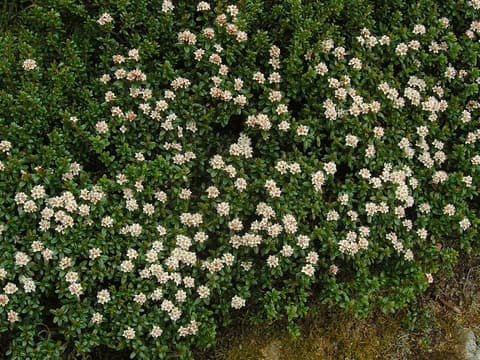
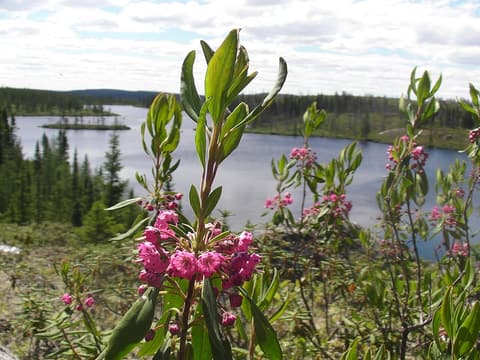
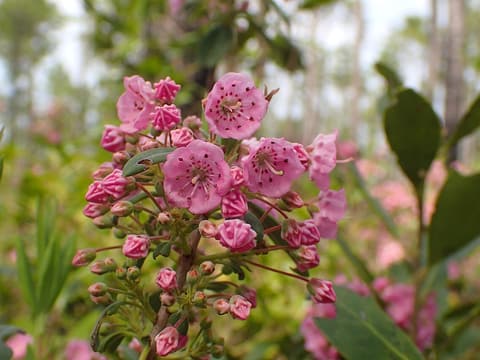
Native evergreen with clusters of origami-like pink and white flowers in June and twisted, sculptural trunks.
Be first when mountain laurel is priced
Saplings ship in a pot, usually 12 to 18 inches tall, in the dormant season, and their height and age are stated here with the price, once available.
We grow it as saplings and seed. One email when it is listed with prices, and nothing else. Or ask, and we reply with what is ready now. Live plants ship February to May and October to November.
Limited timeSign up now and get 10% off when it is ready.
Share: copy link
Mountain Laurel at a glance
- Type
- Shrub
- Mature height
- 5–12 ft
- USDA zones
- 4–9
- Growth rate
- Slow
- Flowers
- April to June
- Fruit
- Capsules, September to October
- First crop
- 4 to 8 years (first flowers)
- Mature spread
- 8 ft
- Sun
- Full, Part, Shade
- Soil moisture
- Average
- Grows wild in
- Dry uplands, the Appalachians, the forest understory and rocky ground
- Native range
- 24 states and the District of Columbia, north to Maine, south to Florida and west to Louisiana See what is native in your state
List all 25
Alabama, Connecticut, Delaware, Florida, Georgia, Indiana, Kentucky, Louisiana, Maine, Maryland, Massachusetts, Mississippi, New Hampshire, New Jersey, New York, North Carolina, Ohio, Pennsylvania, Rhode Island, South Carolina, Tennessee, Vermont, Virginia, West Virginia and the District of Columbia
Mountain laurel grows under oaks on acid, rocky, well-drained soil from Maine to Florida. Its June bloom is one of the sights of the eastern woods, and its glossy evergreen leaves give winter structure. It fails in clay, wet soil and lime. Seed-grown plants are tougher than the cultivars. All parts are toxic, and honey made from it is too, so do not site it near hives. Plant it as an evergreen screen under pines or oaks, on an acid slope that drains.
Size, growth and what to expect
Mountain laurel is slow. Young plants under 15 years add about 5 inches of height and 3½ inches of crown width a year. Our growth estimator likewise files it in the slow class. Most mature plants stand 6 to 10 feet tall and 4 to 8 feet wide as a dense, rounded shrub, though on Appalachian slopes it occasionally becomes a small tree over 30 feet. The oldest stem dated by its rings was at least 65 years old.
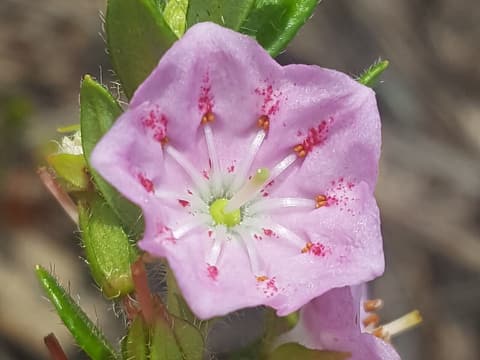
The flowers open from late April into June, from buds formed the previous summer. Each cup is about an inch across, white to rose with purple-red markings inside, and bumblebees are its main pollinators. The capsules that follow are tiny, about 3/16 of an inch, yet each holds 300 to 700 seeds. Every part of the plant is poisonous to people and livestock.
It grows wild from southeast Maine to the Florida panhandle and west to Louisiana, in the mountains, the Piedmont and the coastal plain, often on rocky or sandy acid slopes.
How to grow Mountain Laurel
Mountain laurel takes part shade, deep shade or full sun, though the sunnier the spot the more steady moisture it needs. Give it average, sharply drained ground, and where the soil is heavy plant on a low mound. It fills a corner at full size, so set plants 5 feet apart and 4 feet off a path.
Plant while dormant. Saplings arrive potted with a dense, shallow root mass, so loosen the outer roots, dig wide and shallow, and keep the top of the ball slightly proud of grade. Backfill with native soil and mulch with leaf litter or pine straw, thinner near the stems. No stake is called for. Seed is dust-fine and needs light. Keep it damp in the refrigerator for eight weeks, then sow it on the surface of moist peat mix, uncovered, at room temperature under lights and a clear cover. Seedlings come up within a few weeks.
The roots sit near the surface, so water through the first two summers whenever the top inch dries, and never let the mulch disappear. Deer usually pass it by, but a hard winter changes their minds, so cage young plants. Snapping off spent flower clusters improves next year's bloom.
Mountain laurel sets some seed with its own pollen, but less than when bees bring pollen from another plant, so plant two or more if you want seed. Lace bugs stipple the leaves in hot full sun, and leaf spot follows still, damp shade, so a half-shaded, airy site dodges both. Every part of mountain laurel is poisonous, so keep prunings away from goats, sheep and other stock.
Heights and zones are typical ranges for the species in cultivation; local conditions and seed source shift them.
Sources (14)
- USDA Fire Effects Information System, Kalmia latifolia
- NC State Extension Gardener Plant Toolbox, Kalmia latifolia
- Lady Bird Johnson Wildflower Center, Kalmia latifolia
- USDA NRCS PLANTS Database: Kalmia latifolia
- USDA Forest Service, Woody Plant Seed Manual (2008), Kalmia chapter
- Clemson Cooperative Extension HGIC: Laurel, factsheet HGIC 1069
- Flora of North America, vol. 8: Kalmia latifolia
- Virginia Tech Dendrology: mountain laurel, Kalmia latifolia
- Go Botany, Native Plant Trust: Kalmia latifolia
- UConn Plant Database: Kalmia latifolia
- Jansen, Kleerekooper, Hofman, Kappen, Stary-Weinzinger and van der Heyden 2012, Grayanotoxin Poisoning: 'Mad Honey Disease' and Beyond, Cardiovascular Toxicology 12(3): 208
- Jaynes 1997, Kalmia: Mountain Laurel and Related Species, Timber Press
- Jaynes 1975, The Laurel Book: Rediscovery of the North American Laurels, Hafner Press
- Forest Ecology and Management: Brose 2016, Forest Ecology and Management 374:33-41
Plan the planting
Check your site for it What to plant with it How big, how fast How much to water How to sow it How many for a crop When it flowers and fruits When to plant it where you live How far from the house and wires How old is yours
Read before planting
- Ten planting mistakes that quietly kill trees
- Transplanting young trees: timing, water and protection
- Protecting young trees from voles, rabbits, deer and squirrels
- Native replacements for burning bush, barberry, privet, Bradford pear, boxwood, butterfly bush and forsythia
- Native shrubs and trees deer usually leave alone, and why the lists disagree
- The habitat around a tree is part of the tree
Other laurels (Kalmia) we grow: Carolina Bog Laurel, Hairy Laurel, Sand Myrtle, Sheep Laurel and White Wicky.
Grows in the same conditions
Plants that share its sun and soil
Trees to plant it under: Hop Hornbeam, Chestnut Oak and Sweet Birch (Black Birch).
More like this