Photo: Dave Powell, Public domain · Wikimedia Commons
Squashberry
Viburnum edule
Also called mooseberry, few-flowered highbush cranberry, few-flowered cranberry bush, Viburnum pauciflorum.
A northern viburnum with lobed leaves that turn brilliant red in fall and sour red fruit for jam, for cool, moist woods and stream banks.
Squashberry at a glance
- Type
- Shrub
- Mature height
- 2–7 ft
- USDA zones
- 2–8
- Growth rate
- Fast
- Sun
- Full, Part, Shade
- Soil moisture
- Average, Wet
- Grows wild in
- Stream banks, the forest understory, the Appalachians, swamps and wet flats
- Native range
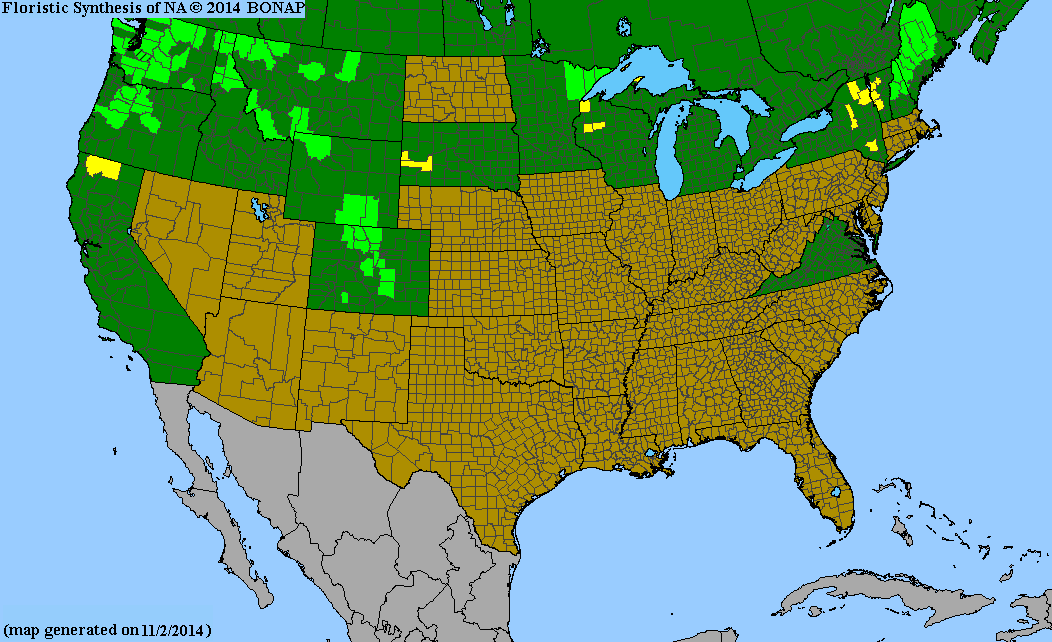
- Alaska and 15 other states, north to Washington, south to Colorado and west to Oregon Also recorded in 1 other state, outside its native range. See what is native in your state
List all 16
Alaska, Colorado, Idaho, Maine, Michigan, Minnesota, Montana, New Hampshire, New York, Oregon, Pennsylvania, South Dakota, Vermont, Washington, Wisconsin and Wyoming
Squashberry is a straggling viburnum of the northern forests, from Alaska across Canada to Newfoundland and south into the northern states. Its three-lobed leaves look like those of our mapleleaf viburnum, but they are not softly hairy beneath, and its fruit is red, not black. The sour fruit makes a good jam or jelly. It is common in the North and rare at the southern edge of its range. New York and Vermont list it as threatened and Wisconsin as endangered, and NatureServe ranks it critically imperiled in New Hampshire. Plant it along a cool, shaded stream or at a woodland edge in the North, where birds and people can share the fruit.
Size, growth and what to expect
Squashberry grows fast, nearly three feet a year in its youth on an average site in our growth estimator's model. It makes a straggling to upright shrub 2 to 7 feet tall, sometimes 12 feet, with smooth gray bark. Seedlings begin to fruit at about 5 years and then crop nearly every year.
Small, rounded clusters of white flowers, about an inch across, open from May into July. The fruit ripens red from August into October, a juicy drupe a quarter to half an inch across with one seed. It is sour and best picked for jam a little before it is fully ripe. It hangs on the twigs into winter, and songbirds, grouse, small mammals and bears eat it. The leaves turn brilliant red in fall.
It grows wild from Alaska to Newfoundland, south to Oregon, Colorado, Minnesota and Pennsylvania. Its home is moist woods, the gravel and rocky banks of streams and lakes, and the edges of swamps and bogs, often under spruce, aspen or birch. New York knows it from 14 small stands, most along Adirondack streams.
How to grow Squashberry
Squashberry grows in sun, part shade or shade, and it grows best with more light. It wants a cool soil that stays moist, and a well-drained loam beside water suits it best. It does not stand drought. Heat and dry air set the southern edge of its wild range, so give it a cool spot. Plant it 4 feet from a wall and set plants 6 feet apart. At its size it can go within 15 feet of overhead wires.
Saplings ship bare-root or potted. Plant them dormant, from leaf fall until bud swell, in a hole wider than the roots and no deeper. Set the crown at the soil line, put the native soil back in, and keep the mulch ring clear of the stems. Seed needs 3 to 5 months of warm, damp conditions and then 3 months of cold. Take it from fresh fruit and sow it before it dries, since fresh seed comes up better than stored seed. Sown outdoors in fall, half an inch deep, it comes up the second spring.
Water weekly through the first two summers, and keep a mulch of leaves over the roots, which grow in the soil's upper, leafy layer. Deer, moose, rabbits and hares browse it, so cage young plants where they are many. A plant damaged at the base sprouts again from the root crown.
Each flower carries both male and female parts, and insects carry the pollen. Tent caterpillars feed heavily on it in outbreak years. A leaf spot and a rust turn up, but neither is serious. The viburnum leaf beetle may become a threat.
Heights and zones are typical ranges for the species in cultivation; local conditions and seed source shift them.
Sources (16)
- USDA Forest Service, Fire Effects Information System: Viburnum edule, Matthews 1992, revised 2018
- NatureServe Explorer: Viburnum edule, Squashberry
- USDA NRCS PLANTS Database: Viburnum edule, VIED
- Lady Bird Johnson Wildflower Center: Viburnum edule
- New York Natural Heritage Program: Squashberry guide
- Vermont Fish and Wildlife Department: Endangered and Threatened Plants of Vermont
- Wisconsin DNR, Natural Heritage Inventory Working List
- Go Botany, Native Plant Trust: Viburnum edule
- Native Plant Network: Moore, Ross and Hunt 2004, Propagation protocol for production of container (plug) Viburnum edule plants, Alaska Plant Materials Center
- Native Plant Network: Luna 2008, Propagation protocol for production of container (plug) Viburnum edule plants, Glacier National Park
- Natural Resources Canada, Canada's Plant Hardiness Site: Viburnum edule
- Jepson eFlora, University and Jepson Herbaria
- BONAP, Floristic Synthesis of North America, county map for Viburnum edule, generated 2014-11-02
- Minnesota Wildflowers: Viburnum edule
- Trees and Shrubs Online (International Dendrology Society): Viburnum edule
- USDA Forest Service, Woody Plant Seed Manual (2008), Viburnum chapter
Check your site for it What to plant with it How big, how fast How much to water How to sow it How many for a crop When it flowers and fruits
- Ten planting mistakes that quietly kill trees
- Transplanting young trees: timing, water and protection
- Protecting young trees from voles, rabbits, deer and squirrels
- The habitat around a tree is part of the tree
- Invasive vines and shrubs are what is killing your woods
- Native trees and shrubs for butterflies and moths: host plants first, nectar second
Grows in the same conditions
Plants that share its sun and soil


More like this