Photo: Blue Whale Trees
Sweet Pepperbush (Summersweet)
Scientific name: Clethra alnifolia
Also called summersweet, clethra, coastal sweetpepperbush.
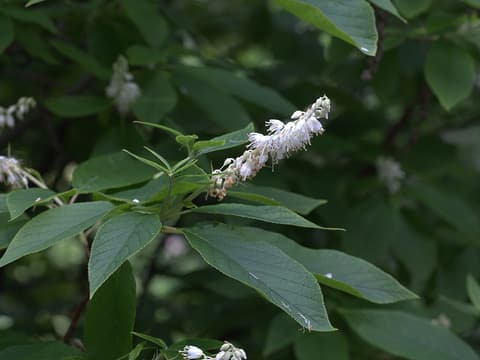
Spires of intensely fragrant white flowers in August, when almost nothing else is blooming, and bees know it.
Be first when sweet pepperbush is priced
Saplings ship bare-root or in a pot, usually 12 to 18 inches tall, in the dormant season, and their height and age are stated here with the price, once available.
We grow it as saplings and seed. One email when it is listed with prices, and nothing else. Or ask, and we reply with what is ready now. Live plants ship February to May and October to November.
Limited timeSign up now and get 10% off when it is ready.
Share: copy link
Sweet Pepperbush at a glance
Showy flowers, Honey tree, Tolerates wet soil, Tolerates shade, Fall color, Winter interest, Erosion control, Salt tolerant
- Type
- Shrub
- Mature height
- 4–8 ft
- USDA zones
- 3–9
- Growth rate
- Medium
- Flowers
- July to August
- Fruit
- Capsules, September to February
- First crop
- About 2 years
- Mature spread
- 6 ft
- Sun
- Full, Part, Shade
- Soil moisture
- Average, Wet
- Grows wild in
- Stream banks, the coast, swamps and wet flats
- Native range
- 20 states, north to Maine, south to Florida and west to Texas See what is native in your state
List all 20
Alabama, Connecticut, Delaware, Florida, Georgia, Louisiana, Maine, Maryland, Massachusetts, Mississippi, New Hampshire, New Jersey, New York, North Carolina, Pennsylvania, Rhode Island, South Carolina, Tennessee, Texas and Virginia
Summersweet grows in wet coastal woods from Maine to Texas and tolerates shade, salt spray and standing water. Its late-summer bloom is a lifeline for bees and butterflies and a notable honey plant. Suckers slowly into a colony; yellow fall color. One of the easiest native shrubs. Along a stream or pond its suckering roots form a low thicket that helps hold the bank. Belongs beside a porch or a back door, where the August scent drifts inside.
Size, growth and what to expect
Few native shrubs bloom as late as sweet pepperbush, whose fragrant white spikes 3 to 6 inches long open on the current season's growth from July into August. It grows at a medium pace, roughly a foot and a half a year in its youth on an average site, which is the rate our growth estimator uses for it. It makes a dense, upright, multi-stemmed shrub 4 to 8 feet tall and 4 to 6 feet wide that suckers into a mounded clump.
The flowers carry high-quality nectar and pollen for bees, butterflies and hummingbirds. Dry brown capsules an eighth of an inch across ripen in September and October and hang on through winter. Birds pick out the seed. Summersweet, its other name, refers to that late, sweet-scented bloom.
It grows wild along the coast from Maine to Florida and west to Texas, in swampy woods, wet marshes and damp thickets, along streams and behind the shore, often on sand.
How to grow Sweet Pepperbush
Sweet pepperbush is easy to place: full sun to fairly deep shade, ordinary garden soil or ground that stays wet, salt spray near the coast. It blooms most in sun. Plants slowly widen by suckers, so set them 4 feet apart and that far from a foundation.
Plant dormant bare-root or potted shrubs between leaf fall and bud break, in a wide, shallow hole. Set the crown at the soil line, put the native soil back in, and mulch out past the roots but not against the stems. It needs neither stake nor fertilizer. Seed is dust fine and needs no chilling. Scatter it on the surface of damp sand or seed mix in spring and press it in without covering it. Keep it constantly moist.
Water weekly through the first two summers; it wilts fast in dry soil until the roots are down. Deer browse it lightly and rabbits sometimes cut stems, so cage it low for a winter or two. It flowers on new wood, so prune in late winter, cutting the oldest stems to the ground to keep the clump full.
A lone sweet pepperbush sets some seed with its own pollen, but cross-pollinated flowers set more, so plant two or more seedlings if you want seed. Summersweet leafs out late, often not until late May, so do not write it off as dead. Spider mites trouble it in a hot, dry corner, one more reason to keep it moist. Flowers open in late July or August; leaves turn yellow in fall.
Heights and zones are typical ranges for the species in cultivation; local conditions and seed source shift them.
Sources (15)
- NC State Extension Gardener Plant Toolbox: Clethra alnifolia
- Missouri Botanical Garden Plant Finder: Clethra alnifolia
- Lady Bird Johnson Wildflower Center: Clethra alnifolia
- USDA Fire Effects Information System: Clethra alnifolia
- USDA Forest Service, Woody Plant Seed Manual (2008), Clethra chapter, Griffin and Blazich
- USDA NRCS Plant Guide: coastal sweet pepperbush, Clethra alnifolia
- NatureServe Explorer: Clethra alnifolia, Coastal Sweet-pepperbush
- Go Botany, Native Plant Trust: Clethra alnifolia
- Trees and Shrubs Online: Clethra alnifolia, from Bean's Trees and Shrubs Hardy in the British Isles
- USDA NRCS PLANTS Database: Clethra alnifolia
- The Morton Arboretum: summersweet clethra
- Flora of North America, vol. 8: Clethra alnifolia
- Reed 2006, Reproductive biology of Clethra alnifolia, HortScience 41: 567-570, USDA Agricultural Research Service
- Reed and Pooler 2012, 'Firefly' Clethra, HortScience 47(3): 429-430, USDA Agricultural Research Service
- Reed, Joung and Roh 2002, Interspecific Hybridization in Clethra, HortScience 37(2): 393-397, USDA Agricultural Research Service
Plan the planting
Check your site for it What to plant with it How big, how fast How much to water How to sow it How many for a crop When it flowers and fruits When to plant it where you live How far from the house and wires How old is yours
Read before planting
- Ten planting mistakes that quietly kill trees
- Transplanting young trees: timing, water and protection
- Protecting young trees from voles, rabbits, deer and squirrels
- Native trees and shrubs for bees: pollen, nectar, nesting and a bloom calendar from willow to witch hazel
- Native trees and shrubs for butterflies and moths: host plants first, nectar second
- The habitat around a tree is part of the tree
Other clethras (Clethra) we grow: Cinnamon Clethra.
Grows in the same conditions
Plants that share its sun and soil
Trees to plant it under: Redbay, Atlantic White Cedar and Pond Cypress.
More like this