Photo: Dcrjsr, CC BY 3.0 · Wikimedia Commons
Downy Serviceberry
Amelanchier arborea
Also called shadbush, juneberry, shadblow.
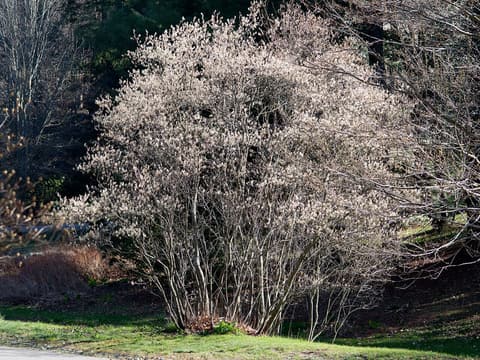
First to bloom in the woods, first fruit of summer, and orange-red fall color. A four-season small tree.
Downy Serviceberry at a glance
- Type
- Small tree
- Mature height
- 15–25 ft
- USDA zones
- 4–9
- Growth rate
- Medium
- Flowers
- March to April
- Fruit
- Berries, June
- First crop
- 2 to 3 years after planting
- Mature spread
- 15 ft
- Sun
- Full, Part
- Soil moisture
- Average
- Grows wild in
- The forest understory, dry uplands, old fields and edges
- Native range
- 35 states and the District of Columbia, north to Minnesota, south to Florida and west to Nebraska See what is native in your state
List all 36
Alabama, Arkansas, Connecticut, Delaware, Florida, Georgia, Illinois, Indiana, Iowa, Kansas, Kentucky, Louisiana, Maine, Maryland, Massachusetts, Michigan, Minnesota, Mississippi, Missouri, Nebraska, New Hampshire, New Jersey, New York, North Carolina, Ohio, Oklahoma, Pennsylvania, Rhode Island, South Carolina, Tennessee, Texas, Vermont, Virginia, West Virginia, Wisconsin and the District of Columbia
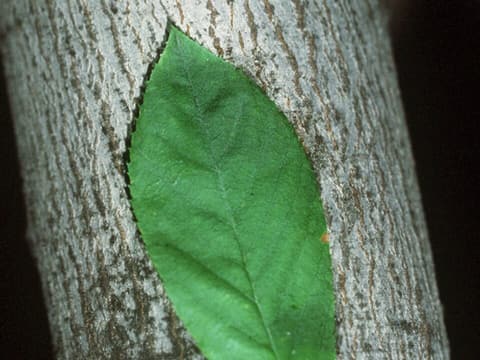
Serviceberry ripens sweet, blueberry-like fruit that robins and cedar waxwings will beat you to. It rarely exceeds 25 feet, making it a fine substitute for Bradford pear or crabapple. Gray bark is its winter feature, and it fits a narrow planting strip along a street. Ideal under a power line or beside a front walk, where a bigger tree would not fit.
Size, growth and what to expect
The name shadbush comes from downy serviceberry's habit of flowering as the shad run upriver to spawn in early spring. Our growth estimator models it at roughly a foot and a half a year, a medium pace. Other ratings run from moderate to slow, so do not count on more. It settles at 15 to 25 feet tall and 10 to 15 feet wide, though wild trees of 30 feet are on record. A sapling bears its first fruit 2 to 3 years after planting.
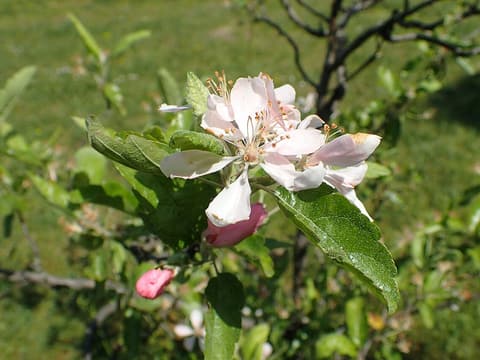
The white flowers open in March and April, before or with the leaves, and the fruit ripens in June. Each berry is about a third of an inch across, turns from green through red to blue-black, and tastes like a highbush blueberry, only a little sweeter. At least 40 kinds of birds and several dozen mammals eat it.
It grows wild from Newfoundland and New Brunswick south to the Florida panhandle and west to Minnesota, Nebraska and Texas, from swampy lowlands to dry sandy bluffs.
How to grow Downy Serviceberry
Downy serviceberry suits full sun or part shade and average soil, clay included, as long as water does not stand. With a light, upright crown it fits a front yard, a patio corner or a woodland edge, and 12 feet from the house is enough. Set trees 10 feet apart.
Plant in the dormant season. Saplings ship bare-root or in pots. Dig a hole twice the root width and no deeper, hold the root flare at grade, refill with the soil you dug, and lay a mulch ring that stops short of the bark. Stake only on a windy site, and take the ties off after a year. Seed needs three to four months of cold, damp storage. Sow cleaned seed outdoors in fall a quarter inch deep, or chill it in the refrigerator and sow in spring. Many seeds wait until the second spring to come up.
Water weekly through the first summer when rain is short. Rabbits and voles gnaw the smooth bark in winter, so screen the base until the bark thickens, and tube against deer, which browse serviceberry readily. Remove suckers and crossing branches after bloom if you want a single trunk.
Each flower carries both male and female parts, so there are no male and female trees to pair. Bees carry the pollen, and a single downy serviceberry sets fruit without a second tree. Fruit ripens in June and birds clear it in days unless you net a branch. In humid springs expect rust spots on leaves and fruit where eastern redcedar grows nearby, and the odd shoot killed by fireblight. Neither threatens the tree.
Heights and zones are typical ranges for the species in cultivation; local conditions and seed source shift them.
Sources (14)
- USDA Fire Effects Information System: Amelanchier arborea
- NC State Extension Gardener Plant Toolbox: Amelanchier arborea
- The Morton Arboretum: downy serviceberry
- Lady Bird Johnson Wildflower Center: Amelanchier arborea
- USDA NRCS Plant Guide: downy serviceberry, Amelanchier arborea
- USDA NRCS PLANTS Database: Amelanchier arborea
- USDA Forest Service, Woody Plant Seed Manual (2008), Amelanchier chapter
- Go Botany, Native Plant Trust: Amelanchier arborea
- Virginia Tech Dendrology: downy serviceberry, Amelanchier arborea
- Minnesota Wildflowers: Amelanchier arborea, downy serviceberry
- Flora of North America, vol. 9: Amelanchier arborea
- Iowa State University Extension and Outreach, Forestry: Downy Serviceberry
- Penn State Extension: Serviceberry in the Garden and in the Kitchen, Susan Marquesen
- University of Maryland Extension: Less Common Fruits for a Home Garden, serviceberry
Check your site for it What to plant with it How big, how fast How much to water How to sow it How many for a crop When it flowers and fruits When to plant it where you live How far from the house and wires Moving one you already have
- Ten planting mistakes that quietly kill trees
- Transplanting young trees: timing, water and protection
- Protecting young trees from voles, rabbits, deer and squirrels
- Small native trees and large shrubs for a small yard, and how to place them
- Invasive or native? Telling tree of heaven, white mulberry, Norway maple, mimosa and Callery pear from the natives they resemble
- Multistem or single stem? Sometimes the trunk is hiding the answer
Other Amelanchier we grow: Allegheny Serviceberry, Bartram's Serviceberry, Nantucket Serviceberry, Roundleaf Serviceberry and Shadblow Serviceberry.
Grows in the same conditions
Plants that share its sun and soil
More like this