Photo: Robert H. Mohlenbrock, Public domain · Wikimedia Commons
Allegheny Serviceberry
Scientific name: Amelanchier laevis
Also called smooth serviceberry, juneberry.
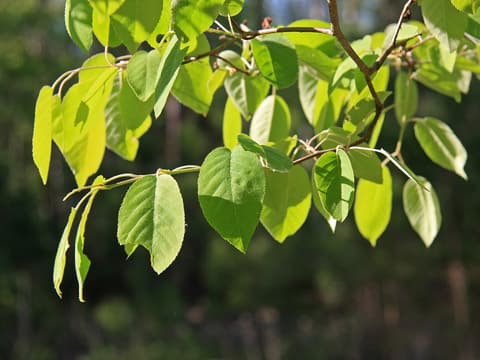
Bronze-purple new leaves under white flowers, and the sweetest fruit of the serviceberries.
Be first when Allegheny serviceberry is priced
Saplings ship bare-root, usually 12 to 18 inches tall, in the dormant season, and their height and age are stated here with the price, once available.
We grow it as saplings and seed. One email when it is listed with prices, and nothing else. Or ask, and we reply with what is ready now. Live plants ship February to May and October to November.
Limited timeSign up now and get 10% off when it is ready.
Share: copy link
Allegheny Serviceberry at a glance
- Type
- Small tree
- Mature height
- 15–25 ft
- USDA zones
- 3–9
- Growth rate
- Medium
- Flowers
- April
- Fruit
- Berries, June
- First crop
- 2 to 3 years after planting
- Mature spread
- 25 ft
- Sun
- Full, Part
- Soil moisture
- Average
- Grows wild in
- The forest understory, rich moist slopes and the Appalachians
- Native range
- 26 states and the District of Columbia, north and west to Minnesota and south to Georgia Also recorded, not native, in Washington. See what is native in your state
List all 27
Alabama, Connecticut, Delaware, Georgia, Illinois, Indiana, Iowa, Kentucky, Maine, Maryland, Massachusetts, Michigan, Minnesota, New Hampshire, New Jersey, New York, North Carolina, Ohio, Pennsylvania, Rhode Island, South Carolina, Tennessee, Vermont, Virginia, West Virginia, Wisconsin and the District of Columbia
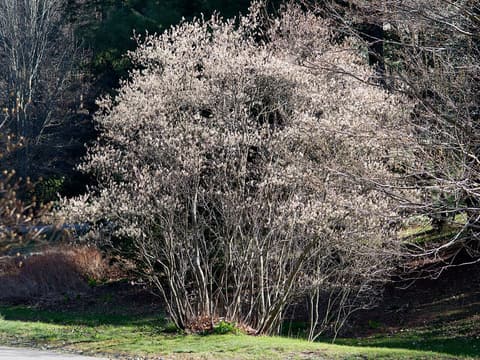
Allegheny serviceberry is the mountain and northern cousin of downy serviceberry, distinguished by hairless, coppery new growth and juicier fruit. Both are excellent; this one shines where springs are cool. Multi-stemmed clumps make a natural screen; single stems make a small shade tree. Kept to one stem, it also suits a street, even under power lines. Belongs at a woodland edge where you can pick the fruit before the birds do.
Size, growth and what to expect
Allegheny serviceberry is the juneberry, so called because its fruit ripens to dark purplish black in June. A young tree puts on roughly a foot and a half of height a year on an average site, the rate our growth estimator assumes for a medium grower. It reaches 15 to 25 feet tall and about as wide, and a single-trunked tree can reach 40 feet. It is fairly short-lived. A sapling bears its first fruit 2 to 3 years after planting.
White flowers open in April, before the leaves. Each fruit is about three eighths of an inch across and matches a blueberry in size, color and taste, and it is juicier than the fruit of downy serviceberry. Songbirds, ruffed grouse and small mammals strip the crop as soon as it ripens.
It grows wild from Newfoundland and southern Ontario south to Delaware, Kentucky and Iowa, and down the mountains to Georgia and Tennessee, in thickets, open woods and sheltered slopes. It resents drought.
How to grow Allegheny Serviceberry
Allegheny serviceberry does best where summers stay cool, in full sun or the light shade of taller trees. It wants an ordinary, evenly moist soil that drains. Give a multi-stemmed clump 12 to 15 feet of space.
Plant dormant bare-root saplings between leaf drop and bud break. Make the hole wide and shallow, twice the root spread, with the root flare level with the surface. Refill with plain soil, water well, and lay a mulch ring two or three inches deep that stops short of the stems. Stake only if the tree will not stand on its own. Seed needs three to four months of cold, damp storage. Sow cleaned seed outdoors in fall a quarter inch deep, or chill it in the refrigerator and sow in spring. Many seeds wait until the second spring to come up.
Serviceberry roots are shallow, so water weekly through the first two summers. Rabbits gnaw the smooth bark in winter and deer browse the tips, so use a wire guard for the first three years. Prune only to remove crossing stems or to shape a clump into a single trunk.
A single plant sets fruit, and birds will take the June crop before it fully ripens unless you net it. Serviceberry can show rust spots on leaves and fruit near junipers and red cedars.
Heights and zones are typical ranges for the species in cultivation; local conditions and seed source shift them.
Sources (15)
- The Morton Arboretum: Allegheny serviceberry
- Missouri Botanical Garden Plant Finder: Amelanchier laevis
- NC State Extension Gardener Plant Toolbox: Amelanchier laevis
- Lady Bird Johnson Wildflower Center: Amelanchier laevis
- USDA Forest Service, Woody Plant Seed Manual: Amelanchier chapter
- Virginia Tech Dendrology: Alleghany serviceberry, Amelanchier laevis
- NatureServe Explorer: Amelanchier laevis
- Flora of North America, vol. 9: Amelanchier laevis
- Go Botany (Native Plant Trust): Amelanchier laevis, smooth shadbush
- Trees and Shrubs Online: Amelanchier laevis
- University of Wisconsin-Madison Extension, Wisconsin Horticulture: Serviceberry, Amelanchier spp.
- University of Illinois Extension, Selecting Shrubs for Your Home: Alleghany serviceberry, Amelanchier laevis
- University of Maryland Extension, Home and Garden Information Center: Serviceberry, an early-flowering Maryland native tree
- USDA NRCS PLANTS Database: Amelanchier laevis
- Clemson Cooperative Extension, Home and Garden Information Center: Serviceberry, HGIC 1026
Plan the planting
Check your site for it What to plant with it How big, how fast How much to water How to sow it How many for a crop When it flowers and fruits When to plant it where you live How far from the house and wires How old is yours Moving one you already have
Read before planting
- Ten planting mistakes that quietly kill trees
- Transplanting young trees: timing, water and protection
- Protecting young trees from voles, rabbits, deer and squirrels
- Native trees and shrubs for bees: pollen, nectar, nesting and a bloom calendar from willow to witch hazel
- Native fruit and nut trees to grow and eat: what each bears, when it starts, and which need a partner
- Multistem or single stem? Sometimes the trunk is hiding the answer
We grow 7 other serviceberries (Amelanchier): see them all.
Grows in the same conditions
Plants that share its sun and soil
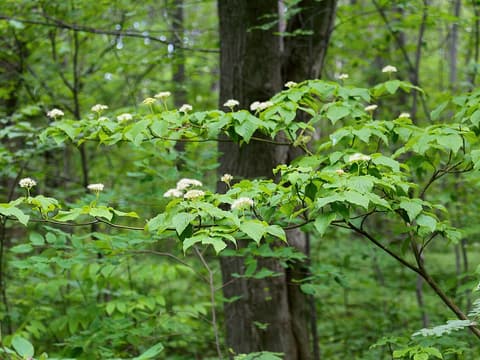
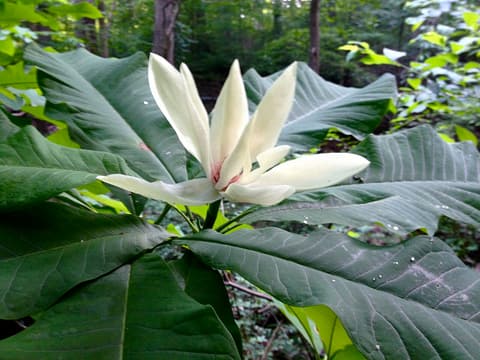
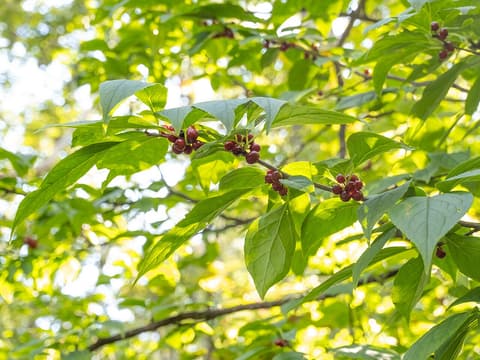
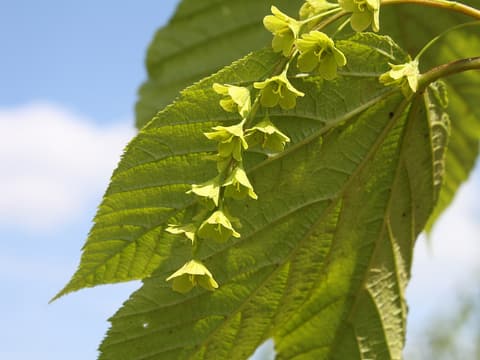
Trees to plant it under: American Beech, Northern Red Oak and Yellow Buckeye.
More like this