Photo: Bearerofthecup, Public domain · Wikimedia Commons
American Wisteria
Scientific name: Wisteria frutescens
Also called Kentucky wisteria, Texas wisteria, Atlantic wisteria, Wisteria macrostachya.
A native wisteria whose purple flower clusters open after its leaves unfold, much tamer than the invasive Asian wisterias it resembles.
Be first when American wisteria is priced
Saplings ship in a pot, usually 12 to 18 inches tall, in the dormant season, and their height and age are stated here with the price, once available.
We grow it as saplings and seed. One email when it is listed with prices, and nothing else. Or ask, and we reply with what is ready now. Live plants ship February to May and October to November.
Limited timeSign up now and get 10% off when it is ready.
Share: copy link
American Wisteria at a glance
- Type
- Shrub
- Mature height
- 15–30 ft
- USDA zones
- 3–9
- Growth rate
- Fast
- Flowers
- April to June
- Fruit
- Pods, August to October
- First crop
- 5 to 10 years after planting (first flowers)
- Mature spread
- 8 ft
- Sun
- Full, Part
- Soil moisture
- Average, Wet
- Grows wild in
- Floodplain forests, stream banks, swamps and wet flats
- Native range
- 19 states, north to Michigan, south to Florida and west to Texas Also recorded, not native, in 9 other states (listed above). See what is native in your state
List all 19, and the 9 others
Alabama, Arkansas, Florida, Georgia, Illinois, Indiana, Kentucky, Louisiana, Maryland, Michigan, Mississippi, Missouri, North Carolina, Ohio, Oklahoma, South Carolina, Tennessee, Texas and Virginia
Also recorded, not native, in Connecticut, Delaware, Iowa, Massachusetts, New Jersey, New York, Pennsylvania, Rhode Island and West Virginia.
American wisteria is a native twining vine of the pea family, much less aggressive than the Chinese and Japanese wisterias that have escaped across the eastern states. The native blooms after its leaves unfold, in shorter clusters, and its pods are smooth. The Asian vines bloom as their leaves emerge, in clusters up to 20 inches long, and their pods are velvety. Kentucky wisteria, with longer clusters, is a form of the same species. Indiana lists it as threatened. Train it over a sturdy arbor or pergola, where its flower clusters can hang overhead.
Size, growth and what to expect
American wisteria grows fast, nearly three feet a year in our growth estimator. It is a twining vine that climbs 15 to 30 feet, and one plant spreads 4 to 8 feet wide. Wisteria often waits 5 to 10 years after planting to bloom, and seed-grown vines can take longer.
Pea-like flowers, lilac to bluish purple and nearly an inch long, open from April into June in drooping clusters 2 to 6 inches long. A few more may follow in summer. Smooth pods 2 to 5 inches long ripen in late summer and split open in fall. Its leaves feed the caterpillars of the marine blue, the Zarucco duskywing, the long-tailed skipper and the silver-spotted skipper.
It grows wild from Virginia to Illinois and south to Florida and Texas. Its home is bottomland forests, swamps and the banks of streams and rivers. Planted vines have also gone wild in Connecticut, Massachusetts, Rhode Island, New York, New Jersey, Pennsylvania, Delaware, West Virginia and Iowa.
How to grow American Wisteria
American wisteria blooms best in full sun and grows in part shade, but not in full shade. It wants a moist, slightly acid soil rich in humus, and it takes ground that floods for a time. On limy soil its leaves can turn yellow. Shelter it from cold winds and from early morning sun on frosty mornings. Its twining stems grow heavy, so give it a strong support. It harms buildings less than the Asian wisterias do. Grown up into a small tree, it may damage the tree over time. Stand the support 4 feet from a wall, and set plants 6 feet apart. Keep it at least 15 feet from overhead wires.
Saplings ship potted. Wisteria dislikes being moved, and an established vine's large root system makes it hard to remove, so choose its spot with care. Plant it from fall to early spring, in a hole wider than the pot and no deeper. Set the crown at the soil line, put the native soil back in, and keep the mulch clear of the stems. Gather the pods in fall, before they burst, and let them finish ripening in an open tray. Soak the seed overnight, and nick its coat with a file to let water in. Sow it three quarters of an inch deep, and keep the soil moist until it sprouts.
Water weekly through the first summer and in dry spells until it is established. It fixes its own nitrogen, so feed it sparingly. Too much fertilizer grows leaves instead of flowers. It blooms on new growth. After it flowers, cut the long shoots back to about 6 inches, and shorten them again in winter to two or three buds.
Each flower carries both male and female parts, so there are no male and female plants to pair. Bumble bees and carpenter bees visit the flowers. Leaf spots, mites and leaf-chewing insects can show up, though none is serious. Eating any part of the plant can make a person sick, and the pods and seeds are the most poisonous.
Heights and zones are typical ranges for the species in cultivation; local conditions and seed source shift them.
Sources (21)
- NC State Extension Gardener Plant Toolbox: Wisteria frutescens
- Lady Bird Johnson Wildflower Center: Wisteria frutescens
- Flora of North America, vol. 11: Wisteria frutescens, L. R. Stritch
- University of Florida IFAS, Center for Aquatic and Invasive Plants, Plant Directory: Wisteria frutescens
- University of Florida IFAS, Florida Bee Gardens: American Wisteria
- Florida Museum of Natural History, University of Florida: Five facts about wisteria in Florida, Marc S. Frank
- Florida Native Plant Society: Wisteria frutescens
- Native Plant Trust, Garden Plant Finder: Wisteria frutescens
- Go Botany, Native Plant Trust: Wisteria frutescens
- The Morton Arboretum: Kentucky wisteria, Wisteria macrostachya
- Mississippi State University Extension: Wisteria, publication on Chinese and Japanese wisteria
- Clemson Cooperative Extension, Forestry and Wildlife: Wisteria is in bloom across South Carolina, Dave Coyle, 2021
- University of Michigan, CLIMBERS: Wisteria frutescens, Robyn J. Burnham
- New Mexico State University Extension, Southwest Yard and Garden: Wisteria seed planning and peach tree seedlings, May 2, 2009
- Royal Horticultural Society: Wisteria growing guide
- NC State Extension Gardener Plant Toolbox: Wisteria sinensis
- NatureServe Explorer: Wisteria frutescens
- Indiana Department of Natural Resources: Endangered, Threatened, and Extirpated Plants of Indiana, 10/29/2025
- Virginia Department of Conservation and Recreation: Natural Heritage Resources of Virginia, Rare Plants
- Oklahoma Natural Heritage Inventory: tracking list
- USDA NRCS PLANTS Database: Wisteria frutescens
Plan the planting
Check your site for it What to plant with it How big, how fast How much to water How to sow it How many for a crop When it flowers and fruits When to plant it where you live How far from the house and wires How old is yours
Read before planting
- Ten planting mistakes that quietly kill trees
- Transplanting young trees: timing, water and protection
- Protecting young trees from voles, rabbits, deer and squirrels
- The habitat around a tree is part of the tree
- What a young tree looks like: first-year seedlings of oak, walnut, hickory, chestnut, maple and redbud, and the weed trees to pull
- Invasive vines and shrubs are what is killing your woods
Grows in the same conditions
Plants that share its sun and soil
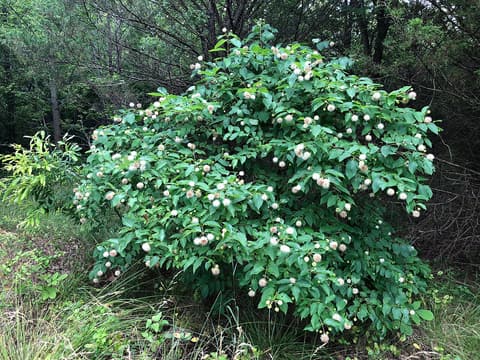
Trees to plant it under: River Birch, American Elm and Peachleaf Willow.
More like this