
Photo: Tim King, CC0 · Wikimedia Commons
Heartleaf Paper Birch
Betula cordifolia
Also called mountain paper birch, heart-leaved paper birch, mountain white birch, heartleaf birch, Betula papyrifera var. cordifolia.
The white birch of the high mountains and the far North, with heart-shaped leaves, orange fall color and bark that peels in pinkish-white sheets.
Be first when heartleaf paper birch is priced
Saplings ship bare-root or in a pot, usually 12 to 18 inches tall, in the dormant season, and their height and age are stated here with the price, once available.
We grow it as saplings and seed. One email when it is listed with prices, and nothing else. Or ask, and we reply with what is ready now. Live plants ship February to May and October to November.
Limited timeSign up now and get 10% off when it is ready.
Share: copy link
Heartleaf Paper Birch at a glance
- Type
- Medium tree
- Mature height
- 50–65 ft
- USDA zones
- 2–6
- Growth rate
- Slow
- Flowers
- May to June
- Fruit
- Cones, August to October
- First crop
- 10 to 15 years
- Mature spread
- 25 ft
- Sun
- Full, Part
- Soil moisture
- Average
- Grows wild in
- The Appalachians, rocky ground and rich moist slopes
- Native range
- 14 states, north and west to Minnesota and south to North Carolina See what is native in your state
List all 14
Connecticut, Maine, Massachusetts, Michigan, Minnesota, New Hampshire, New York, North Carolina, Pennsylvania, Tennessee, Vermont, Virginia, West Virginia and Wisconsin
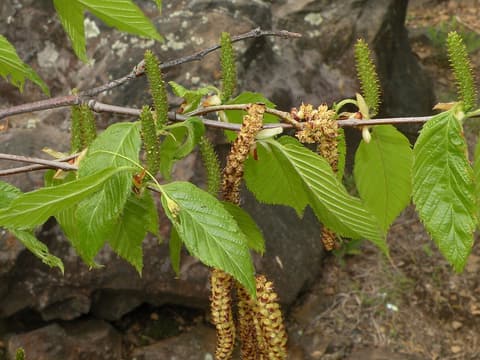
Heartleaf paper birch is the white birch of the high mountains and the far Northeast, at home on cool, rocky slopes and in open forest near tree line. Its bark peels in paper-thin sheets, white to pinkish tan or bronze, and its leaves have heart-shaped bases. Long treated as a variety of paper birch, it is now often held a species of its own. Its southernmost stands, in the Black Mountains of North Carolina, grow farther south than any paper birch. Tennessee lists it as endangered. Plant it as a specimen on a cool, moist slope where summers stay mild.
Size, growth and what to expect
Heartleaf paper birch grows slowly, about a foot a year in our growth estimator. Side by side in Quebec, its seedlings reached 4 feet in five years where paper birch reached 10. It makes a tree of 50 to 65 feet with a narrow crown, and it stays shrubby on exposed summits. It appears to outlive paper birch, and trees on Mount Washington have passed 200 years.
Slender male catkins hang from the twig tips in May and early June, as the leaves unfold. The slender, hanging cones ripen in late summer and break apart in fall, scattering winged seed on the wind. In fall its leaves turn orange.
It grows wild from Newfoundland and Labrador across southern Quebec and Ontario to northeastern Minnesota. In the United States it ranges from Maine to Minnesota and south on high Appalachian peaks to Pennsylvania, West Virginia, Virginia, Tennessee and North Carolina. Like paper birch, it is a tree of cold climates, so it does best where summers stay cool.
How to grow Heartleaf Paper Birch
Heartleaf paper birch grows in full sun or part shade, in a cool, moist soil, often rocky. Drought and hot summers stress it. Plant it 20 feet from a wall, and set trees 25 feet apart. Keep it more than 50 feet from overhead wires.
Saplings ship bare-root or potted. Plant in early spring or fall, in a hole wider than the roots and no deeper, and put the native soil back in. Pick the cones in early fall, while they still hold together, and sow the seed at once on the surface of moist soil, barely covered, since light helps it sprout. For spring, hold it damp in the refrigerator for 4 to 8 weeks first. Seedlings want light shade their first summer.
Water weekly through the first two summers, and keep a mulch over the roots to hold the soil cool and moist. Keep grass and weeds back while it is young, since its seedlings grow slowly.
Male and female catkins grow on the same tree, and the wind carries the pollen. Its close relative paper birch sets some seed with its own pollen, but crosses between trees give far better seed, so plant two trees from different parents for seed. It may suffer less from insect attack than paper birch.
Heights and zones are typical ranges for the species in cultivation; local conditions and seed source shift them.
Sources (12)
- Flora of North America, vol. 3: Betula cordifolia
- USDA Forest Service, Silvics of North America: Betula papyrifera, paper birch, Safford, Bjorkbom and Zasada
- USDA Forest Service, Woody Plant Seed Manual: Betula chapter, Karrfalt
- Clausen 1966, Studies of compatibility in Betula, USDA Forest Service North Central Forest Experiment Station Research Paper NC-6
- Trees and Shrubs Online: Betula cordifolia
- Minnesota Wildflowers: Betula cordifolia, heart-leaved birch
- Go Botany, Native Plant Trust: Betula cordifolia
- Lady Bird Johnson Wildflower Center: Betula papyrifera var. cordifolia
- NatureServe Explorer: Betula cordifolia
- State lists: Tennessee
- NC State Extension Gardener Plant Toolbox: Betula papyrifera, paper birch
- The Morton Arboretum: Paper birch
Plan the planting
Check your site for it What to plant with it How big, how fast How much to water How to sow it How many for a crop When it flowers and fruits When to plant it where you live How far from the house and wires How old is yours Moving one you already have
Read before planting
- Ten planting mistakes that quietly kill trees
- Transplanting young trees: timing, water and protection
- Protecting young trees from voles, rabbits, deer and squirrels
- How fast every tree and shrub we grow gets tall: growth rate, A to Z
- Multistem or single stem? Sometimes the trunk is hiding the answer
- Leaf litter, not wood chips, under the canopy
Other birches (Betula) we grow: Gray Birch, River Birch, Sweet Birch (Black Birch) and Yellow Birch.
Grows in the same conditions
Plants that share its sun and soil
Under its canopy: Roseshell Azalea, Catawba Rhododendron and Cinnamon Clethra.