Photo: Krista Lundgren, U.S. Fish and Wildlife Service, Public domain · Wikimedia Commons
Prairie Rose
Rosa arkansana
Also called Arkansas rose, sunshine rose, dwarf prairie rose, prairie wild rose, Rosa suffulta.
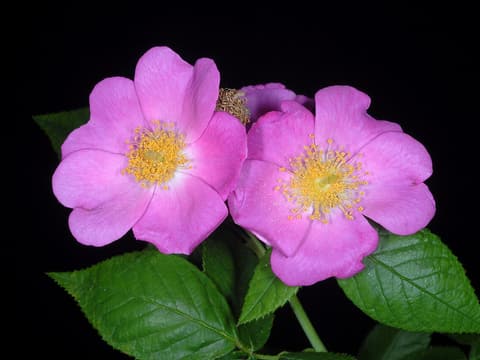
A low, prickly rose of the Plains whose stems often die back to near the ground, with clusters of pink flowers in early summer and orange-red hips into winter.
Be first when prairie rose is priced
Saplings ship bare-root or in a pot, usually 12 to 18 inches tall, in the dormant season, and their height and age are stated here with the price, once available.
We grow it as saplings and seed. One email when it is listed with prices, and nothing else. Or ask, and we reply with what is ready now. Live plants ship February to May and October to November.
Limited timeSign up now and get 10% off when it is ready.
Share: copy link
Prairie Rose at a glance
- Type
- Shrub
- Mature height
- 1–5 ft
- USDA zones
- 3–7
- Growth rate
- Fast
- Flowers
- May to August
- Fruit
- Hips, August to October
- First crop
- 2 to 5 years
- Mature spread
- 10 ft
- Sun
- Full, Part
- Soil moisture
- Dry, Average
- Grows wild in
- Dry uplands, rocky ground, old fields and edges
- Native range
- 19 states, north to North Dakota, south to Texas, east to Ohio and west to Montana Also recorded, not native, in Massachusetts, New York and the District of Columbia. See what is native in your state
List all 19
Arkansas, Colorado, Illinois, Indiana, Iowa, Kansas, Michigan, Minnesota, Missouri, Montana, Nebraska, New Mexico, North Dakota, Ohio, Oklahoma, South Dakota, Texas, Wisconsin and Wyoming
Prairie rose is a low wild rose of the Great Plains, a prickly shrub of prairies, dry hillsides and roadsides. It shares its name with the climbing prairie rose we grow, a tall rambler of the Midwest and South, but this one stays short and its stems often die back to near the ground. It stands drought exceptionally well, and in the Great Drought of 1934 it never wilted and bore an unusually large crop of hips. Ohio lists it as presumed extirpated. Mass it along a dry, sunny bank or among prairie grasses, where its pink flowers and orange-red hips feed bees and birds.
Size, growth and what to expect
No source rates its growth, so our growth estimator uses the fast rate of our other wild roses, about 1.7 feet a year at its size. It makes a prickly shrub 1 to 5 feet tall, though the stems often die back to near the ground in drought or hard winters and sprout again. It is long-lived, and its stout roots reach 8 to 12 feet down.
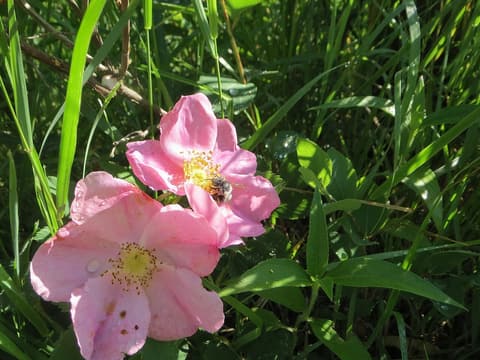
Clusters of pink flowers, sometimes fading to white, about an inch and a half across, open from May into August. Bumble bees and other native bees visit them. Dull orange-red hips about half an inch across follow in clusters of two or three, ripen from late summer into fall and hang on into winter. Cottontails eat it in winter, and mule deer browse it in summer.
It grows wild from Alberta and Manitoba south through the Great Plains to Texas and New Mexico, and east to Wisconsin, Missouri and Ohio. Its home is prairies, dry hillsides, rocky slopes, bluffs, open woods and roadsides. In New England and New York it has come in from elsewhere, and those stands seldom last.
How to grow Prairie Rose
Prairie rose wants full sun, and it takes light shade. It grows in most soils, from sand to clay loam, but not in very wet or very acid ground. Once rooted it shrugs off drought. Keep it 3 feet from a wall or walk. At its size it can go within 15 feet of overhead wires.
Saplings ship bare-root or potted. Plant them dormant, from leaf fall until bud swell, in a hole wider than the roots and no deeper. Set the crown at the soil line, put the native soil back in, and keep the mulch clear of the stems. Prairie rose is hard to raise from seed, and untreated seed has sprouted at under one percent. Treat any sowing as a trial, and expect most seed to wait a year or more before it comes up.
Water weekly through the first summer, then let it fend for itself. Deer and rabbits browse it, so guard young plants with wire. Cut winter-killed stems to the ground in early spring, and new shoots will replace them.
Each flower carries both male and female parts, so there are no male and female plants to pair. Most wild roses first flower and set seed at 2 to 5 years old, with good crops every year or two. Browsing deer cut its flowering and its seed crop. It is one of the more aggressive native roses and moves into grazed and abandoned fields.
Heights and zones are typical ranges for the species in cultivation; local conditions and seed source shift them.
Sources (5)
Plan the planting
Check your site for it What to plant with it How big, how fast How much to water How to sow it How many for a crop When it flowers and fruits When to plant it where you live How far from the house and wires How old is yours
Read before planting
- Ten planting mistakes that quietly kill trees
- Transplanting young trees: timing, water and protection
- Protecting young trees from voles, rabbits, deer and squirrels
- How fast every tree and shrub we grow gets tall: growth rate, A to Z
- The habitat around a tree is part of the tree
- Invasive vines and shrubs are what is killing your woods
Other roses (Rosa) we grow: Climbing Prairie Rose and Prickly Rose.
Grows in the same conditions
Plants that share its sun and soil
Trees to plant it under: Common Hackberry, Western Soapberry and Winged Elm.
More like this