Photo: Cephas, CC BY-SA 4.0, cropped · Wikimedia Commons
Red Pine
Pinus resinosa
Also called Norway pine, eastern red pine, Canadian pine.
A tall, straight northern pine with reddish, plated bark and long needles in pairs, for windbreaks on dry, sandy ground where summers stay cool.
Be first when red pine is priced
Saplings ship bare-root or in a pot, usually 12 to 18 inches tall, in the dormant season, and their height and age are stated here with the price, once available.
We grow it as saplings and seed. One email when it is listed with prices, and nothing else. Or ask, and we reply with what is ready now. Live plants ship February to May and October to November.
Limited timeSign up now and get 10% off when it is ready.
Share: copy link
Red Pine at a glance
- Type
- Large tree
- Mature height
- 50–80 ft
- USDA zones
- 2–5
- Growth rate
- Medium
- Flowers
- May to June
- Fruit
- Cones, August to October
- First crop
- 15 to 25 years (open-grown trees; 50 to 60 in closed stands)
- Mature spread
- 25 ft
- Sun
- Full, Part
- Soil moisture
- Dry, Average
- Grows wild in
- Sandy barrens, dry uplands and rocky ground
- Native range
- 14 states, north and west to Minnesota and south to West Virginia Also recorded, not native, in Indiana, Maryland, Missouri, North Carolina and Virginia. See what is native in your state
List all 14
Connecticut, Illinois, Maine, Massachusetts, Michigan, Minnesota, New Hampshire, New Jersey, New York, Pennsylvania, Rhode Island, Vermont, West Virginia and Wisconsin
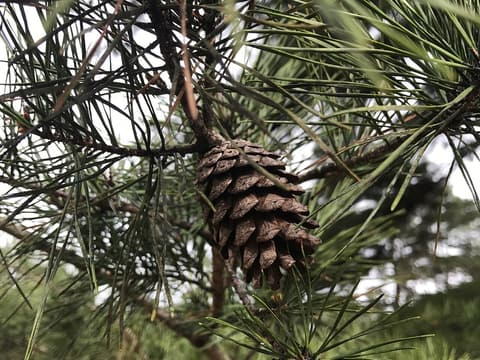
Red pine, also called Norway pine, is the tall, straight evergreen of the northern sand plains, and its long needles snap cleanly when bent. It is the state tree of Minnesota and has been one of the most widely planted trees of the northern states and Canada. Connecticut, Illinois and New Jersey list it as endangered. The Morton Arboretum warns that red pine "is not recommended for planting anywhere in the Midwest," because of its many insect and disease problems. Strips of it are planted on sandy farmland to cut wind erosion, and to hold dunes and blowing sand. Set it in a windbreak row on poor, sandy ground where summers stay cool.
Size, growth and what to expect
Red pine grows at a medium pace, about a foot and a half a year in our growth estimator. It matures at 50 to 80 feet with a crown 20 to 25 feet wide, and the tallest have reached 150 feet. It lives 200 to 400 years, and the oldest tree dated by its rings reached 500.
Open-grown trees begin to bear cones at 15 to 25 years, and good crops come every 3 to 7 years. Pollen is shed in May and June, and the cones ripen from August to October of their second year. The cones are 1.5 to 2.5 inches long and shed their seed through fall and winter. Bald eagles and ospreys nest in old red pines, and red squirrels and snowshoe hares feed on it.
It grows wild around the Great Lakes and the St. Lawrence, from Nova Scotia and Maine west to Manitoba and Minnesota, and south to northern Pennsylvania, northern New Jersey and Connecticut. It also grows locally in northern Illinois and the mountains of West Virginia. It struggles where summers are hot and humid and is not suited to planting south of zone 5.
How to grow Red Pine
Red pine needs full sun and a lean, acid soil of sand or gravel that drains well, and once established it stands drought. It does best where summers are cool and winters cold. On heavy, poorly drained or limy soil, and where summers are warm, it grows poorly and suffers more pests. Plant it 15 feet from a wall, and set trees 15 feet apart. Keep it more than 50 feet from overhead wires.
Saplings ship bare-root or potted. Plant in early spring or fall, in a hole wider than the roots and no deeper, with the root collar at the soil line. Firm the soil around the roots and water it in. Fresh seed needs no chilling and can be sown in fall. Seed that has been stored needs two months of cold, damp storage in the refrigerator before a spring sowing. Sow it a quarter inch deep and keep the bed moist.
Water every week or two through the first summer, then only in long droughts. Keep grass and brush pulled back for the first few years, since young red pines do not grow under sod or dense brush. Guard seedlings where snowshoe hares and rabbits are many, since they can kill them. In a group it sheds its lower branches on its own, so it needs little pruning.
Each tree carries both male and female cones, and red pine is self-fertile enough to set good seed even as a lone tree. Scleroderris canker, needle cast diseases and root rots kill young plantations, and in the Northeast the red pine scale kills trees of every size. Sawflies strip young trees, and pine shoot moths deform them. Spray from road salt also kills it.
Heights and zones are typical ranges for the species in cultivation; local conditions and seed source shift them.
Sources (15)
- USDA Forest Service, Silvics of North America: Red Pine, Rudolf 1990
- USDA Forest Service, Fire Effects Information System: Pinus resinosa, Hauser 2008
- USDA Forest Service, Woody Plant Seed Manual: Pinus chapter, Krugman and Jenkinson
- Flora of North America, vol. 2: Pinus resinosa
- The Morton Arboretum: Red pine
- Missouri Botanical Garden Plant Finder: Pinus resinosa
- Lady Bird Johnson Wildflower Center: Pinus resinosa
- USDA NRCS Plant Guide: Red pine
- Virginia Tech Dendrology: red pine
- NatureServe Explorer: Pinus resinosa
- Connecticut Department of Energy and Environmental Protection: Connecticut's Endangered, Threatened and Special Concern Species 2015
- Illinois Endangered Species Protection Board: Checklist of Endangered and Threatened Animals and Plants of Illinois, revised 10/31/2025
- New Jersey Natural Heritage Program: List of Endangered Plant Species and Plant Species of Concern, January 2024
- West Virginia Natural Heritage Program: Rare Plants tracked, 4 August 2020
- Virginia Tech, Eastern OLDLIST of maximum tree ages: Pinus resinosa
Plan the planting
Check your site for it What to plant with it How big, how fast How much to water How to sow it How many for a crop When it flowers and fruits When to plant it where you live How far from the house and wires How old is yours Moving one you already have
Read before planting
- Ten planting mistakes that quietly kill trees
- Transplanting young trees: timing, water and protection
- Protecting young trees from voles, rabbits, deer and squirrels
- How fast every tree and shrub we grow gets tall: growth rate, A to Z
- Six trees not to plant near a house, and what to plant instead
- Pruning at the branch collar, and when to make the cut
Other pines (Pinus) we grow: Jack Pine, Longleaf Pine, Pond Pine, Sand Pine, Spruce Pine and Table Mountain Pine.
Grows in the same conditions
Plants that share its sun and soil
Under its canopy: Black Huckleberry, Deerberry and Mapleleaf Viburnum.
More like this