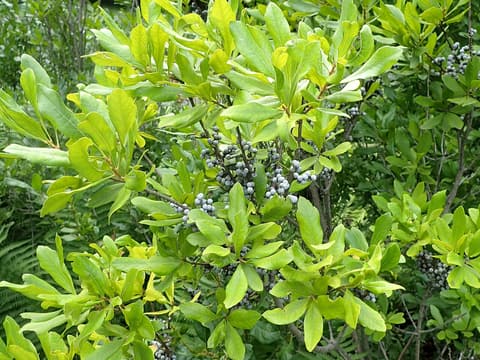
Photo: Hajotthu, CC BY 3.0, cropped · Wikimedia Commons
Sweet Gale
Myrica gale
Also called bog myrtle, meadow fern, sweetgale, sweet bayberry.
A fragrant shrub of northern bogs and lake shores, with resin-dotted leaves that smell sweet when crushed and roots that fix their own nitrogen.
Be first when sweet gale is priced
Saplings ship bare-root or in a pot, usually 12 to 18 inches tall, in the dormant season, and their height and age are stated here with the price, once available.
We grow it as saplings and seed. One email when it is listed with prices, and nothing else. Or ask, and we reply with what is ready now. Live plants ship February to May and October to November.
Limited timeSign up now and get 10% off when it is ready.
Share: copy link
Sweet Gale at a glance
- Type
- Shrub
- Mature height
- 2–6 ft
- USDA zones
- 2–6
- Growth rate
- Medium
- Flowers
- March to May
- Fruit
- Nutlets, October
- First crop
- 3 to 4 years
- Mature spread
- 5 ft
- Sun
- Full, Part
- Soil moisture
- Average, Wet
- Grows wild in
- Stream banks, swamps and wet flats
- Native range
- Alaska and 16 other states, north to Washington, south to North Carolina and west to Oregon See what is native in your state
List all 17
Alaska, Connecticut, Maine, Massachusetts, Michigan, Minnesota, New Hampshire, New Jersey, New York, North Carolina, Oregon, Pennsylvania, Rhode Island, Vermont, Virginia, Washington and Wisconsin
Sweet gale is a low, bushy shrub of bogs, fens and the shores of northern lakes and streams. Its leaves are dotted with yellow resin glands and smell sweet when crushed, and in Europe its branches once flavored beer. Like our northern bayberry, it fixes nitrogen with bacteria in its roots, so it thrives on poor, wet ground. North Carolina lists it as endangered, and Pennsylvania lists it as threatened. Mass it along a pond or stream edge, or in a wet corner of the garden.
Size, growth and what to expect
Sweet gale grows at a medium pace, about a foot a year in our growth estimator. It makes a bushy shrub 2 to 6 feet tall with upright branches. It spreads by root suckers and by branches that root where they touch the ground, into thickets that lean out over the water.
The catkins open from March to May, before the leaves. On female plants, the small resin-dotted nutlets ripen in October in brown, cone-like clusters. Two spongy wings float each nutlet away on the water, and the fruits attract birds.
It grows wild around the northern world. In North America it ranges from Alaska and Labrador south to Oregon, the Great Lakes, New England and New Jersey. It grows rarely as far south as Virginia and the mountains of North Carolina.
How to grow Sweet Gale
Sweet gale grows in full sun or part shade, in soil that stays wet or moist. It thrives in acid, peaty soil, though it also grows in limy fens. Set plants 3 feet apart and keep them 3 feet from a wall. At its size it can go within 15 feet of overhead wires.
Saplings ship bare-root or potted. Set each one in a hole wider than the roots and no deeper, put the native soil back in, and water it in well. The seed needs light to sprout. Keep it damp in the refrigerator for six weeks, then sow it in spring on the surface of moist mix, uncovered. Unchilled seed also sprouts, though fewer seedlings come up.
Water it weekly through the first summer unless it grows at the water's edge, and do not let the soil dry out. It needs no fertilizer, since bacteria in its roots fix nitrogen for it.
Plants are mostly male or female, and only females bear the nutlets, so plant three or more seedlings for a male and a female. A plant can even switch from one to the other from year to year.
Heights and zones are typical ranges for the species in cultivation; local conditions and seed source shift them.
Sources (12)
- Flora of North America, vol. 3: Myrica gale
- USDA Forest Service, Woody Plant Seed Manual: Myrica and Morella chapter, Griffin and Blazich
- Lady Bird Johnson Wildflower Center: Myrica gale
- Minnesota Wildflowers: Myrica gale, sweet-gale
- Go Botany, Native Plant Trust: Myrica gale
- Oregon State University, Landscape Plants: Myrica gale
- Trees and Shrubs Online: Myrica gale
- Biological Flora of the British Isles: Myrica gale, Skene, Sprent, Raven and Herdman, Journal of Ecology 88 (2000) 1079-1094
- Michigan Flora: Myrica gale
- NatureServe Explorer: Myrica gale
- State lists: North Carolina 2024
- Native Plant Trust, Garden Plant Finder: Myrica gale
Plan the planting
Check your site for it What to plant with it How big, how fast How much to water How to sow it How many for a crop When it flowers and fruits When to plant it where you live How far from the house and wires How old is yours
Read before planting
- Ten planting mistakes that quietly kill trees
- Transplanting young trees: timing, water and protection
- Protecting young trees from voles, rabbits, deer and squirrels
- How fast every tree and shrub we grow gets tall: growth rate, A to Z
- The habitat around a tree is part of the tree
- Invasive vines and shrubs are what is killing your woods
Grows in the same conditions
Plants that share its sun and soil
Trees to plant it under: Northern White Cedar, American Elm and Peachleaf Willow.
More like this