Photo: Jerzy Opioła, CC BY-SA 4.0, cropped · Wikimedia Commons
Bladdernut
Scientific name: Staphylea trifolia
Also called American bladdernut.
Drooping white bell flowers in May and papery inflated seed pods that rattle in the fall wind.
Be first when bladdernut is priced
Saplings ship bare-root or in a pot, usually 12 to 18 inches tall, in the dormant season, and their height and age are stated here with the price, once available.
We grow it as saplings and seed. One email when it is listed with prices, and nothing else. Or ask, and we reply with what is ready now. Live plants ship February to May and October to November.
Limited timeSign up now and get 10% off when it is ready.
Share: copy link
Bladdernut at a glance
- Type
- Shrub
- Mature height
- 8–15 ft
- USDA zones
- 4–8
- Growth rate
- Fast
- Flowers
- April to May
- Fruit
- Pods, August to October
- First crop
- 4 to 5 years (in quantity)
- Mature spread
- 15 ft
- Sun
- Part, Shade
- Soil moisture
- Average, Wet
- Grows wild in
- Stream banks, rich moist slopes and the forest understory
- Native range
- 32 states and the District of Columbia, north to Minnesota, south to Florida and west to Nebraska See what is native in your state
List all 33
Alabama, Arkansas, Connecticut, Delaware, Florida, Georgia, Illinois, Indiana, Iowa, Kansas, Kentucky, Louisiana, Maryland, Massachusetts, Michigan, Minnesota, Mississippi, Missouri, Nebraska, New Hampshire, New Jersey, New York, North Carolina, Ohio, Oklahoma, Pennsylvania, South Carolina, Tennessee, Vermont, Virginia, West Virginia, Wisconsin and the District of Columbia
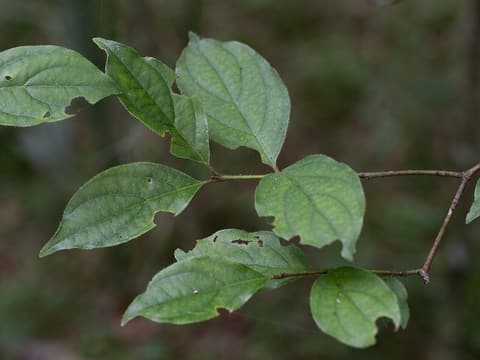
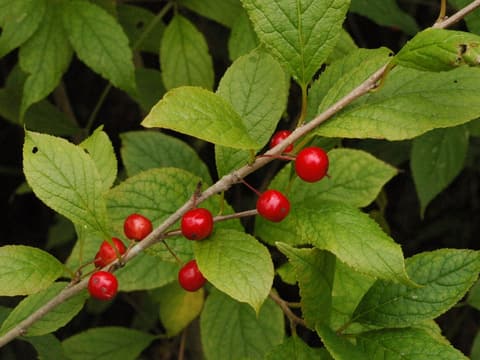
Bladdernut is an uncommon shrub of moist, shady stream banks and rich woods, striped green bark and all. It suckers into a loose thicket, tolerates heavy shade and flooding, and its curious inflated pods are a conversation piece. Underused because it is hard to find, not because it is hard to grow. Made for a collector's woodland garden, or for holding a damp bank under big trees.
Size, growth and what to expect
Bladdernut is a fast-growing shrub. Our growth estimator models it at nearly three feet a year in youth, its figure for a fast grower. Stems reach 10 to 15 feet, and a colony spreads 10 to 20 feet wide as the suckers run.
The drooping clusters of greenish-white bells open in April and May, each flower about a third of an inch long, and bees and butterflies work them. By late summer the flowers have become papery inflated pods 1 to 2 inches long, green at first and light brown by fall, hanging on into early winter. The young bark is smooth and green with pale streaks.
It grows wild from New England and Ontario west to Minnesota and Kansas and south to Florida, in bottomland woods and thickets along streams.
How to grow Bladdernut
Bladdernut belongs in part shade or full shade on average to wet ground: a stream bank, a low spot under big trees, the north side of a building. It takes brief flooding. The plant widens by suckers, so give it a 10 foot circle and room to drift.
Plant while dormant. Saplings come bare-root or potted. Open a wide, shallow hole, set the crown at grade, and use the soil you dug with nothing added. Keep mulch a few inches off the stems. Seed is slow and must not dry out. Sow it cleaned, outdoors in fall, in a bed screened against mice, and expect part of it to sit through a second winter. For a spring sowing, hold it damp at room temperature for three months and then in the refrigerator for three months.
Water through the first summer, especially where the site drains faster than a woodland floor. Rabbits and deer browse the soft shoots, so ring young plants with wire for two winters.
Bladdernut will not set seed with its own pollen, and a suckering patch is still one plant, so plant two or more seedlings from different parents. It spreads by root suckers into a loose colony, which is what you want on a bank and not in a small border. The inflated pods ripen tan and rattle all winter, and the striped bark shows best in winter. Cut damaged canes out after flowering.
Heights and zones are typical ranges for the species in cultivation; local conditions and seed source shift them.
Sources (15)
- NC State Extension Gardener Plant Toolbox: Staphylea trifolia
- Missouri Botanical Garden Plant Finder: Staphylea trifolia
- Lady Bird Johnson Wildflower Center: Staphylea trifolia
- USDA NRCS PLANTS Database: Staphylea trifolia, STTR
- Garwood and Horvitz 1985, American Journal of Botany 72: 453-466, Factors limiting fruit and seed production of a temperate shrub, Staphylea trifolia
- The Morton Arboretum: American bladdernut
- Missouri Department of Conservation field guide: American Bladdernut
- Virginia Tech Dendrology: bladdernut, Staphylea trifolia
- Flora of North America, vol. 9: Staphylea trifolia
- Native Plant Trust, Go Botany: Staphylea trifolia
- NatureServe Explorer: Staphylea trifolia
- University of Tennessee Extension, Tennessee Smart Yards: Staphylea trifolia
- University of Arkansas Division of Agriculture, Plant of the Week: Bladdernut, Klingaman 2011
- Forest Research (Chinese Academy of Forestry) 2007, no. 5: Study on the Biological Characteristics of Staphylea bumalda DC. (Liu, Zhang and Liu 2007)
- Anhui Agricultural Sciences 2013: Preliminary Study on the Biological Characteristics of Staphylea bumalda DC in Anqing (Yu 2013)
Plan the planting
Check your site for it What to plant with it How big, how fast How much to water How to sow it How many for a crop When it flowers and fruits When to plant it where you live How far from the house and wires How old is yours
Read before planting
- Ten planting mistakes that quietly kill trees
- Transplanting young trees: timing, water and protection
- Protecting young trees from voles, rabbits, deer and squirrels
- The habitat around a tree is part of the tree
- What a young tree looks like: first-year seedlings of oak, walnut, hickory, chestnut, maple and redbud, and the weed trees to pull
- Invasive vines and shrubs are what is killing your woods
Grows in the same conditions
Plants that share its sun and soil
Trees to plant it under: Florida Maple, Slippery Elm and Ohio Buckeye.
More like this