Photo: Mason Brock, Public domain · Wikimedia Commons
Green Alder
Alnus viridis
Also called mountain alder, American green alder, Alnus crispa, Alnus alnobetula.
The alder of the far North, a spreading, nitrogen-fixing shrub for stream banks and poor, gravelly ground, with catkins that open with the leaves.
Be first when green alder is priced
Saplings ship bare-root or in a pot, usually 12 to 18 inches tall, in the dormant season, and their height and age are stated here with the price, once available.
We grow it as saplings and seed. One email when it is listed with prices, and nothing else. Or ask, and we reply with what is ready now. Live plants ship February to May and October to November.
Limited timeSign up now and get 10% off when it is ready.
Share: copy link
Green Alder at a glance
- Type
- Shrub
- Mature height
- 3–14 ft
- USDA zones
- 2–8
- Growth rate
- Medium
- Flowers
- May to June
- Fruit
- Cones, September to November
- First crop
- About 2 years
- Mature spread
- 15 ft
- Sun
- Full, Part
- Soil moisture
- Average, Wet
- Grows wild in
- Stream banks, rocky ground and the Appalachians
- Native range
- Alaska and 17 other states, north to Washington, south to North Carolina and west to Oregon See what is native in your state
List all 18
Alaska, California, Idaho, Maine, Massachusetts, Michigan, Minnesota, Montana, New Hampshire, New York, North Carolina, Oregon, Pennsylvania, Tennessee, Vermont, Washington, Wisconsin and Wyoming
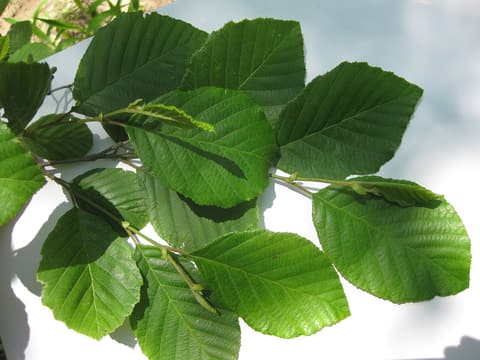
Green alder is the alder of the far North, a spreading shrub of stream banks, lakeshores, rocky slopes and bog edges from Alaska to Greenland. Unlike our smooth alder, it opens its catkins with the new leaves rather than before them. Its roots fix nitrogen, so it is among the first shrubs on bare gravel and on soil left by glaciers. It helps hold stream banks and slopes against erosion. Pennsylvania lists it as endangered. Grow it on a poor, gravelly bank or along a stream edge.
Size, growth and what to expect
Green alder grows at a medium pace, about a foot and a half a year in our growth estimator. It makes a spreading, many-stemmed shrub 3 to 14 feet tall, and it can form dense thickets. Its leaves stay green until they drop in fall. Its roots fix 18 to 55 pounds of nitrogen an acre a year.
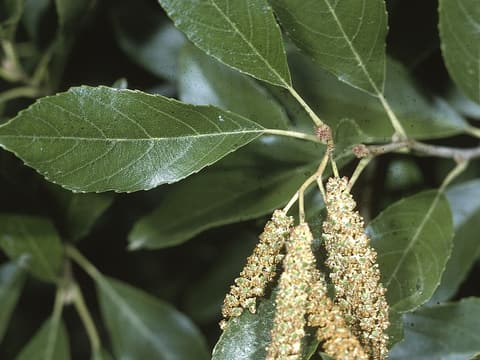
Slender male catkins hang from the twig tips in May and June, as the leaves unfold, beside small, upright red female catkins. The female catkins turn into small woody cones that ripen from September to November, and the winged seed blows away on the wind. Moose, hares and beavers browse it. Many birds eat its seeds, buds and catkins, and its thickets shelter nesting birds.
It grows wild across the far North of the world. In North America it ranges from Alaska and Greenland south to New England, New York, Pennsylvania and the upper Great Lakes. An outpost grows on Roan Mountain, on the North Carolina and Tennessee line. In the West its Sitka alder form grows south to California, Idaho, Montana and Wyoming.
How to grow Green Alder
Green alder grows in full sun or part shade, but not under a dense canopy. It wants a moist, acid soil, sandy, gravelly or rocky, near some source of water. Set plants 6 feet apart and keep them 8 feet from a wall. At its size it can go within 15 feet of overhead wires.
Saplings ship bare-root or potted. Plant dormant saplings in fall or early spring, in a hole wider than the roots and no deeper, and put the native soil back in. It needs no fertilizer, since its roots fix nitrogen. Much of the seed is often empty or dead, so sow it thickly. Chill it damp in the refrigerator for one to two months, then sow it in spring an eighth of an inch deep and keep it moist. Seed can also go outdoors in fall on moist, bare soil.
Water it weekly through the first summer unless the ground stays moist. It needs no pruning, and a clump cut back in winter or spring sprouts again from the base.
It carries male and female catkins on the same shrub, and the wind carries the pollen. Green alder sets some seed with its own pollen, but most of its seed comes from another plant's pollen, so plant two seedlings from different parents for seed. Like other alders, it can get leaf spots, cankers and powdery mildew.
Heights and zones are typical ranges for the species in cultivation; local conditions and seed source shift them.
Sources (12)
- USDA Forest Service, Fire Effects Information System: Alnus viridis subsp. crispa, Matthews 1992
- USDA Forest Service, Woody Plant Seed Manual: Alnus chapter, Harrington and others
- Flora of North America, vol. 3: Alnus viridis
- USDA NRCS Plant Guide: Sitka alder, Alnus viridis ssp. sinuata
- Oregon State University, Landscape Plants: Alnus alnobetula subsp. crispa
- Trees and Shrubs Online: Alnus alnobetula
- Minnesota Wildflowers: Alnus viridis, green alder
- Go Botany, Native Plant Trust: Alnus viridis
- Lady Bird Johnson Wildflower Center: Alnus viridis
- Michigan Flora: Alnus viridis
- NatureServe Explorer: Alnus viridis
- State lists: Pennsylvania, 17 Pa. Code 45.12
Plan the planting
Check your site for it What to plant with it How big, how fast How much to water How to sow it How many for a crop When it flowers and fruits When to plant it where you live How far from the house and wires How old is yours
Read before planting
- Ten planting mistakes that quietly kill trees
- Transplanting young trees: timing, water and protection
- Protecting young trees from voles, rabbits, deer and squirrels
- How fast every tree and shrub we grow gets tall: growth rate, A to Z
- The habitat around a tree is part of the tree
- Invasive vines and shrubs are what is killing your woods
Other alders (Alnus) we grow: Seaside Alder and Smooth Alder (Swamp Alder).
Grows in the same conditions
Plants that share its sun and soil
Trees to plant it under: Eastern Hemlock, Northern White Cedar and Yellow Buckeye.
More like this