Photo: Eric Hunt, CC BY-SA 3.0, cropped · Wikimedia Commons
Hop Hornbeam
Scientific name: Ostrya virginiana
Also called ironwood, eastern hophornbeam.
A tough, shade-tolerant tree of dry upland woods with shreddy bark and hop-like seed clusters.
Be first when hop hornbeam is priced
Saplings ship bare-root or in a pot, usually 12 to 18 inches tall, in the dormant season, and their height and age are stated here with the price, once available.
We grow it as saplings and seed. One email when it is listed with prices, and nothing else. Or ask, and we reply with what is ready now. Live plants ship February to May and October to November.
Limited timeSign up now and get 10% off when it is ready.
Share: copy link
Hop Hornbeam at a glance
- Type
- Medium tree
- Mature height
- 25–40 ft
- USDA zones
- 3–9
- Growth rate
- Slow
- Flowers
- March to June
- Fruit
- Nutlets, August to October
- First crop
- About 25 years
- Mature spread
- 30 ft
- Sun
- Full, Part, Shade
- Soil moisture
- Dry, Average
- Grows wild in
- Dry uplands, the forest understory and rocky ground
- Native range
- 38 states and the District of Columbia, north to North Dakota, south to Florida and west to Wyoming See what is native in your state
List all 39
Alabama, Arkansas, Connecticut, Delaware, Florida, Georgia, Illinois, Indiana, Iowa, Kansas, Kentucky, Louisiana, Maine, Maryland, Massachusetts, Michigan, Minnesota, Mississippi, Missouri, Nebraska, New Hampshire, New Jersey, New York, North Carolina, North Dakota, Ohio, Oklahoma, Pennsylvania, Rhode Island, South Carolina, South Dakota, Tennessee, Texas, Vermont, Virginia, West Virginia, Wisconsin, Wyoming and the District of Columbia
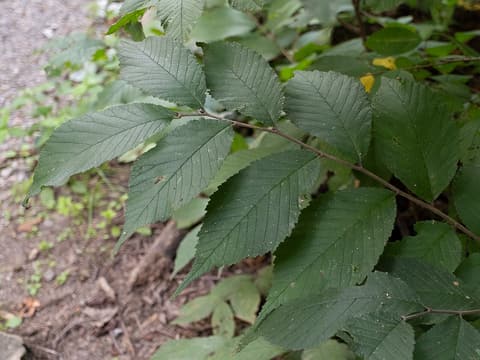
Hop hornbeam takes drought, shade, rocky soil and neglect, and grows into a small elm-like tree with fine texture and yellow fall color. Its hop-shaped seed bracts feed grouse and finches. Rarely offered because it is slow in the nursery, but exceptional in the landscape. It is planted along streets and boulevards. Made for a dry slope under old oaks, or for a yard that never gets watered.
Size, growth and what to expect
A young hop hornbeam stands only 10 to 15 feet tall after 15 years, well under a foot a year. Our growth estimator models it a little faster, at about a foot a year on an average site, slowing toward maturity. Most trees top out at 25 to 40 feet with a trunk under a foot through, and the crown spreads 15 to 30 feet. Trees typically live about 100 years, though one in Maine was ring-counted to 281.
Trees begin bearing seed at about 25 years. Each nut is a quarter inch long inside an inflated papery sac, and the clusters look like hops, which gives the tree its name. Its buds and catkins are a main winter food for ruffed grouse, on par with aspen and birch. The other common name, ironwood, comes from its extremely hard wood.
It grows wild from Nova Scotia and Manitoba south to Florida and Texas, scattered in the understory of hardwood forests on dry slopes, ridgetops and shallow rocky soils. It is slow to establish and does not tolerate salt.
How to grow Hop Hornbeam
Few trees are less fussy. Hop hornbeam grows in full sun, part shade or deep shade, so it fills out even under an existing canopy. It wants dry to average soil that drains, rocky ground included. At full size, keep it 20 feet from the house and clear of wires. Set trees 12 to 24 feet apart.
Plant while dormant. Saplings ship bare-root or potted, and the roots move best on a small tree. Open the hole wide and no deeper than the roots, hold the flare at the surface, and refill with what you removed. Mulch a ring with a gap at the trunk, and stake only on a windy site. Pick the hoplike clusters while they are pale greenish brown and sow the nutlets outdoors that fall, a quarter inch deep under mulch. Seedlings come up the next spring. Seed held for a spring sowing needs two to three months warm and damp, then three to five months cold.
Water weekly the first two summers when rain is short. Rabbits and voles chew the thin bark, so leave a wire cylinder on for three winters, and expect deer to rub a young stem in fall. Take the cylinder off once the bark roughens. Prune broken wood only.
Male and female catkins open together on the same tree in spring and the wind carries the pollen, so one tree sets seed alone. This tree asks for patience. Growth is slow for years, then steady, and the reward is wood so hard that ice storms seldom break it. Keep ironwood clear of drives that get salted. Male catkins hang on the twigs all winter.
Heights and zones are typical ranges for the species in cultivation; local conditions and seed source shift them.
Sources (14)
- USDA Forest Service, Silvics of North America, Eastern Hophornbeam
- NC State Extension Gardener Plant Toolbox, Ostrya virginiana
- Morton Arboretum, Ironwood
- USDA NRCS PLANTS Database: Ostrya virginiana
- USDA NRCS Plant Guide: hop hornbeam, Ostrya virginiana
- USDA Forest Service, Woody Plant Seed Manual (2008), Ostrya chapter, Leak and Bonner
- Flora of North America, vol. 3: Ostrya virginiana
- Iowa State University Extension and Outreach, Forestry: Ironwood
- Lady Bird Johnson Wildflower Center: Ostrya virginiana
- USDA Forest Service, Fire Effects Information System: Ostrya virginiana
- Go Botany, Native Plant Trust: Ostrya virginiana
- Virginia Tech Dendrology: hophornbeam, Ostrya virginiana
- USDA Forest Service, Northern Research Station, Climate Change Tree Atlas: Life History and Disturbance Response of Ostrya virginiana
- Virginia Tech Dendrology, Eastern OLDLIST of maximum tree ages (Neil Pederson): Ostrya virginiana, eastern hophornbeam
Plan the planting
Check your site for it What to plant with it How big, how fast How much to water How to sow it How many for a crop When it flowers and fruits When to plant it where you live How far from the house and wires How old is yours Moving one you already have
Read before planting
- Ten planting mistakes that quietly kill trees
- Transplanting young trees: timing, water and protection
- Protecting young trees from voles, rabbits, deer and squirrels
- What to plant under a big tree: native shrubs for shade, and how to plant without hurting the tree
- Winter identification: telling native trees apart by bark, buds and twigs
- Multistem or single stem? Sometimes the trunk is hiding the answer
Grows in the same conditions
Plants that share its sun and soil
Under its canopy: Mapleleaf Viburnum, Downy Arrowwood and Gray Dogwood.
More like this