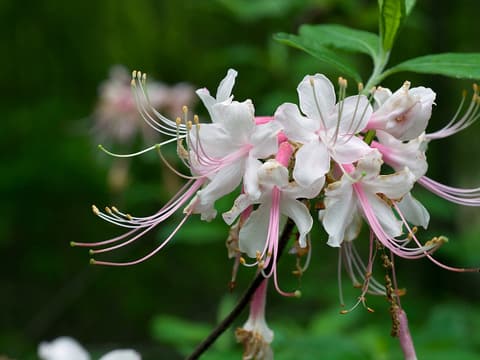
Photo: Fritzflohrreynolds, CC BY-SA 3.0, cropped · Wikimedia Commons
Trailing Arbutus
Epigaea repens
Also called mayflower, Plymouth mayflower, ground laurel, gravel plant.
A creeping evergreen only inches high whose sweetly scented pink and white flowers open in early spring, the mayflower of New England woods.
Be first when trailing arbutus is priced
Saplings ship in a pot, usually 12 to 18 inches tall, in the dormant season, and their height and age are stated here with the price, once available.
We grow it as saplings and seed. One email when it is listed with prices, and nothing else. Or ask, and we reply with what is ready now. Live plants ship February to May and October to November.
Limited timeSign up now and get 10% off when it is ready.
Share: copy link
Trailing Arbutus at a glance
- Type
- Shrub
- Mature height
- 1 ft
- USDA zones
- 2–8
- Growth rate
- Slow
- Flowers
- February to May
- Fruit
- Capsules, June to July
- First crop
- 3 years (first flowers)
- Mature spread
- 2 ft
- Sun
- Part, Shade
- Soil moisture
- Average
- Grows wild in
- The forest understory, sandy barrens, rocky ground and the Appalachians
- Native range
- 28 states and the District of Columbia, north and west to Minnesota and south to Florida See what is native in your state
List all 29
Alabama, Connecticut, Delaware, Florida, Georgia, Illinois, Indiana, Iowa, Kentucky, Maine, Maryland, Massachusetts, Michigan, Minnesota, Mississippi, New Hampshire, New Jersey, New York, North Carolina, Ohio, Pennsylvania, Rhode Island, South Carolina, Tennessee, Vermont, Virginia, West Virginia, Wisconsin and the District of Columbia
Trailing arbutus is a creeping evergreen shrub with leathery leaves and clusters of fragrant pink or white flowers in early spring. It is the mayflower of New England, the state flower of Massachusetts since 1918 and protected by law there since 1925. Ants carry off its seeds, drawn by the soft pulp around them. It suffers where woods are logged or grazed, which may explain why it has grown scarce in places. Florida lists it as endangered, and Indiana lists it as threatened. Grow it as a low evergreen carpet on a lightly shaded bank of sandy, acid soil, where little leaf litter falls.
Size, growth and what to expect
Trailing arbutus grows slowly even in good conditions, and our growth estimator treats it as slow. It makes a creeping mat only 2 to 6 inches high, its stems trailing up to 20 inches and its patches up to 2 feet across. The leathery, evergreen leaves are oval, 2 to 4 inches long, with stiff, rusty hairs along the edges. Plants usually begin to flower at about 3 years.
Clusters of half-inch, trumpet-shaped flowers, pink to white and sweetly spicy, open from February to May, often before the trees leaf out. Fleshy, whitish capsules like small raspberries ripen in June and July and split to show tiny brown seeds in a white pulp.
It grows wild from Newfoundland and Manitoba south to Florida and Mississippi. Its home is moist to dry pine or hardwood woods and clearings, on sandy, rocky or peaty soil. It is rare in Florida, where it grows only in the west of the state, and it has not been seen in Illinois since the late 1800s.
How to grow Trailing Arbutus
Trailing arbutus is a creeping evergreen for part shade or light shade, on an open spot where fallen leaves will not smother it. It wants a well-drained, acid soil, sandy to rocky, with some leaf mold, that stays moist. It is very difficult to establish, since it resents disturbance and fails in drought or flood. Set plants 2 feet apart and keep them 2 feet from a wall. At its size it can go within 15 feet of overhead wires.
Saplings ship potted. Plant them in spring or fall, in a hole wider than the root ball and no deeper, without breaking up the roots. It needs a partner fungus on its roots to thrive, and soil from around healthy trailing arbutus carries the fungus. Never dig plants from the wild, since moved plants nearly always die. For the best germination, chill the damp seed in the refrigerator for 30 days first. Sow the tiny seed on the surface of a damp mix of acid soil, sand and peat, under glass or plastic to keep it humid. Seedlings come up over three to nine weeks, most within a month.
Water weekly through the first two summers, and never let the ground dry out. Keep fallen leaves from piling over the mat. Do not hoe or dig around it, since it will not stand disturbance.
Plants are usually male or female, though a few bear flowers with both parts, so plant three or more seedlings for a male and a female. Bees and butterflies visit the fragrant flowers, and it is a host plant of the hoary elfin butterfly. Small game sometimes eat the fleshy fruit.
Heights and zones are typical ranges for the species in cultivation; local conditions and seed source shift them.
Sources (10)
- NC State Extension Gardener Plant Toolbox: Epigaea repens
- Lady Bird Johnson Wildflower Center: Epigaea repens
- Flora of North America, vol. 8: Epigaea repens
- USDA Forest Service, Woody Plant Seed Manual (2008), Epigaea chapter, Bonner
- Go Botany, Native Plant Trust: Epigaea repens
- NatureServe Explorer: Epigaea repens
- Florida Administrative Code, Rule 5B-40.0055, Regulated Plant Index, effective January 8, 2020
- Florida Natural Areas Inventory: tracking list
- Indiana Department of Natural Resources: Endangered, Threatened, and Extirpated Plants of Indiana, 10/29/2025
- Mississippi Natural Heritage Program: Special Plant Tracking List, 2018
Plan the planting
Check your site for it What to plant with it How big, how fast How much to water How to sow it How many for a crop When it flowers and fruits When to plant it where you live How far from the house and wires How old is yours
Read before planting
- Ten planting mistakes that quietly kill trees
- Transplanting young trees: timing, water and protection
- Protecting young trees from voles, rabbits, deer and squirrels
- How fast every tree and shrub we grow gets tall: growth rate, A to Z
- The habitat around a tree is part of the tree
- Invasive vines and shrubs are what is killing your woods
Grows in the same conditions
Plants that share its sun and soil
Trees to plant it under: Hop Hornbeam, Eastern Hemlock and Carolina Hemlock.
More like this