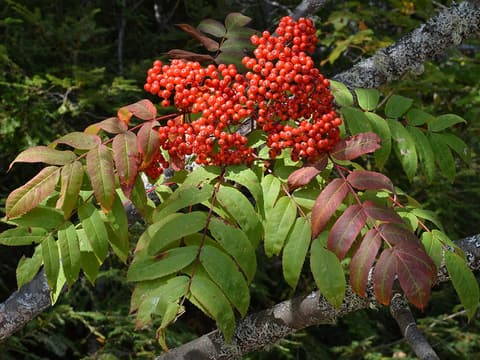
Photo: Bruce Marlin, CC BY-SA 2.5, cropped · Wikimedia Commons
American Mountain Ash
Scientific name: Sorbus americana
Also called American rowan, dogberry.
Flat white flower clusters, orange-red berries and brilliant fall color for cold, cool-summer regions.
Be first when American mountain ash is priced
Saplings ship bare-root, usually 12 to 18 inches tall, in the dormant season, and their height and age are stated here with the price, once available.
We grow it as saplings and seed. One email when it is listed with prices, and nothing else. Or ask, and we reply with what is ready now. Live plants ship February to May and October to November.
Limited timeSign up now and get 10% off when it is ready.
Share: copy link
American Mountain Ash at a glance
- Type
- Small tree
- Mature height
- 15–30 ft
- USDA zones
- 2–7
- Growth rate
- Slow
- Flowers
- May to July
- Fruit
- Berries, August to March
- First crop
- About 15 years (the European species)
- Mature spread
- 20 ft
- Sun
- Full, Part
- Soil moisture
- Average
- Grows wild in
- The Appalachians and rocky ground
- Native range
- 20 states, north and west to Minnesota and south to Georgia See what is native in your state
List all 20
Connecticut, Georgia, Illinois, Maine, Maryland, Massachusetts, Michigan, Minnesota, New Hampshire, New Jersey, New York, North Carolina, Pennsylvania, Rhode Island, South Carolina, Tennessee, Vermont, Virginia, West Virginia and Wisconsin
American mountain ash is a northern tree of bogs, ridges and cool coasts, not the European species sold as rowan. In hot lowland gardens it struggles. Where it is happy, in New England, the Upper Midwest and the high Appalachians, waxwings and grosbeaks strip the berries every winter. At home in a small northern yard, as a specimen tree with fall color and winter birds.
Size, growth and what to expect
American mountain ash is slow growing and short-lived, a smooth-barked shrub or small tree of 15 to 30 feet. Our growth estimator models it at about a foot a year in youth, its figure for a slow grower. Stunted, deformed trees may live more than 50 years.
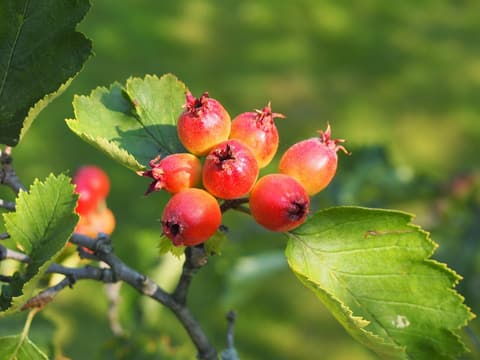
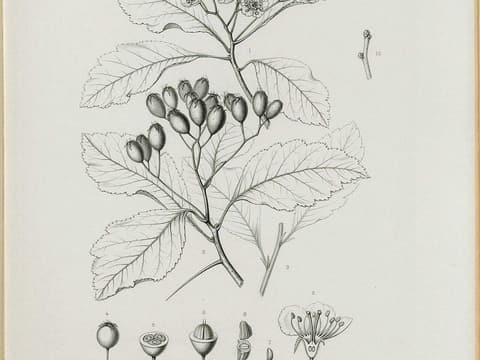
No bearing age is on record for the American species, but its European cousin starts at about 15 years and then crops almost every year. Flat creamy white flower clusters 3 to 6 inches across open from May to July. The bright red-orange berries, about a quarter inch across, ripen in August and hang on the tree all winter. Grouse, robins, waxwings and jays eat them, and moose and deer browse the shoots. It is also called American rowan, after the traditional name for the mountain ashes.
It grows wild from Newfoundland and Nova Scotia south to New Jersey and Pennsylvania, down the mountains to South Carolina and Georgia, and west to Minnesota.
How to grow American Mountain Ash
American mountain ash belongs to the cold country, and it wants cool summers, full sun or light shade, and a moist, acid soil that drains. It will not thrive on hot, dry or compacted ground. At full size it needs 15 feet from buildings and other trees.
Plant bare-root saplings while dormant, ideally in early spring in the far north. Dig a hole twice the width of the roots and no deeper, keep the root flare at grade, and backfill with plain soil. Mulch a wide ring three inches deep to keep the roots cool, clear of the trunk. Sow seed in fall a quarter inch deep in a bed screened with hardware cloth.
Water once a week through the first summer and during dry spells afterward, since drought stress invites borers. Rabbits and voles girdle the thin bark, and deer browse the shoots, so guard the trunk for the first three years. Pruning is not needed.
Each flower carries both male and female parts, so there are no male and female trees to pair. American mountain ash needs pollen from a second tree to set a good crop, and bees carry it, so plant two or more seedlings. Mountain ash is not a true ash, so emerald ash borer does not attack it. Fire blight can blacken shoots in a wet spring, and sunscald can crack an exposed trunk.
Heights and zones are typical ranges for the species in cultivation; local conditions and seed source shift them.
Sources (12)
- USDA Fire Effects Information System: Sorbus americana
- NC State Extension Gardener Plant Toolbox: Sorbus americana
- USDA Forest Service, Woody Plant Seed Manual: Sorbus chapter
- USDA NRCS PLANTS Database: Sorbus americana
- Lady Bird Johnson Wildflower Center: Sorbus americana
- Virginia Tech Dendrology: American mountain-ash, Sorbus americana
- Flora of North America, vol. 9: Sorbus americana
- Go Botany (Native Plant Trust): Sorbus americana, American mountain-ash
- Trees and Shrubs Online: Sorbus americana
- University of Minnesota Extension: Emerald ash borer in Minnesota
- The Morton Arboretum: Emerald ash borer
- The American Heritage Dictionary of the English Language, 5th edition: rowan
Plan the planting
Check your site for it What to plant with it How big, how fast How much to water How to sow it How many for a crop When it flowers and fruits When to plant it where you live How far from the house and wires How old is yours Moving one you already have
Read before planting
- Ten planting mistakes that quietly kill trees
- Transplanting young trees: timing, water and protection
- Protecting young trees from voles, rabbits, deer and squirrels
- Native trees for New England and New York: from the coast to the North Woods
- Native trees for the Great Lakes and Midwest: Michigan, Ohio, Indiana, Illinois and Wisconsin
- Multistem or single stem? Sometimes the trunk is hiding the answer
Other mountain ashes (Sorbus) we grow: Showy Mountain Ash.
Grows in the same conditions
Plants that share its sun and soil
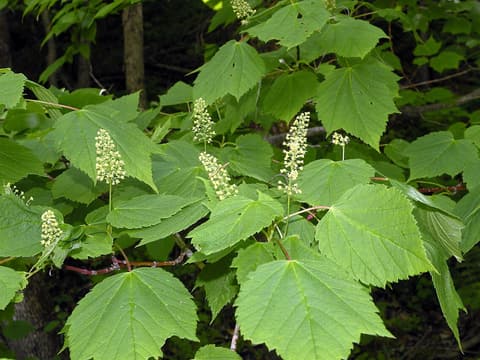
Trees to plant it under: Eastern Hemlock, Red Spruce and Northern Red Oak.
More like this