No photograph of this plant yet
Creek Plum
Prunus rivularis
Also called wild goose plum, Munson plum, river plum, thicket plum, Prunus munsoniana.
A thorny wild plum that suckers into thickets along streams, with fragrant white flowers before the leaves and red or yellow plums in late summer.
Be first when creek plum is priced
Saplings ship bare-root or in a pot, usually 12 to 18 inches tall, in the dormant season, and their height and age are stated here with the price, once available.
We grow it as saplings and seed. One email when it is listed with prices, and nothing else. Or ask, and we reply with what is ready now. Live plants ship February to May and October to November.
Limited timeSign up now and get 10% off when it is ready.
Share: copy link
Creek Plum at a glance
- Type
- Small tree
- Mature height
- 3–25 ft
- USDA zones
- 7–8
- Growth rate
- Fast
- Flowers
- March to April
- Fruit
- Plums, July to September
- First crop
- 3 years
- Mature spread
- 25 ft
- Sun
- Full, Part
- Soil moisture
- Dry, Average
- Grows wild in
- Stream banks, rocky ground, old fields and edges
Creek plum is a thorny wild plum of stream banks, prairie hillsides and the borders of woods. Its Latin name, rivularis, refers to its liking for stream banks. Some botanists now count the wild goose plum, a larger plant, as the same species, while others keep the two apart. Its genes suggest it may have arisen from a cross of Chickasaw plum with hortulan plum or a close kin, two plums we also grow. The wild goose plum is the parent of the Wild Goose group of orchard plums, and the name wild goose plum is given to our hortulan plum as well. Ohio lists it as threatened, and NatureServe ranks it critically imperiled in Colorado and Kansas. Its thickets are good for erosion control. Mass it along a creek bank or a sunny fence line, where its thicket gives birds fruit and cover.
Size, growth and what to expect
No source rates its growth, so our growth estimator uses the fast rate of our Chickasaw plum, nearly three feet a year. On the limestone of central Texas it makes a thorny thicket of 3 to 8 feet. In its wild goose plum form it grows into a small tree of up to about 25 feet.
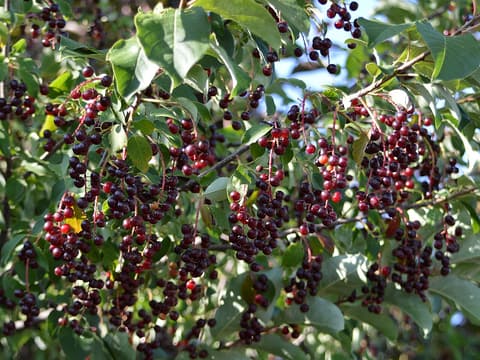
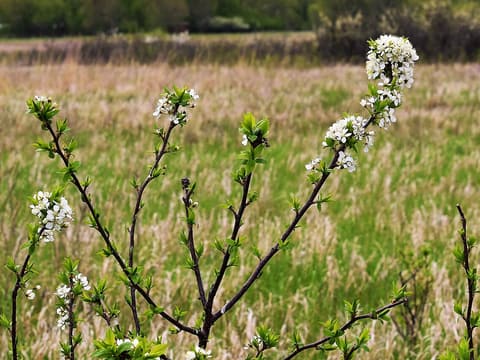
White flowers about half an inch across open in clusters of two to four in March and April, before or as the leaves unfold. They are fragrant, and bees and butterflies visit them. The plums ripen from July into September, half an inch to an inch across, red or yellow, often blushed crimson, with small white dots. Birds and mammals eat them, and the thicket gives them cover.
It grows wild from central Texas north to Kansas and Colorado, and east through Arkansas, Louisiana and Missouri to Illinois, Ohio, Kentucky, Tennessee, Alabama and Georgia. Its home is stream banks, creeksides, roadside thickets, prairie hillsides, limestone woodlands and the borders of woods.
How to grow Creek Plum
Creek plum grows in full sun or part shade, and in full sun it makes a denser, fuller thicket. It takes limestone clay or sand, moist or dry, and it suits alkaline ground. Pull stray root suckers, or give the thicket room to spread. Set trees 15 feet apart, and keep each one 15 feet from a wall. Keep it at least 15 feet from overhead wires.
Saplings ship bare-root or potted. Plant them dormant, from leaf fall until bud swell, in a hole wider than the roots and no deeper. Set the root flare at the soil line, put the native soil back in, and keep the mulch clear of the stems. Clean the pits and sow them outdoors in early fall, an inch deep, under hardware cloth against mice. For spring, hold them damp in the refrigerator for 80 to 100 days first.
Water weekly through the first summer, then only in a long drought. Deer browse the twigs of wild plums, so guard each young plant with wire for its first two or three years. Prune in late winter, only to remove dead, broken or crossing branches.
Plums need pollen from a second plum to set fruit, and a thicket from one root counts as one tree, so plant two or more from different seed. Seedlings can bear from about their third year. Texas creek plums are tart, and Native Americans ate them only now and then. Webworms can strike it, as they do many plants of the rose family. As in all plums and cherries, the seed inside the fruit is poisonous and should never be eaten.
Heights and zones are typical ranges for the species in cultivation; local conditions and seed source shift them.
Sources (8)
- Flora of North America, vol. 9: Prunus rivularis
- Lady Bird Johnson Wildflower Center: Prunus rivularis
- Lady Bird Johnson Wildflower Center: Prunus munsoniana
- Texas A&M AgriLife Extension, Texas Native Plants Database: Creek Plum
- USDA Forest Service, Woody Plant Seed Manual (2008), Prunus chapter
- Trees and Shrubs Online (International Dendrology Society): Prunus hortulana, with P. munsoniana, from Bean
- NatureServe Explorer: Prunus rivularis
- Flora of North America, vol. 9: Prunus hortulana
Plan the planting
Check your site for it What to plant with it How big, how fast How much to water How to sow it How many for a crop When it flowers and fruits When to plant it where you live How far from the house and wires How old is yours Moving one you already have
Read before planting
- Ten planting mistakes that quietly kill trees
- Transplanting young trees: timing, water and protection
- Protecting young trees from voles, rabbits, deer and squirrels
- How fast every tree and shrub we grow gets tall: growth rate, A to Z
- Multistem or single stem? Sometimes the trunk is hiding the answer
- Leaf litter, not wood chips, under the canopy
We grow 14 other plums and cherries (Prunus): see them all.
Grows in the same conditions
Plants that share its sun and soil
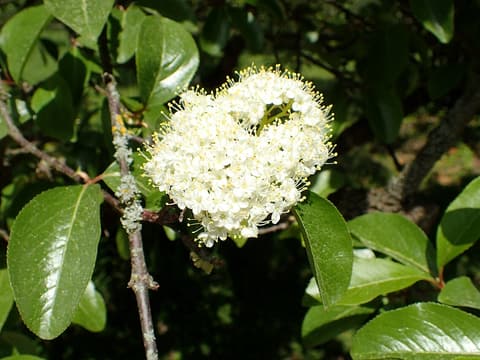
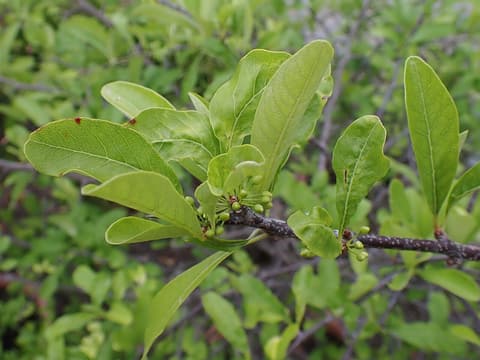
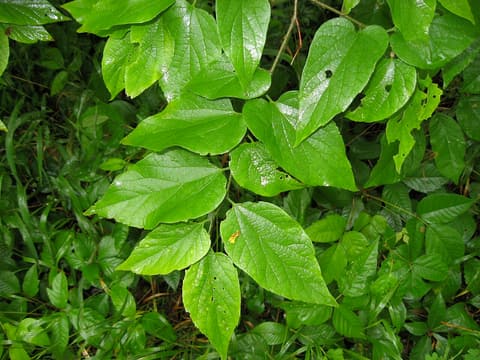
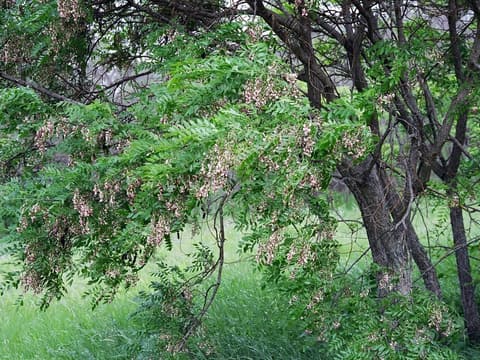
Trees to plant it under: Common Hackberry, Sugarberry and September Elm.
More like this