Photo: Halpaugh, Public domain · Wikimedia Commons
Groundsel Bush
Baccharis halimifolia
Also called groundsel tree, sea myrtle, eastern baccharis.
A fast native shrub for salt spray and wet ground on the coast, whose female plants turn silvery in fall with plumed seeds.
Be first when groundsel bush is priced
Saplings ship bare-root or in a pot, usually 12 to 18 inches tall, in the dormant season, and their height and age are stated here with the price, once available.
We grow it as saplings and seed. One email when it is listed with prices, and nothing else. Or ask, and we reply with what is ready now. Live plants ship February to May and October to November.
Limited timeSign up now and get 10% off when it is ready.
Share: copy link
Groundsel Bush at a glance
- Type
- Shrub
- Mature height
- 5–12 ft
- USDA zones
- 5–10
- Growth rate
- Fast
- Flowers
- August to October
- Fruit
- Seeds, October to December
- First crop
- 2 to 3 years
- Mature spread
- 10 ft
- Sun
- Full, Part
- Soil moisture
- Dry, Average, Wet
- Grows wild in
- The coast, swamps and wet flats, old fields and edges
- Native range
- 20 states and the District of Columbia, north to New York, south to Florida and west to Texas See what is native in your state
List all 21
Alabama, Arkansas, Connecticut, Delaware, Florida, Georgia, Louisiana, Maryland, Massachusetts, Mississippi, New Jersey, New York, North Carolina, Oklahoma, Pennsylvania, Rhode Island, South Carolina, Tennessee, Texas, Virginia and the District of Columbia
Groundsel bush is a native shrub of salt marsh edges, beaches and wet fields on the Atlantic and Gulf coasts, the only eastern member of the aster family that reaches tree size. It is one of the few eastern shrubs that stand salt spray at the shore. It spreads readily from wind-borne seed and can turn weedy in gardens and pastures. Where it was planted in Europe and Australia, it has become an invasive weed. Use it as a quick hedge or screen at the shore, or along a ditch, a pond or a rain garden.
Size, growth and what to expect
Groundsel bush grows fast, nearly three feet a year in our growth estimator. It makes a rounded, many-branched shrub 5 to 12 feet tall and 4 to 10 feet wide, and a plant can be trained to a single trunk as a small tree. Its leaves often hang on into winter, and the bare stems stay slightly green.
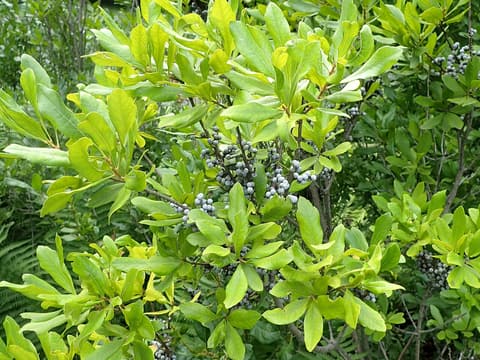
Small flower heads crowd the branch tips from August into October, yellowish on the males and white on the females. In October and November the female plants turn silvery as their seeds ripen under plumes of white bristles, which carry them far on the wind. Birds eat the seeds and nest in the dense branches.
It grows wild along the Atlantic and Gulf coasts from Massachusetts to Florida and Texas. Inland it reaches Arkansas, Oklahoma and the Piedmont, and it grows in Mexico and the West Indies too. Its home is the edges of salt and brackish marshes, beaches, wet fields, ditches and old fields. NatureServe ranks it imperiled in Rhode Island, at the north end of its range.
How to grow Groundsel Bush
Groundsel bush grows best in full sun and takes part shade. It takes sand or clay and poor or wet ground. It stands flooding, brackish water and salt spray, and once rooted it rides out drought. Set it 5 feet from a wall, and set plants 4 feet apart for a hedge. At its size it can go within 15 feet of overhead wires.
Saplings ship bare-root or potted. Plant them dormant, from leaf fall until bud swell, in a hole wider than the roots and no deeper. Set the crown at the soil line, put the native soil back in, and keep the mulch clear of the stems. The tiny seed needs light to sprout, so press it onto a sandy mix and do not cover it. Sow it in fall or early spring and keep it moist, and it comes up in one to two weeks. Cuttings taken in summer root too.
Water weekly through the first summer if rain is short. Cut a leggy hedge back hard, since it regrows quickly even from the base. Pull seedlings that come up where they are not wanted, since weed killers do little.
Plants are male or female, and only females bear the silvery seed heads. The wind carries its pollen, and bees and small butterflies feed at the male flowers. Its wood is brittle, and native leaf beetles can strip the leaves in fall. Its pollen is believed to cause allergies. The leaves and seeds are poisonous, and livestock that eat much of the foliage can be poisoned.
Heights and zones are typical ranges for the species in cultivation; local conditions and seed source shift them.
Sources (10)
- NC State Extension Gardener Plant Toolbox: Baccharis halimifolia
- Missouri Botanical Garden Plant Finder: Baccharis halimifolia
- Lady Bird Johnson Wildflower Center: Baccharis halimifolia
- USDA Forest Service, Fire Effects Information System: Baccharis halimifolia
- Flora of North America, vol. 20: Baccharis halimifolia
- USDA NRCS Plant Guide: Groundsel tree, Baccharis halimifolia (Nesom)
- USDA NRCS Plant Fact Sheet: Eastern baccharis, Baccharis halimifolia (New Jersey State Office and Cape May Plant Materials Center)
- USDA Forest Service, Woody Plant Seed Manual (2008), Baccharis chapter (Karrfalt and Olson)
- USDA NRCS PLANTS Database: Baccharis halimifolia
- NatureServe Explorer: Baccharis halimifolia, Eastern Baccharis
Plan the planting
Check your site for it What to plant with it How big, how fast How much to water How to sow it How many for a crop When it flowers and fruits When to plant it where you live How far from the house and wires How old is yours
Read before planting
- Ten planting mistakes that quietly kill trees
- Transplanting young trees: timing, water and protection
- Protecting young trees from voles, rabbits, deer and squirrels
- How fast every tree and shrub we grow gets tall: growth rate, A to Z
- The habitat around a tree is part of the tree
- Invasive vines and shrubs are what is killing your woods
Grows in the same conditions
Plants that share its sun and soil
Trees to plant it under: Pond Cypress, Black Gum (Tupelo) and American Elm.
More like this