Photo: Choess, CC BY-SA 3.0, cropped · Wikimedia Commons
Dwarf Chinquapin Oak
Scientific name: Quercus prinoides
Also called dwarf chinkapin oak, scrub chestnut oak.
A true shrub oak that starts dropping sweet, low-tannin acorns within a few years of planting.
Be first when dwarf chinquapin oak is priced
Saplings ship bare-root or in a pot, usually 12 to 18 inches tall, in the dormant season, and their height and age are stated here with the price, once available.
We grow it as saplings and acorns. One email when it is listed with prices, and nothing else. Or ask, and we reply with what is ready now. Live plants ship February to May and October to November.
Limited timeSign up now and get 10% off when it is ready.
Share: copy link
Dwarf Chinquapin Oak at a glance
- Type
- Shrub
- Mature height
- 6–15 ft
- USDA zones
- 4–8
- Growth rate
- Slow
- Flowers
- April to June
- Fruit
- Acorns, August to October
- First crop
- 3 to 5 years
- Mature spread
- 20 ft
- Sun
- Full, Part
- Soil moisture
- Dry, Average
- Grows wild in
- Dry uplands, sandy barrens and rocky ground
- Native range
- 32 states and the District of Columbia, north to Minnesota, south to Florida and west to Nebraska See what is native in your state
List all 33
Alabama, Arkansas, Connecticut, Delaware, Florida, Georgia, Illinois, Indiana, Iowa, Kansas, Kentucky, Louisiana, Maine, Maryland, Massachusetts, Michigan, Minnesota, Mississippi, Missouri, Nebraska, New Hampshire, New Jersey, New York, North Carolina, Oklahoma, Pennsylvania, Rhode Island, Tennessee, Vermont, Virginia, West Virginia, Wisconsin and the District of Columbia
Native from New England and the Great Lakes south to the Florida Panhandle and Oklahoma, dwarf chinquapin oak grows on dry sandy or rocky ground where bigger oaks struggle. It suckers into low colonies, bears acorns at three to five years old, and its acorns are among the least bitter of any eastern oak, so deer, turkey and squirrels strip them fast. Ideal for small yards, wildlife plantings and dry slopes. Where the soil is poor and dry, it also helps check erosion. A low oak hedge for a sunny fence line, or an acorn crop for the table.
Size, growth and what to expect
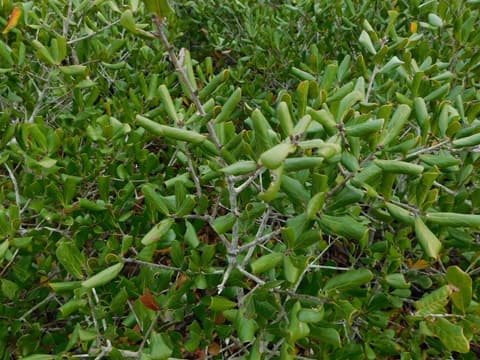
The first acorns on a dwarf chinquapin oak come at only 3 to 5 years, and there is a crop every year rather than every few. It grows slowly, and our growth estimator models it at about a foot a year, its figure for a slow grower. Expect something modest. Most plants stay a shrub of 6 to 15 feet with stems up to 5 inches through. Only rarely does one grow into a small tree of 20 feet.
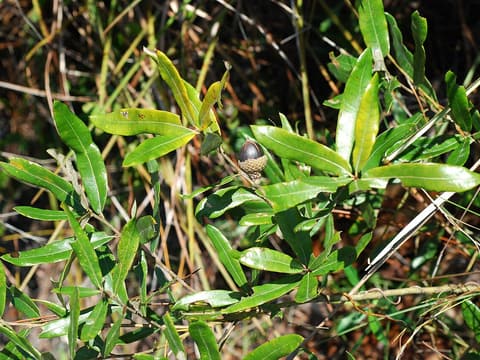
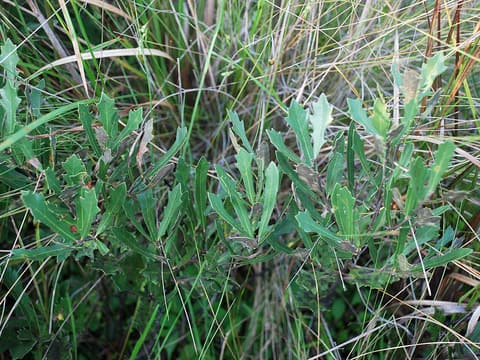
Each acorn is half to three quarters of an inch long under a tan, warty cap that covers about a third of the nut. Wood ducks, grouse, quail, turkeys, jays, woodpeckers, squirrels, chipmunks, bears and deer all take them. The botanical name prinoides means resembling chestnut oak, for the likeness of its leaves. It flowers in April in the Southeast and from May into mid-June around New York. The acorns ripen the same year, from August into October.
It grows wild from New Hampshire to Florida and west to Iowa and Oklahoma, on dry rocky ground such as sandstone and shale outcrops among oaks and pines.
How to grow Dwarf Chinquapin Oak
Dwarf chinquapin oak suits the dry, sunny ground where bigger trees sulk. It takes full sun or part shade and wants soil that drains, be it sand, gravel or thin rock. It threatens no roof or wire, so 10 feet from a wall is plenty, with room to widen. Set plants 12 feet apart.
Plant in the dormant season. Saplings ship bare-root or in deep pots. Set it in a hole twice as broad as the roots and no deeper, hold the root flare level with grade, and return the soil you dug, unamended. Mulch a ring short of the stems. Staking is rarely needed. Sow acorns the day they drop, an inch deep under pinned hardware cloth, since they root before winter and mice hunt them.
Water deeply once a week through the first summer when rain falls short. Renew the mulch and cage the plant against rabbits and deer for three winters, then pull the cage once browsing no longer sets it back.
Prune only in winter, because oaks cut in spring draw the beetles that carry oak wilt. A lone shrub sets a light crop, so plant two or three seedlings together.
Heights and zones are typical ranges for the species in cultivation; local conditions and seed source shift them.
Sources (11)
- University of Maryland Extension: Native Trees of Maryland, dwarf chinquapin oak
- NC State Extension Gardener Plant Toolbox: Quercus prinoides
- Lady Bird Johnson Wildflower Center: Quercus prinoides
- USDA Forest Service, Woody Plant Seed Manual (2008), Quercus chapter, Bonner
- USDA Forest Service, Field Guide to Native Oak Species of Eastern North America, FHTET-03-01, Stein, Binion and Acciavatti 2003
- NatureServe Explorer: Quercus prinoides
- University of Minnesota Extension: Oak wilt in Minnesota
- Go Botany, Native Plant Trust: Quercus prinoides
- Virginia Tech Dendrology: dwarf chinquapin oak, Quercus prinoides
- Flora of North America, vol. 3: Quercus prinoides
- Iowa State University Extension and Outreach, Forestry: Dwarf Chinkapin Oak
Plan the planting
Check your site for it What to plant with it How big, how fast How much to water How to sow it How many for a crop When it flowers and fruits When to plant it where you live How far from the house and wires How old is yours
Read before planting
- Ten planting mistakes that quietly kill trees
- Transplanting young trees: timing, water and protection
- Protecting young trees from voles, rabbits, deer and squirrels
- Which oak to plant: the fastest, the first to bear, the biggest acorns, and oaks for small yards, wet ground and deer
- Native trees and shrubs for dry, sandy soil: the plants of barrens and dunes, and how to grow them
- Red oaks and white oaks, and where each belongs
We grow 42 other oaks (Quercus): see them all.
Grows in the same conditions
Plants that share its sun and soil
Trees to plant it under: Black Oak, Pignut Hickory and Mockernut Hickory.
More like this