Photo: Gilles Ayotte, CC BY-SA 4.0, cropped · Wikimedia Commons
Pale Dogwood
Scientific name: Cornus obliqua · Family: Cornaceae (dogwood family)
Also called blue-fruited dogwood, Cornus amomum subsp. obliqua, Cornus amomum var. schuetzeana, Swida obliqua, Cornus purpusii.
A spreading dogwood for wet, sunny ground, with sweetly fragrant creamy flowers in early summer and blue fruit that birds take in fall.
Be first when pale dogwood is priced
Saplings ship bare-root or in a pot, usually 12 to 18 inches tall, in the dormant season, and their height and age are stated here with the price, once available.
We grow it as saplings and seed. One email when it is listed with prices, and nothing else. Or ask, and we reply with what is ready now. Live plants ship February to May and October to November.
Limited timeSign up now and get 10% off when it is ready.
Share: copy link
Pale Dogwood at a glance
- Type
- Shrub
- Mature height
- 6–15 ft
- USDA zones
- 4–8
- Growth rate
- Medium
- Flowers
- May to July
- Fruit
- Berries, August to October
- First crop
- 3 to 4 years
- Mature spread
- 10 ft
- Sun
- Full, Part
- Soil moisture
- Average, Wet
- Grows wild in
- Stream banks, floodplain forests, swamps and wet flats
- Native range
- 28 states and the District of Columbia, north and west to North Dakota and south to Arkansas See what is native in your state
List all 29
Arkansas, Connecticut, Illinois, Indiana, Iowa, Kansas, Kentucky, Maine, Maryland, Massachusetts, Michigan, Minnesota, Missouri, Nebraska, New Hampshire, New Jersey, New York, North Dakota, Ohio, Oklahoma, Pennsylvania, Rhode Island, South Dakota, Tennessee, Vermont, Virginia, West Virginia, Wisconsin and the District of Columbia
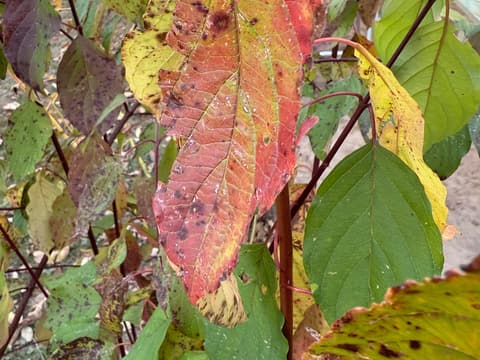
Pale dogwood is a wide, spreading shrub of stream banks, shorelines, wet meadows and bottomland woods across the Midwest and the Northeast. It also goes by the name silky dogwood, and it is sold under that name or as a subspecies of Cornus amomum, the eastern silky dogwood we also grow. Its leaves are narrow and wedge-shaped at the base, pale whitish beneath with flat white hairs. Silky dogwood's leaves are broader and rounded at the base, with tan or rusty hairs beneath, some of them curling, though many plants fall between the two where both grow. New Jersey lists it as endangered. It is useful on poorly drained ground and for preventing erosion on lake shores and stream banks. Give it a wet, sunny corner, a pond margin or a stream bank, where birds can strip its blue fruit in fall.
Size, growth and what to expect
Pale dogwood grows at a medium pace, about a foot and a half a year in our growth estimator. It makes an open, rounded shrub 6 to 15 feet tall, most often 6 to 10 feet tall and as wide. Its branches sometimes arch to the ground and root where they touch. It begins to fruit at 3 to 4 years old.
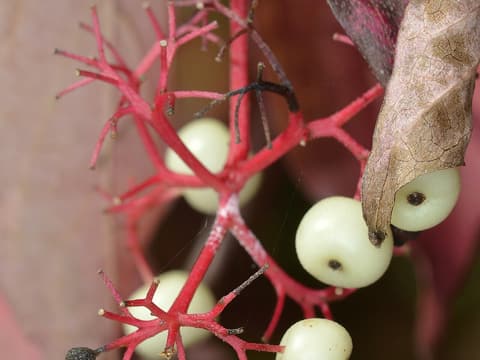
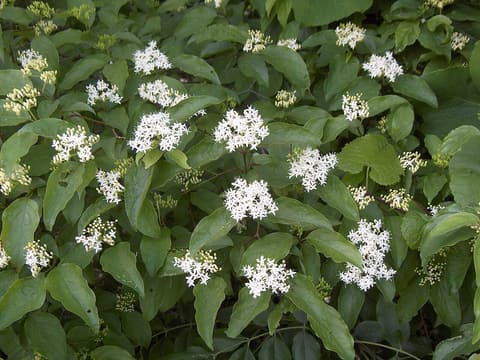
Flat clusters of small, creamy white flowers open from May into July, and they are sweetly fragrant. Many kinds of bees visit them, along with wasps, flies and butterflies. The blue fruit, about a third of an inch across and often bleached white where the sun strikes it, ripens from August into October. Waxwings, catbirds, thrushes, wood ducks and gamebirds eat it, and spring azure caterpillars feed on the plant.
It grows wild from New Brunswick and Quebec west to the Dakotas, and south to Virginia, Tennessee, Arkansas, Oklahoma and Kansas. Its home is stream and river banks, shorelines, bottomland woods, wet meadows, marshes, swamps and fens.
How to grow Pale Dogwood
Pale dogwood grows in full sun or part shade, in soil that stays moist or wet, sandy or not, and it tolerates alkaline soil. Plant it 5 feet from a wall and set plants 6 feet apart. At its size it can go within 15 feet of overhead wires.
Saplings ship bare-root or potted. Plant them dormant, from leaf fall until bud swell, in a hole wider than the roots and no deeper. Set the crown at the soil line, put the native soil back in, and keep the mulch clear of the stems. Clean the stones from the ripe fruit and sow them outdoors in fall, a quarter to half an inch deep. Seedlings come up the next spring. Stones kept until spring need 90 days damp in the refrigerator first. Cuttings also root easily.
Unless the ground stays wet, water it every day for the first two weeks after planting, every two to three days until week 12, and weekly through the first two summers. Deer browse the twigs and leaves and rabbits gnaw the bark, so cage young plants where they are common.
Each flower carries both male and female parts, so there are no male and female plants to pair. Long-horned beetle larvae, leaf beetles, weevils, aphids, scale insects and sawfly larvae feed on its wood and leaves.
Heights and zones are typical ranges for the species in cultivation; local conditions and seed source shift them.
Sources (11)
- Flora of North America, vol. 12: Cornus obliqua Rafinesque, by Zack E. Murrell and Derick B. Poindexter
- Flora of North America, vol. 12: Cornus amomum Miller, by Zack E. Murrell and Derick B. Poindexter
- Iowa State University Extension and Outreach, Natural Resources: Silky Dogwood
- Lady Bird Johnson Wildflower Center: Cornus obliqua
- Illinois Wildflowers (John Hilty): Swamp Dogwood, Cornus obliqua
- Minnesota Wildflowers: Cornus amomum, silky dogwood
- NatureServe Explorer: Cornus obliqua
- New Jersey Department of Environmental Protection, Natural Heritage Program: List of Endangered Plant Species and Plant Species of Concern, January 2024
- Tennessee Natural Heritage Program: Rare Plant List 2021
- Virginia Department of Conservation and Recreation: Natural Heritage Resources of Virginia, Rare Plants, September 2026
- USDA Forest Service, Woody Plant Seed Manual (2008), Cornus chapter
Plan the planting
Check your site for it What to plant with it How big, how fast How much to water How to sow it How many for a crop When it flowers and fruits When to plant it where you live How far from the house and wires How old is yours
Read before planting
- Ten planting mistakes that quietly kill trees
- Transplanting young trees: timing, water and protection
- Protecting young trees from voles, rabbits, deer and squirrels
- The habitat around a tree is part of the tree
- What a young tree looks like: first-year seedlings of oak, walnut, hickory, chestnut, maple and redbud, and the weed trees to pull
- Invasive vines and shrubs are what is killing your woods
We grow 9 other dogwoods (Cornus): see them all.
Grows in the same conditions
Plants that share its sun and soil
Trees to plant it under: American Elm, River Birch and Peachleaf Willow.
More like this