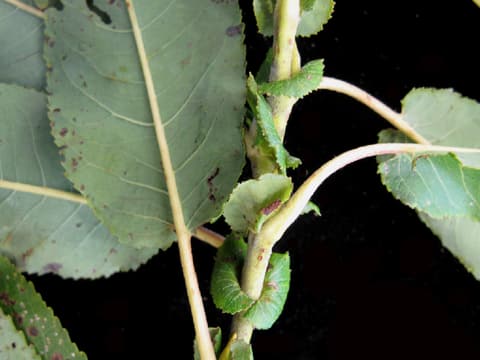
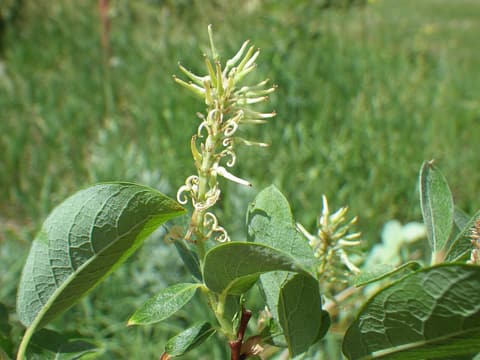
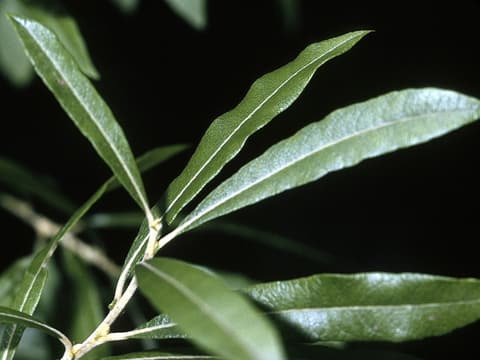
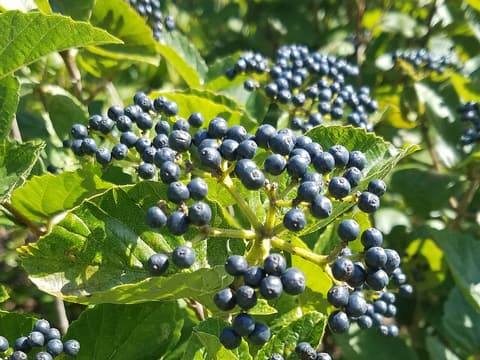
Photo: Robert H. Mohlenbrock, Public domain · Wikimedia Commons
Silky Willow
Scientific name: Salix sericea · Family: Salicaceae (willow family)
Also called Salix grisea, Salix coactilis.
A fast shrub willow for wet, sunny ground, with narrow leaves silky white beneath and spring catkins that native bees and honey bees visit.
Be first when silky willow is priced
Saplings ship bare-root or in a pot, usually 12 to 18 inches tall, in the dormant season, and their height and age are stated here with the price, once available.
We grow it as saplings. One email when it is listed with prices, and nothing else. Or ask, and we reply with what is ready now. Live plants ship February to May and October to November.
Limited timeSign up now and get 10% off when it is ready.
Share: copy link
Silky Willow at a glance
- Type
- Shrub
- Mature height
- 6–12 ft
- USDA zones
- 3–8
- Growth rate
- Fast
- Flowers
- March to June
- Fruit
- Capsules, May to June
- First crop
- 5 to 10 years
- Mature spread
- 12 ft
- Sun
- Full, Part
- Soil moisture
- Average, Wet
- Grows wild in
- Stream banks, floodplain forests, swamps and wet flats
- Native range
- 28 states and the District of Columbia, north and west to Minnesota and south to Georgia See what is native in your state
List all 29
Alabama, Arkansas, Connecticut, Delaware, Georgia, Illinois, Indiana, Iowa, Kentucky, Maine, Maryland, Massachusetts, Michigan, Minnesota, Missouri, New Hampshire, New Jersey, New York, North Carolina, Ohio, Pennsylvania, Rhode Island, South Carolina, Tennessee, Vermont, Virginia, West Virginia, Wisconsin and the District of Columbia
Silky willow is a many-stemmed shrub willow of stream banks, lake shores, swamps and wet meadows across the East, and its narrow leaves carry short, silky hairs beneath. Its branches are brittle at the base, and pieces that break off can root and start new plants. With its narrow, silvery leaves, it is a good native choice in place of the invasive Russian olive. Set it at a pond edge, in a wet ditch or on a stream bank, where it grows into a dense clump of upright stems.
Size, growth and what to expect
Silky willow grows fast, nearly three feet a year in our growth estimator, and reaches about 12 feet in 20 years. It makes a dense, upright shrub of many slender, purplish stems, 6 to 12 feet tall and up to 12 feet wide. It is fairly short-lived, as fast willows often are.
Catkins open from March into early June, as or just before the leaves unfold, and native bees and honey bees visit them. The small capsules split in late spring and early summer to release cottony seed. The leaves are 2 to 4 inches long, dull green above and silky beneath. Caterpillars of the Acadian hairstreak and the viceroy feed on them.
It grows wild from Nova Scotia and Quebec south to Georgia, west to Arkansas and north to Wisconsin. Its home is wet, boggy shores, sandy terraces and rocky ledges along streams, low woods, sedge meadows, acid bogs and seeps. NatureServe ranks it critically imperiled in Delaware and Wisconsin.
How to grow Silky Willow
Silky willow grows in full sun or part shade, in soil that stays moist or wet, and it stands water that pools for a time. It takes clay, sand or peaty ground but does poorly in alkaline soil. Plant it 6 feet from a wall and set plants 4 feet apart. At its size it can go within 15 feet of overhead wires.
Saplings ship bare-root or potted. Plant them dormant, from leaf fall until bud swell, in a hole wider than the roots and no deeper. Set the crown at the soil line, put the wet native soil back in, and keep the mulch clear of the stems. Willow seed lives only a few days, so sow it the day the capsules split. Press it onto wet, bare soil in sun, uncovered, and keep the bed moist. Stem and root cuttings are other ways to raise it.
Unless the ground stays wet, water it every day for the first two weeks after planting, every two to three days until week 12, and weekly through the first two summers. Deer and other browsers eat it, so cage young plants where they are common. It sprouts back from the base when cut.
Plants are male or female, and bees carry pollen from the male catkins to the female ones. As with other willows, seedlings take 5 to 10 years to bear seed. It has no serious pest or disease, but its wood is weak and the brittle stems break easily.
Heights and zones are typical ranges for the species in cultivation; local conditions and seed source shift them.
Sources (7)
- NC State Extension Gardener Plant Toolbox: Salix sericea
- Lady Bird Johnson Wildflower Center: Salix sericea
- Flora of North America, vol. 7: Salix sericea Marshall, by George W. Argus
- Go Botany, Native Plant Trust: Salix sericea, silky willow
- USDA NRCS PLANTS Database: Salix sericea
- NatureServe Explorer: Salix sericea
- USDA Forest Service, Woody Plant Seed Manual (2008), Salix chapter
Plan the planting
Check your site for it What to plant with it How big, how fast How much to water How to sow it How many for a crop When it flowers and fruits When to plant it where you live How far from the house and wires How old is yours
Read before planting
- Ten planting mistakes that quietly kill trees
- Transplanting young trees: timing, water and protection
- Protecting young trees from voles, rabbits, deer and squirrels
- The habitat around a tree is part of the tree
- Invasive vines and shrubs are what is killing your woods
- Native trees and shrubs for butterflies and moths: host plants first, nectar second
Other willows (Salix) we grow: Bebb's Willow, Carolina Willow, Florida Willow, Missouri River Willow, Peachleaf Willow and Prairie Willow.
Grows in the same conditions
Plants that share its sun and soil

Trees to plant it under: River Birch, American Elm and Peachleaf Willow.
More like this