Photo: Derek Ramsey, CC BY-SA 2.5, cropped · Wikimedia Commons
Winterberry Holly
Scientific name: Ilex verticillata
Also called black alder, Canada holly.
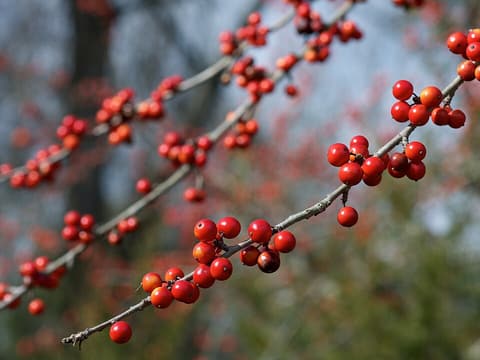
Bare winter branches lined with scarlet berries, on a deciduous holly that loves wet ground.
Be first when winterberry holly is priced
Saplings ship bare-root or in a pot, usually 12 to 18 inches tall, in the dormant season, and their height and age are stated here with the price, once available.
We grow it as saplings and seed. One email when it is listed with prices, and nothing else. Or ask, and we reply with what is ready now. Live plants ship February to May and October to November.
Limited timeSign up now and get 10% off when it is ready.
Share: copy link
Winterberry Holly at a glance
- Type
- Shrub
- Mature height
- 6–12 ft
- USDA zones
- 3–9
- Growth rate
- Medium
- Flowers
- June to July
- Fruit
- Berries, August to March
- First crop
- A few years (first flowers)
- Mature spread
- 12 ft
- Sun
- Full, Part
- Soil moisture
- Average, Wet
- Grows wild in
- Stream banks, swamps and wet flats
- Native range
- 32 states and the District of Columbia, north to Minnesota, south to Florida and west to Texas See what is native in your state
List all 33
Alabama, Arkansas, Connecticut, Delaware, Florida, Georgia, Illinois, Indiana, Iowa, Kentucky, Louisiana, Maine, Maryland, Massachusetts, Michigan, Minnesota, Mississippi, Missouri, New Hampshire, New Jersey, New York, North Carolina, Ohio, Pennsylvania, Rhode Island, South Carolina, Tennessee, Texas, Vermont, Virginia, West Virginia, Wisconsin and the District of Columbia
Winterberry is the holly of swamps and pond edges, and the berries that light up winter feed robins, bluebirds and waxwings after everything else is gone. Seed-grown plants include males and females. Ideal for a rain garden or a wet hedge, with branches to cut for the December table.
Size, growth and what to expect
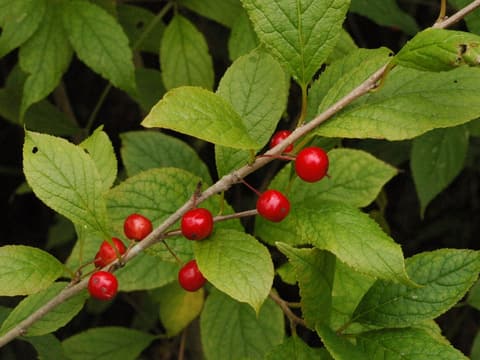
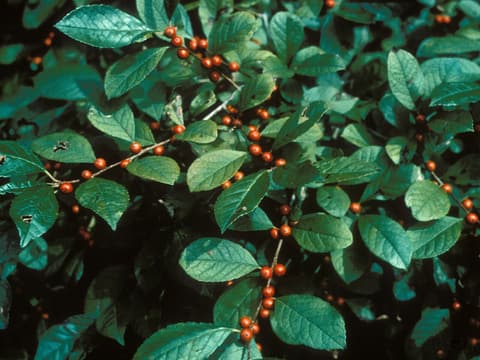
Winterberry holly comes as male or female plants, and only the females carry the bright red quarter-inch berries. Our growth estimator models it as a medium shrub, roughly a foot and a half of new height a year in its youth on an average site. It makes a rounded shrub 6 to 12 feet tall and as wide, and it often suckers into a thicket.
Small greenish-white flowers open in the leaf axils in June and July, and one male within 50 feet pollinates a group of females. The berries ripen from August into fall and hang on the bare stems through the winter and often into early spring. More than 48 kinds of birds eat them, and the shrub hosts the caterpillars of Henry's elfin butterfly.
It grows wild from Nova Scotia west to Minnesota and south to the Florida panhandle and east Texas, in swamps, damp thickets and low woods and along ponds and streams.
How to grow Winterberry Holly
Winterberry holly takes full sun or light shade, in moist soil or ground that floods, with more berries in sun. Soil must be acid; in limey ground the leaves yellow and the plant dwindles. Shrubs slowly widen by suckers, so space a group 5 feet apart.
Plant dormant bare-root or potted plants between leaf fall and bud break, in a hole wider than the roots and no deeper. Set the crown at grade, put the native soil back in, and lay a mulch ring that stops short of the stems. No amendments, no stake. Seed needs a warm spell and then a winter. Sow it outdoors in fall a quarter inch deep, and seedlings come up the second spring. For a spring sowing, keep it in a damp bag for two months at room temperature and then two months in the refrigerator.
Water weekly the first two summers unless the site stays wet. Deer browse the young growth and rabbits cut stems in winter, so cage it for two years. It flowers on new wood, so any pruning goes in late winter, and little is needed; cut a few of the oldest stems out every few years to keep it full.
Winterberry is male or female and seedlings do not show which until first bloom, a few years in, so plant a group so that a male lands among the females. The berries are toxic to people and pets, though birds take them once winter hardens.
Heights and zones are typical ranges for the species in cultivation; local conditions and seed source shift them.
Sources (11)
- NC State Extension Gardener Plant Toolbox: Ilex verticillata
- Missouri Botanical Garden Plant Finder: Ilex verticillata
- Lady Bird Johnson Wildflower Center: Ilex verticillata
- USDA NRCS PLANTS Database: Ilex verticillata
- USDA Forest Service, Woody Plant Seed Manual (2008), Ilex chapter, Bonner
- USDA NRCS Plant Fact Sheet: common winterberry, Ilex verticillata
- NatureServe Explorer: Ilex verticillata, Common Winterberry
- Go Botany, Native Plant Trust: Ilex verticillata
- Trees and Shrubs Online: Ilex verticillata, from Bean's Trees and Shrubs Hardy in the British Isles
- The Morton Arboretum: common winterberry
- Native Plant Network propagation protocol: Ilex verticillata, Van Der Grinten 2001, USDA NRCS Big Flats Plant Materials Center
We grow 11 other hollies (Ilex): see them all.
Grows in the same conditions
Plants that share its sun and soil
Trees to plant it under: River Birch, American Elm and Atlantic White Cedar.
More like this