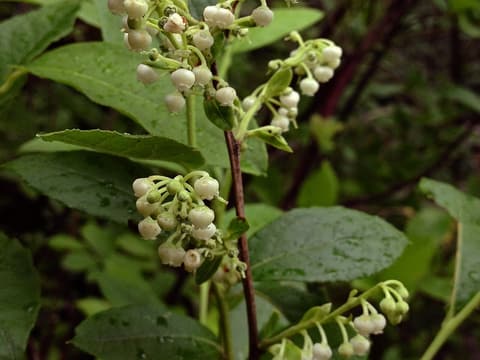
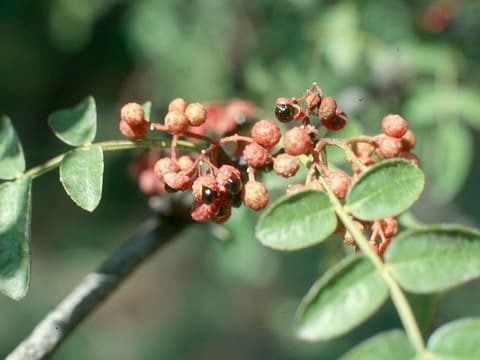
Photo: Krzysztof Ziarnek, CC BY-SA 4.0, cropped · Wikimedia Commons
Yellowroot
Scientific name: Xanthorhiza simplicissima · Family: Ranunculaceae (buttercup family)
Also called shrub yellowroot, brook-feather, parsley-leaved yellowroot, Xanthorhiza apiifolia.
A low, suckering shrub for shady stream banks and moist woods, with leaves like celery that turn yellow and reddish purple in fall.
Be first when yellowroot is priced
Saplings ship bare-root or in a pot, usually 12 to 18 inches tall, in the dormant season, and their height and age are stated here with the price, once available.
We grow it as saplings and seed. One email when it is listed with prices, and nothing else. Or ask, and we reply with what is ready now. Live plants ship February to May and October to November.
Limited timeSign up now and get 10% off when it is ready.
Share: copy link
Yellowroot at a glance
- Type
- Shrub
- Mature height
- 1–3 ft
- USDA zones
- 3–9
- Growth rate
- Medium
- Flowers
- April to May
- Fruit
- Pods, June to October
- First crop
- —
- Mature spread
- 10 ft
- Sun
- Part, Shade
- Soil moisture
- Dry, Average, Wet
- Grows wild in
- Stream banks, the forest understory and rocky ground
- Native range
- 13 states, north and east to Pennsylvania, south to Florida and west to Texas Also recorded, not native, in 7 other states (listed above). See what is native in your state
List all 13, and the 7 others
Alabama, Florida, Georgia, Kentucky, Louisiana, Mississippi, North Carolina, Pennsylvania, South Carolina, Tennessee, Texas, Virginia and West Virginia
Also recorded, not native, in Connecticut, Maine, Maryland, Massachusetts, New Jersey, New York and Ohio.
Yellowroot is a low, truly woody shrub of the buttercup family that spreads by slender underground stems into a dense groundcover. It grows wild on shaded stream banks and in moist woods of the Appalachians and the Southeast. Its roots and inner bark are bright yellow, and they were once used to make a yellow dye. Florida lists it as endangered. Its spreading stems can help stabilize a slope. Use it as a groundcover on a shady stream bank, a moist slope or a woodland edge, where it has room to spread.
Size, growth and what to expect
Yellowroot grows at a medium pace, 6 inches to a foot a year in our growth estimator. Its upright, mostly unbranched stems stand 1 to 3 feet tall, each topped by a cluster of leaves, and it spreads into a patch 6 to 10 feet wide. An Arnold Arboretum planting from 1887 seed still flowered in 2018.
Drooping sprays of small, star-shaped, purple-brown flowers open in April and May. The leaves, divided like celery into three to five toothed leaflets, turn yellow, bronze and reddish purple in fall. Star-shaped clusters of small pods follow, green at first and drying to yellowish brown. Gamebirds, songbirds and small mammals use it for cover and food.
It grows wild from Pennsylvania and West Virginia south to northern Florida and west to Kentucky, Tennessee and Mississippi, with a few stands in western Louisiana and southeastern Texas. Its home is shaded stream banks, moist woods, thickets and rocky ledges. It has escaped from gardens farther north, in New England, New York, New Jersey, Maryland and Ohio.
How to grow Yellowroot
Yellowroot grows in part shade or full shade, in a moist, acid soil, sandy or loamy and rich in leaf litter. It takes wet ground, and some drought once it is settled. Alkaline soil yellows its leaves, and the best fall color comes with some sun. Set plants 3 feet apart and keep them 3 feet from a wall. At its size it can go within 15 feet of overhead wires.
Saplings ship bare-root or potted. Plant them dormant, from leaf fall until bud swell, in a hole wider than the roots and no deeper. Set the crown at the soil line, put the native soil back in, and keep the mulch clear of the stems. Sow the seed in early winter and keep the covered flats in an unheated greenhouse for about three months. Seedlings come up 10 to 20 days after the flats are uncovered in early spring. Dividing an older clump is the surest way to make more plants.
Water it every day for the first two weeks after planting, then every two to three days until week 12. After that, water weekly through the first two summers if rain is short. Deer tend to leave it alone. A walk or a metal edging holds back its spread where it is not wanted, and a heavy coat of ice can break its brittle stems.
Each flower carries both male and female parts, so there are no male and female plants to pair. It has no major pest or disease problems. In good conditions it can spread without limit by its underground stems.
Heights and zones are typical ranges for the species in cultivation; local conditions and seed source shift them.
Sources (11)
- Flora of North America, vol. 3: Xanthorhiza simplicissima Marshall, and the genus Xanthorhiza
- NC State Extension Gardener Plant Toolbox: Xanthorhiza simplicissima
- Missouri Botanical Garden Plant Finder: Xanthorhiza simplicissima
- The Morton Arboretum: Yellowroot
- Lady Bird Johnson Wildflower Center: Xanthorhiza simplicissima
- Go Botany, Native Plant Trust: Xanthorhiza simplicissima, shrub yellowroot
- Pawling 2011, Propagating shrub yellowroot (Xanthorhiza simplicissima Marsh.), Native Plants Journal 12(1): 37-40
- NatureServe Explorer: Xanthorhiza simplicissima
- Florida Administrative Code, Rule 5B-40.0055, Regulated Plant Index, effective January 8, 2020
- Florida Natural Areas Inventory: Element Tracking Summary, October 30, 2026
- Arnold Arboretum: Yellowroot Mystery, 2018
Plan the planting
Check your site for it What to plant with it How big, how fast How much to water How to sow it How many for a crop When it flowers and fruits When to plant it where you live How far from the house and wires How old is yours
Read before planting
- Ten planting mistakes that quietly kill trees
- Transplanting young trees: timing, water and protection
- Protecting young trees from voles, rabbits, deer and squirrels
- Low native shrubs and groundcovers for sun, shade, sand and bog
- The habitat around a tree is part of the tree
- What a young tree looks like: first-year seedlings of oak, walnut, hickory, chestnut, maple and redbud, and the weed trees to pull
Grows in the same conditions
Plants that share its sun and soil
Trees to plant it under: Hop Hornbeam, Common Hackberry and Florida Maple.
More like this