Photo: Blue Whale Trees
Allegheny Chinquapin
Scientific name: Castanea pumila
Also called American chinquapin, Allegheny chinkapin, chinkapin, dwarf chestnut, common chinquapin, dwarf American chestnut.
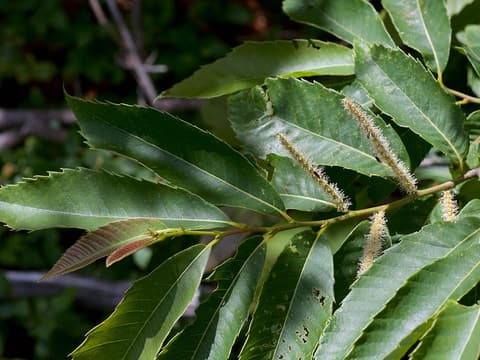
A shrubby native cousin of the American chestnut, Allegheny chinquapin ripens one sweet nut per small bur and bears within a few years of planting.
Be first when Allegheny chinquapin is priced
Saplings ship bare-root or in a pot, usually 12 to 18 inches tall, in the dormant season, and their height and age are stated here with the price, once available.
We grow it as saplings and nuts. One email when it is listed with prices, and nothing else. Or ask, and we reply with what is ready now. Live plants ship February to May and October to November.
Limited timeSign up now and get 10% off when it is ready.
Share: copy link
Allegheny Chinquapin at a glance
- Type
- Small tree
- Mature height
- 10–25 ft
- USDA zones
- 5–9
- Growth rate
- Medium
- Flowers
- May to July
- Fruit
- Nuts, September to October
- First crop
- 2 to 3 years (a crop in the third season)
- Mature spread
- 20 ft
- Sun
- Full, Part
- Soil moisture
- Dry, Average
- Grows wild in
- Dry uplands and sandy barrens
- Native range
- 23 states and the District of Columbia, north to New York, south to Florida and west to Texas See what is native in your state
List all 24
Alabama, Arkansas, Delaware, Florida, Georgia, Indiana, Kentucky, Louisiana, Maryland, Massachusetts, Mississippi, Missouri, New Jersey, New York, North Carolina, Ohio, Oklahoma, Pennsylvania, South Carolina, Tennessee, Texas, Virginia, West Virginia and the District of Columbia
Allegheny chinquapin is one of the few chestnuts native to North America. Chinquapin and chinkapin are two spellings of one Virginia Algonquian word, and neither is wrong. The nuts are sweet enough to eat raw and reckoned better eating than American chestnut, but the plant is self-incompatible, so one on its own sets almost none. Accounts of its blight resistance disagree, but what growers see is consistent: stems canker and die, the root crown sprouts again, and the plant keeps bearing. We grow it from seed, nothing grafted or cloned. Planted on disturbed ground, it helps stabilize the soil. Perfect for a wildlife hedge or a small-scale nut planting.
Size, growth and what to expect
Allegheny chinquapin bears young. Seedlings of one selected strain carried nuts by their second or third growing season, with substantial crops by the fifth year.
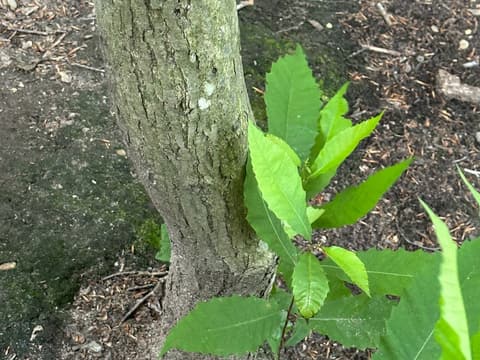
Six-year-old plants of that strain yielded 1,200 to 1,500 nuts a year. Growth is medium, roughly a foot and a half of new height a year in youth on an average site by our growth estimator's model. In a yard expect a large shrub or small tree of 10 to 25 feet, though it can reach 30 feet. Many plants stay lower and shrubby, which fits its other name, dwarf chestnut. Each spiny bur is an inch to an inch and a half long and holds a single shiny brown nut up to about three quarters of an inch long. Squirrels, chipmunks, deer, wild turkeys, black bears, blue jays and woodpeckers take them. The nuts ripen in September and October.
It grows wild from New Jersey and Pennsylvania south to Florida and west to eastern Texas, eastern Oklahoma and southern Ohio, on dry, rocky or sandy ground and well-drained terraces.
How to grow Allegheny Chinquapin
Allegheny chinquapin needs full sun to crop well. Give it acid, fast draining ground, sandy loam or thin rocky upland. Avoid heavy clay and any place where water stands after rain. Plants sucker into a broad clump, so allow 12 to 15 feet between them.
Set out bare-root or potted saplings while dormant, late fall to early spring. Handle the taproot gently, keep the root flare at grade, backfill with the soil you dug and skip amendments. Mulch three inches deep, a hand's width clear of the stem. Nuts root in autumn rather than spring as chestnuts do, so sow them an inch deep the fall they drop, under hardware cloth against rodents. Fall-sown seed germinates above 90 percent, seed dried over winter below 50.
Water weekly through the first three summers in dry spells, renew the mulch, and cage or tube the stems against voles, rabbits and deer, which browse this plant hard. Established plants take drought well and rarely need pruning.
Allegheny chinquapin does not pollinate itself, and a thicket of suckers from one root is still one plant, so plant two or more from different seed. Blight cankers stems in time, after which the crown resprouts and bearing carries on. Weevils take some nuts. Expect a crop in the third season.
Heights and zones are typical ranges for the species in cultivation; local conditions and seed source shift them.
Sources (12)
- USDA Fire Effects Information System: Castanea pumila
- NC State Extension Gardener Plant Toolbox: Castanea pumila
- Lady Bird Johnson Wildflower Center: Castanea pumila
- USDA NRCS Plant Guide: chinkapin, Castanea pumila
- USDA NRCS Plant Fact Sheet: Allegheny chinkapin, Castanea pumila
- USDA Forest Service, Woody Plant Seed Manual: Castanea chapter
- Virginia Tech Dendrology: Alleghany chinkapin, Castanea pumila
- NatureServe Explorer: Castanea pumila
- Flora of North America, vol. 3: Castanea pumila
- Trees and Shrubs Online: Castanea pumila
- USDA NRCS PLANTS Database: Castanea pumila
- The American Heritage Dictionary of the English Language, 5th edition: chinquapin
Plan the planting
Check your site for it What to plant with it How big, how fast How much to water How to sow it How many for a crop When it flowers and fruits When to plant it where you live How far from the house and wires How old is yours Moving one you already have
Read before planting
- Ten planting mistakes that quietly kill trees
- Transplanting young trees: timing, water and protection
- Protecting young trees from voles, rabbits, deer and squirrels
- Chinquapin or chestnut: telling the four we grow apart
- Native trees and shrubs for dry, sandy soil: the plants of barrens and dunes, and how to grow them
- Chinese chestnut: size, growth rate, bark, and how it differs from the American chestnut
Other chestnuts and chinquapins (Castanea) we grow: American Chestnut, Chinese Chestnut and Ozark Chinquapin.
Grows in the same conditions
Plants that share its sun and soil
Trees to plant it under: Pignut Hickory, Mockernut Hickory and Black Oak.
More like this