Photo: Blue Whale Trees
American Chestnut
Scientific name: Castanea dentata · Family: Fagaceae (beech family)
Also called American sweet chestnut.
Once a dominant tree of the eastern forests, with sweet nuts for people and wildlife, now held to sprouts by a blight that kills its stems but not its roots.
Be first when American chestnut is priced
Saplings ship bare-root or in a pot, usually 12 to 18 inches tall, in the dormant season, and their height and age are stated here with the price, once available.
We grow it as saplings and nuts. One email when it is listed with prices, and nothing else. Or ask, and we reply with what is ready now. Live plants ship February to May and October to November.
Limited timeSign up now and get 10% off when it is ready.
Share: copy link
American Chestnut at a glance
- Type
- Small tree
- Mature height
- 15–30 ft
- USDA zones
- 4–8
- Growth rate
- Fast
- Flowers
- June to July
- Fruit
- Nuts, September to October
- First crop
- 4 years
- Mature spread
- 20 ft
- Sun
- Full, Part
- Soil moisture
- Dry, Average
- Grows wild in
- Dry uplands, rich moist slopes and the Appalachians
- Native range
- 25 states and the District of Columbia, north to Maine, south to Florida and west to Mississippi Also recorded, not native, in Iowa, Louisiana, Missouri and Wisconsin. See what is native in your state
List all 26
Alabama, Connecticut, Delaware, Florida, Georgia, Illinois, Indiana, Kentucky, Maine, Maryland, Massachusetts, Michigan, Mississippi, New Hampshire, New Jersey, New York, North Carolina, Ohio, Pennsylvania, Rhode Island, South Carolina, Tennessee, Vermont, Virginia, West Virginia and the District of Columbia
American chestnut was once a dominant tree of the eastern forests, up to a quarter or half of the canopy trees across its range. It was prized for rot-resistant timber and sweet nuts. Chestnut blight, a fungus from Asia first found in New York City in 1904, spread through its whole range by 1950 and had killed an estimated four billion trees by 1960. The roots survive and keep sending up sprouts, but the blight kills them again, usually before they bear much. NatureServe ranks the species vulnerable worldwide. NC State Extension, the Missouri Botanical Garden and the Morton Arboretum all advise against planting it as an ornamental. The American Chestnut Foundation encourages growing wild-type trees to keep the species' genes alive for breeding. Plant it as a living link to the old forest, knowing the blight will likely cut it back.
Size, growth and what to expect
American chestnut grows fast, and our growth estimator gives it about two and three quarter feet a year. The blight is present nearly everywhere in its range. There, expect a tree of 15 to 30 feet before the fungus kills it back. Once infected, a sapling rarely lasts a year. Before the blight it grew 50 to 75 feet tall, and old trees reached 100 feet or more. Few pre-blight trees lived longer than about 100 years. Trees can live up to 300 years, and the oldest one dated by its rings reached 270. Only a tiny share of trees is ever dated this way, so older ones may exist.
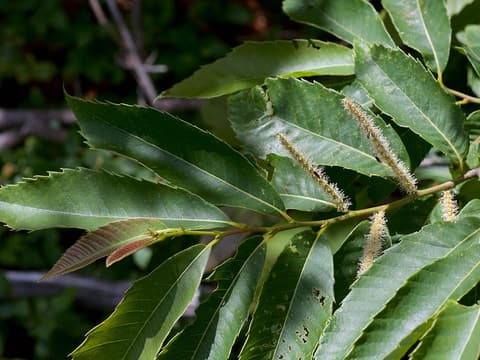
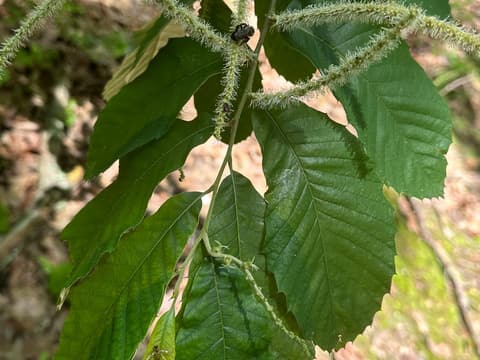
It flowers in June and July with creamy catkins 5 to 10 inches long. Each spiny bur, 2 to 2½ inches across, holds two or three sweet nuts that fall in September and October. The nuts are smaller than Chinese chestnut's, and an Allegheny chinquapin bur holds only one. Turkeys, grouse, blue jays, squirrels, deer and black bears eat them.
Its range ran from southern Maine and Ontario to Georgia, Alabama and Mississippi, and west to Ohio and Indiana. It grew mostly on well-drained slopes and ridges, and in rich coves. It was also planted far beyond its native range, west to Iowa and Wisconsin.
How to grow American Chestnut
American chestnut needs full sun to grow fast and to flower, though it will live in shade. Give it a well-drained, acidic soil, sandy, gravelly or loamy. Keep it off clay and off wet or low ground, where Phytophthora root rot, mainly a southern disease, kills chestnuts outright. Set trees 30 feet apart, and keep each one 15 feet from a wall and 15 feet from overhead wires.
Saplings ship bare-root or potted. Plant them dormant, from leaf fall until bud swell, in a hole about twice as wide as the roots and no deeper, with the root collar level with the ground. Put the native soil back in, firm it around the roots, and keep a circle 3 feet across free of grass and weeds. The nuts die if they dry out, so keep them cool and damp until you sow. Sow them in fall an inch deep, on their sides, under hardware cloth. For spring, hold them damp in the refrigerator for two to three months first.
Water it every day for the first two weeks after planting, then every two to three days until week 12. After that, water regularly through the first year, then only in a severe drought. Voles, deer and other animals eat chestnut shoots and roots, so sink a short tube a few inches into the soil against voles and add a wire cage against deer. Weeds are among the worst killers of young chestnuts, so keep that circle clear.
Viable nuts take at least two trees to cross-pollinate, so plant two or more from different seed, within 300 feet of each other. An open-grown tree can bear from about its fourth year. Chestnut blight is the main trouble, and wild American chestnuts have no resistance to it. The fungus enters through bark wounds and girdles the stem, which dies above the canker. Chestnut weevils grow inside the nuts, and gathering every fallen nut in fall breaks their cycle.
Heights and zones are typical ranges for the species in cultivation; local conditions and seed source shift them.
Sources (19)
- USDA Forest Service, Southern Research Station: The Silvics of Castanea dentata (Marsh.) Borkh., American Chestnut, Fagaceae (Beech Family), Wang, Knapp, Clark and Mudder, GTR-SRS-173, 2013
- The American Chestnut Foundation: Growing Chestnuts
- The American Chestnut Foundation: FAQs
- The American Chestnut Foundation: American Chestnut Seeds and Seedlings
- The American Chestnut Foundation: American Chestnut History
- The Journal of the American Chestnut Foundation 26(2), March/April 2012, Introduction to Chestnut Blight, Huckabee Smith (PDF)
- NC State Extension Gardener Plant Toolbox: Castanea dentata
- Missouri Botanical Garden Plant Finder: Castanea dentata
- The Morton Arboretum: American chestnut
- Flora of North America, vol. 3: Castanea dentata
- Lady Bird Johnson Wildflower Center: Castanea dentata
- Virginia Tech Dendrology: American chestnut
- USDA Forest Service, Woody Plant Seed Manual (2008), Castanea chapter (PDF)
- NatureServe Explorer: Castanea dentata
- Trees and Shrubs Online: Castanea dentata, from Bean
- Maryland Natural Heritage Program list, March 2021 (PDF)
- Virginia Tech Dendrology, Eastern OLDLIST of maximum tree ages (Neil Pederson): Castanea dentata, American chestnut
- Canadian Journal of Forest Research: Tree life history strategies: the role of defenses (Loehle 1988), Appendix 1
- Internet Archive: Ashe 1911, Chestnut in Tennessee, Tennessee State Geological Survey Bulletin 10-B
Plan the planting
Check your site for it What to plant with it How big, how fast How much to water How to sow it How many for a crop When it flowers and fruits When to plant it where you live How far from the house and wires How old is yours Moving one you already have
Read before planting
- Ten planting mistakes that quietly kill trees
- Transplanting young trees: timing, water and protection
- Protecting young trees from voles, rabbits, deer, squirrels and beavers
More about American chestnut
- Chinquapin or chestnut: telling the four we grow apart
- Chinese chestnut: size, growth rate, bark, and how it differs from the American chestnut
- Native fruit and nut trees to grow and eat: what each bears, when it starts, and which need a partner
All 10 articles about American chestnut
- Will it come true from seed? Store-bought nuts, grafted fruit, cultivars, and the seedlings they make
- Cankers on a trunk or branch
- Which native nuts and fruit poison dogs, horses and children, and which are food
- What tree dropped this? Spiky balls, helicopters, long pods, nuts and cones, and which of them you can plant
- Native trees for the Southern Appalachians: the valleys, the slopes and the high ridges
- Natural hybrids in native trees: why oaks, hickories and maples cross
- What tree is this? Identifying a native broadleaf tree by its leaves
Other chestnuts and chinquapins (Castanea) we grow: Allegheny Chinquapin, Chinese Chestnut and Ozark Chinquapin.
Grows in the same conditions
Plants that share its sun and soil
Trees to plant it under: Red Hickory, Northern Red Oak and Pignut Hickory.
More like this