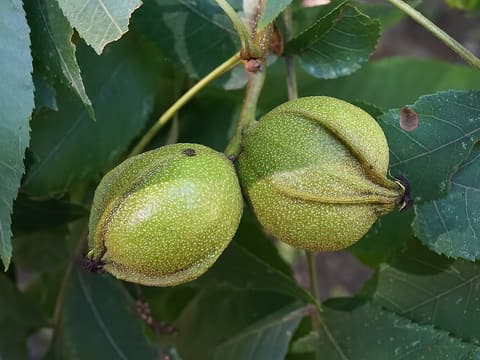
Photo: R. A. Nonenmacher, CC BY-SA 4.0, cropped · Wikimedia Commons
Black Walnut
Scientific name: Juglans nigra
Also called eastern black walnut, American walnut.
Rich, strong-flavored nuts and the most valuable timber in the East, on a fast-growing tree for big spaces.
Be first when black walnut is priced
Saplings ship bare-root or in a pot, usually 12 to 18 inches tall, in the dormant season, and their height and age are stated here with the price, once available.
We grow it as saplings and nuts. One email when it is listed with prices, and nothing else. Or ask, and we reply with what is ready now. Live plants ship February to May and October to November.
Limited timeSign up now and get 10% off when it is ready.
Share: copy link
Black Walnut at a glance
- Type
- Large tree
- Mature height
- 70–100 ft
- USDA zones
- 4–9
- Growth rate
- Fast
- Flowers
- April to June
- Fruit
- Nuts, September to October
- First crop
- About 10 years (a few nuts at 4 to 6; large crops from 20 to 30)
- Mature spread
- 50 ft
- Sun
- Full
- Soil moisture
- Average
- Grows wild in
- Floodplain forests and rich moist slopes
- Native range
- 33 states and the District of Columbia, north to Minnesota, south to Florida and west to South Dakota Also recorded, not native, in 7 other states (listed above). See what is native in your state
List all 34, and the 7 others
Alabama, Arkansas, Connecticut, Delaware, Florida, Georgia, Illinois, Indiana, Iowa, Kansas, Kentucky, Louisiana, Maryland, Massachusetts, Michigan, Minnesota, Mississippi, Missouri, Nebraska, New Jersey, New York, North Carolina, Ohio, Oklahoma, Pennsylvania, South Carolina, South Dakota, Tennessee, Texas, Vermont, Virginia, West Virginia, Wisconsin and the District of Columbia
Also recorded, not native, in Colorado, Maine, New Hampshire, New Mexico, North Dakota, Rhode Island and Utah.
Black walnut grows quickly on deep, fertile, well-drained soil and can reach sawlog size in a lifetime. The roots release juglone, which suppresses tomatoes, apples and many ornamentals, so keep it out of the vegetable garden. We sell nuts and seedlings from heavy-bearing parents. A natural choice for a nut grove or a timber planting far from the garden.
Size, growth and what to expect
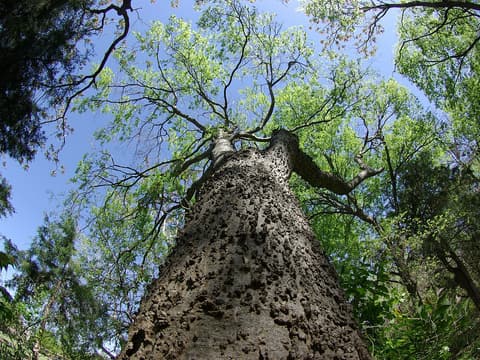
Young black walnuts on the best ground put on three to four feet of height a year. Our growth estimator models the tree at nearly three feet a year, its rate for a fast grower. In a yard expect 70 to 100 feet, while forest trees on the best sites reach 100 to 120 feet with trunks 30 to 40 inches through. The crown spreads 30 to 50 feet. Trees typically live 150 years, and the oldest known has been ring-counted to 260.
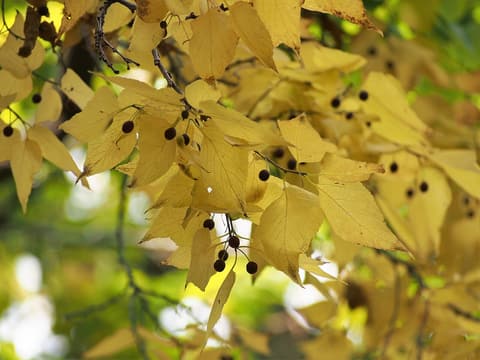
An open-grown tree may drop a few nuts at 4 to 6 years old, but large crops wait until 20 to 30 years. The best bearing starts around 30 and continues for another 100 years, with a good crop perhaps twice in 5 years. Each nut sits in a round green husk up to 2 inches across. Nigra means black, for the dark bark and the stain the nuts leave.
It grows wild as scattered trees from Vermont and Massachusetts west to southern Ontario, Minnesota and Nebraska, and south to Oklahoma and central Texas.
How to grow Black Walnut
Black walnut wants full sun and deep, average soil that drains, ground that grows good corn. At full size it needs 50 feet from the house and the vegetable garden. Set trees 30 to 60 feet apart.
Plant while dormant, between leaf fall and bud swell. Saplings ship bare-root or in tall pots that keep the taproot straight. Dig wide but no deeper than the roots, hold the root flare at grade, and backfill with what you dug. Sow nuts in fall, husks off, two inches deep under pinned hardware cloth, or squirrels take them all.
Water weekly through the first summer when rain is short, and mulch a wide ring off the bark. Voles girdle young walnuts under snow, so sleeve the stem until the bark roughens, and cage against deer. Prune in late summer, because spring cuts bleed.
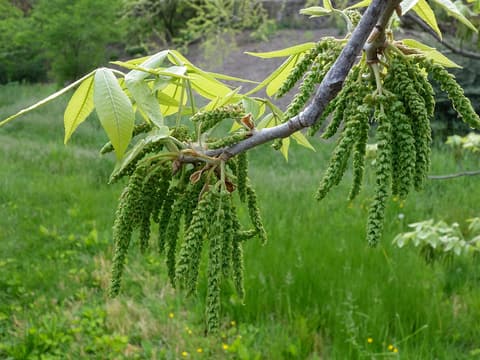
A lone black walnut can set nuts from its own pollen, but its catkins usually shed when its own flowers are not ready. A second walnut nearby improves the crop. The taproot goes down fast, so plant small trees and leave them be. Roots, husks and leaves release juglone, which kills tomatoes, potatoes, apples and blueberries nearby. Anthracnose drops leaves early in wet summers. Thousand cankers disease has reached the East; watch for a crown thinning from the top. Seedlings usually bear their first real crop at around ten years.
Heights and zones are typical ranges for the species in cultivation; local conditions and seed source shift them.
Sources (17)
- USDA Forest Service, Silvics of North America: black walnut
- NC State Extension Gardener Plant Toolbox: Juglans nigra
- The Morton Arboretum: black walnut
- USDA NRCS PLANTS Database: Juglans nigra, JUNI
- USDA NRCS Plant Guide: black walnut
- USDA NRCS Plant Fact Sheet: black walnut
- USDA Forest Service, Woody Plant Seed Manual (2008), Juglans chapter
- USDA Fire Effects Information System: Juglans nigra
- Missouri Department of Conservation field guide: Black Walnut
- Virginia Tech Dendrology: black walnut, Juglans nigra
- Lady Bird Johnson Wildflower Center: Juglans nigra
- Flora of North America, vol. 3: Juglans nigra
- USDA Forest Service, North Central Research Station: Cecich, Floral biology and pollination of eastern black walnut
- The Morton Arboretum: Black walnut toxicity
- Randolph and others 2013, Castanea 78: 2-14, Status of black walnut (Juglans nigra L.) in the Eastern United States in light of the discovery of thousand cankers disease
- USDA Forest Service, Northern Research Station, Climate Change Tree Atlas (retired March 2026
- Ontario's old growth forests, Michael Henry: Ontario's oldest trees, updated February 2025
Plan the planting
Check your site for it What to plant with it How big, how fast How much to water How to sow it How many for a crop When it flowers and fruits When to plant it where you live How far from the house and wires How old is yours Moving one you already have
Read before planting
- Ten planting mistakes that quietly kill trees
- Transplanting young trees: timing, water and protection
- Protecting young trees from voles, rabbits, deer and squirrels
- Juglone: which plants a black walnut poisons, how far its reach goes, and what to plant beneath it
- How fast native trees grow: a year’s growth by species, soil and sun
- Six trees not to plant near a house, and what to plant instead
Other walnuts (Juglans) we grow: Butternut and Little Walnut.
Grows in the same conditions
Plants that share its sun and soil
Under its canopy: Wild Black Currant, American Hornbeam (Musclewood) and Spicebush.
More like this