Photo: David J. Stang, CC BY-SA 4.0, cropped · Wikimedia Commons
Mountain Camellia (Mountain Stewartia)
Scientific name: Stewartia ovata
Also called mountain stewartia.
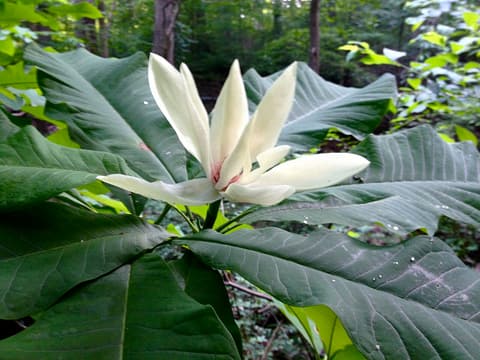
Large white camellia-like flowers in July on a rare Appalachian small tree with orange-red fall color.
Be first when mountain camellia is priced
Saplings ship in a pot, usually 12 to 18 inches tall, in the dormant season, and their height and age are stated here with the price, once available.
We grow it as saplings and seed. One email when it is listed with prices, and nothing else. Or ask, and we reply with what is ready now. Live plants ship February to May and October to November.
Limited timeSign up now and get 10% off when it is ready.
Share: copy link
Mountain Camellia at a glance
- Type
- Small tree
- Mature height
- 10–20 ft
- USDA zones
- 5–8
- Growth rate
- Slow
- Flowers
- July
- Fruit
- Capsules, August to September
- First crop
- 7 to 17 years (first flowers, north of its range)
- Mature spread
- 15 ft
- Sun
- Part, Shade
- Soil moisture
- Average
- Grows wild in
- The Appalachians, stream banks, rich moist slopes and the forest understory
- Native range
- 9 states, north to Virginia, south to Florida and west to Mississippi See what is native in your state
List all 9
Alabama, Florida, Georgia, Kentucky, Mississippi, North Carolina, South Carolina, Tennessee and Virginia
Mountain stewartia is seldom seen in cultivation. It produces three-inch summer flowers when little else blooms, then brilliant fall color. Slow and choice. In winter the bark takes over, with gray-brown ridges and orange-brown furrows. Made for the east side of a house, as a specimen out of the afternoon sun.
Size, growth and what to expect
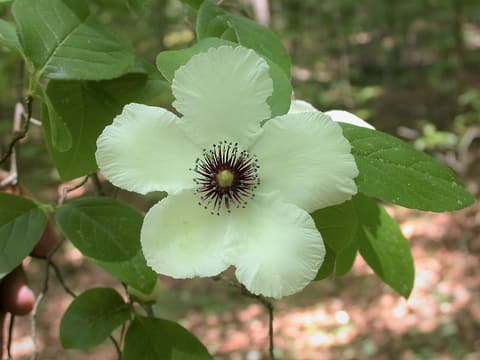
Mountain camellia opens its flowers in July, when few other trees are in bloom. Each is 2½ to 3 inches across with five ruffled white petals around purple stamens and orange anthers, and the seed follows in a woody five-part capsule. It is slow, about a foot a year on an average site in our growth estimator's model. It makes a small understory tree or large shrub of 10 to 15 feet, about as wide as it is tall, with a rounded to oval habit.
The name comes from the likeness of those flowers to a camellia's. The leaves turn orange and red in fall, and birds and small mammals spread the seed. The capsules ripen in August and September.
It grows wild in the southern Appalachians and Piedmont from Virginia to Alabama, on wooded stream banks, at the bases of bluffs, and in shaded ravines and openings in rhododendron thickets. It is sensitive to drought, heat and compacted soil.
How to grow Mountain Camellia
Mountain camellia wants part shade, cast by tall trees or a wall that blocks the afternoon. It grows in soil of average moisture that neither dries hard nor stays soggy. Allow 15 feet from a building and keep it clear of a big maple's roots.
Plant in the dormant season. We ship it potted, because the fine roots do not take bare-root handling, and the less you break up the ball the better. Dig twice the ball's width and no deeper, set the top of the ball level with grade, and backfill with the soil you took out. Mulch over the roots, off the trunk, and stake only on a windy site. Seed needs a warm spell and then a cold one. Sow it fresh in fall in a protected outdoor bed under fine wire screen, and expect most seedlings the second spring. Indoors, keep it damp at room temperature for three to five months and then in the refrigerator for three months before sowing.
Water through the first three summers whenever a week goes dry, since this tree does not bounce back from wilting. Keep the mulch topped up and fence against deer rub while the trunk is thin. Prune nothing but broken wood.
Mountain camellia carries both male and female parts in each flower, and bees carry the pollen. Most stewartias set seed with their own pollen, and even a lone tree can bear viable seed. Mountain stewartia is slow and resents being moved, so pick the spot as permanent. Flowers open a few at a time through July rather than all at once.
Heights and zones are typical ranges for the species in cultivation; local conditions and seed source shift them.
Sources (9)
- NC State Extension Gardener Plant Toolbox, Stewartia ovata
- Missouri Botanical Garden Plant Finder, Stewartia ovata
- Clemson Cooperative Extension HGIC, Native Stewartias
- Trees and Shrubs Online (International Dendrology Society): Stewartia ovata, J. Grimshaw 2016
- Boland and Rounsaville 2019, Taming the Wild Stewartia, Combined Proceedings International Plant Propagators' Society 69: 233-239
- Center for Plant Conservation: Patiently Growing a Stellar Stewartia Collection, from the Polly Hill Arboretum
- NatureServe Explorer: Stewartia ovata
- Virginia Tech Dendrology: mountain-camellia, Stewartia ovata
- The Polly Hill Arboretum: Stewartia ovata (Mountain Stewartia), cultivars from the notes of Polly Hill
Plan the planting
Check your site for it What to plant with it How big, how fast How much to water How to sow it How many for a crop When it flowers and fruits When to plant it where you live How far from the house and wires How old is yours Moving one you already have
Read before planting
- Ten planting mistakes that quietly kill trees
- Transplanting young trees: timing, water and protection
- Protecting young trees from voles, rabbits, deer and squirrels
- Is my new tree dying or just in shock? The first year’s signs, the scratch test and what to do
- Bare-root trees on arrival: the first hour, the first week and the first spring
- Multistem or single stem? Sometimes the trunk is hiding the answer
Other stewartias (Stewartia) we grow: Silky Camellia.
Grows in the same conditions
Plants that share its sun and soil
Trees to plant it under: Eastern Hemlock, Yellow Buckeye and Yellow Birch.
More like this